Quick Answer
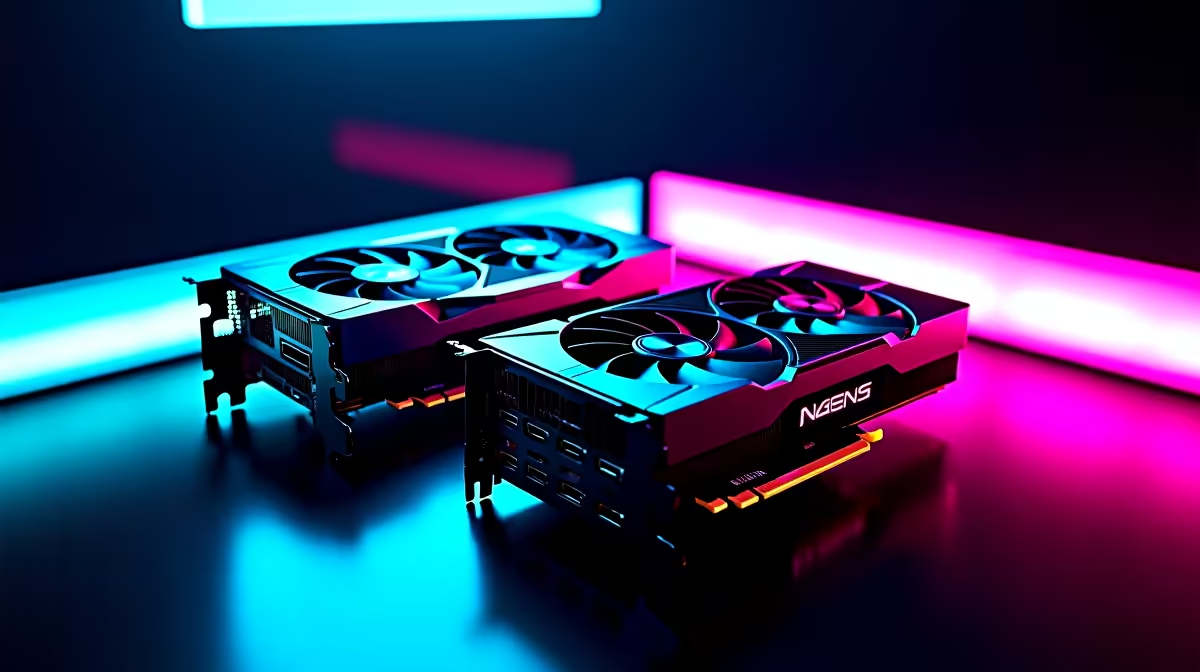
The RX 9070 delivers meaningfully better rasterisation performance and more capable ray tracing than the RX 7800 XT, and in the SA market the price gap between them makes the 9070 the smarter long-term buy for 1440p and entry-level 4K gaming in 2026. The 7800 XT remains a capable 1080p to 1440p card but is increasingly a last-gen value pick rather than a performance leader.
Architecture Gap: RDNA 4 vs RDNA 3
The RX 9070 is AMD's first RDNA 4 card at this tier, and the architectural leap over the 7800 XT's RDNA 3 is substantial. RDNA 4 brings a redesigned compute unit layout, improved AI accelerators, and significantly upgraded ray tracing hardware. Where RDNA 3 treated ray tracing as a secondary concern, RDNA 4's RT units are roughly twice as capable per compute unit, putting the 9070 much closer to Nvidia's RT performance at the same price point.
Beyond raw RT, RDNA 4 introduces FidelityFX Super Resolution 4 (FSR 4) with machine learning upscaling. FSR 4 image quality is a substantial step up from FSR 3, narrowing the gap with DLSS 4 in a way that matters for SA gamers who typically pair AMD cards with FreeSync monitors rather than G-Sync panels.
The RX 9070 also carries 16GB of GDDR6 versus the 7800 XT's 16GB, but the 9070's wider 256-bit bus and higher bandwidth give it a clear edge in memory-intensive scenarios like high-resolution texture packs and open-world games.
Price-to-Performance in the SA Market
In the SA GPU market, pricing fluctuates with the rand-dollar exchange rate, but the pattern is consistent: the RX 9070 typically lands around R8,000 to R10,000, while the RX 7800 XT has settled into the R6,500 to R8,000 range as stock clears. That R1,500 to R2,000 gap needs to be weighed against the performance delta.
At 1440p in demanding titles, the RX 9070 consistently pulls 15 to 25% higher frame rates than the 7800 XT. For competitive titles at 1080p, the gap is smaller and the 7800 XT delivers smooth gameplay. But if you're building for the next two to three years, the 9070's superior feature set, better driver trajectory under RDNA 4, and higher ceiling at 4K make it the better investment per rand spent over a meaningful lifespan.
Evetech typically ships GPU orders within 2 to 5 business days nationally, so factor that in if you're building on a deadline for a LAN event or semester start.
Gaming Performance by Title and Resolution
For popular SA esports titles like Valorant, CS2, and Apex Legends, both cards are massively overspecified at 1080p on a 144Hz monitor, but the 9070's advantage becomes clearer in CPU-limited scenarios where it sustains higher minimum frames. For graphically intensive single-player games like Cyberpunk 2077 or Alan Wake 2, the gap at 1440p is noticeable: the 9070 handles these titles comfortably with RT features enabled where the 7800 XT struggles to stay above 60fps with RT on at 1440p.
For varsity LAN gaming where titles range from CS2 to Fortnite to GTA Online, either card handles the load, but the 9070 gives meaningful headroom for higher refresh displays and future titles without an upgrade cycle.
Power Consumption and Thermal Considerations
The RX 9070 has a TDP around 220W compared to the 7800 XT's 263W. That's a meaningful efficiency win for the newer card: lower heat output, quieter fan curves, and better performance per watt. For SA builders mindful of electricity costs and heat inside their cases, the 9070's efficiency advantage is a genuine quality-of-life improvement day-to-day.
Frequently Asked Questions
Is the RX 9070 worth upgrading to from a 7800 XT?
If you're at 1440p and wanting better ray tracing or FSR 4 quality, yes. If you're happy at 1080p on a 144Hz monitor, the jump is harder to justify given the cost. The 9070 makes more sense as a primary purchase than an upgrade from RDNA 3 at the same tier.
Which card is better for a FreeSync monitor at 1440p?
Both support AMD FreeSync, but the RX 9070's higher frame rates at 1440p mean you'll spend more time in the FreeSync range even in demanding titles. Pair it with a 144Hz or 165Hz 1440p panel for the best result.
Does the 9070 support DisplayPort 2.1 for high-refresh 4K?
Yes, the RX 9070 includes DisplayPort 2.1 outputs, which support 4K at 144Hz without compression. The 7800 XT uses DisplayPort 2.1 as well, so both cards are future-proofed for high-refresh 4K displays.
Will the 7800 XT be supported with AMD drivers long-term?
AMD supports RDNA 3 cards, but RDNA 4 will receive priority for new features, optimisations, and FSR 4 integration. The 7800 XT will remain functional but will fall behind in feature support within the next few driver generations.
Ready to Find Your Perfect Match? Compare both cards and find the right GPU for your build. Browse graphics cards at Evetech