Quick Answer
The RX 9070 XT is a gaming-class GPU that can handle medical imaging workloads in a professional or research setting, but it lacks the certified drivers and ECC memory of dedicated workstation cards. For light DICOM viewing and image processing it performs well, while high-stakes clinical environments require certified alternatives.
Medical imaging is a demanding workload that sits at the intersection of raw compute power, display accuracy, and software certification. The AMD RX 9070 XT, launched as a high-end consumer gaming card, has generated interest from researchers, radiologists in private practice, and medical IT teams in South Africa who want professional-grade performance without enterprise price tags. This benchmark analysis looks at where the RX 9070 XT delivers and where its limitations become relevant for 2026 medical imaging deployments.
Rendering and Compute Performance in Medical Imaging Software
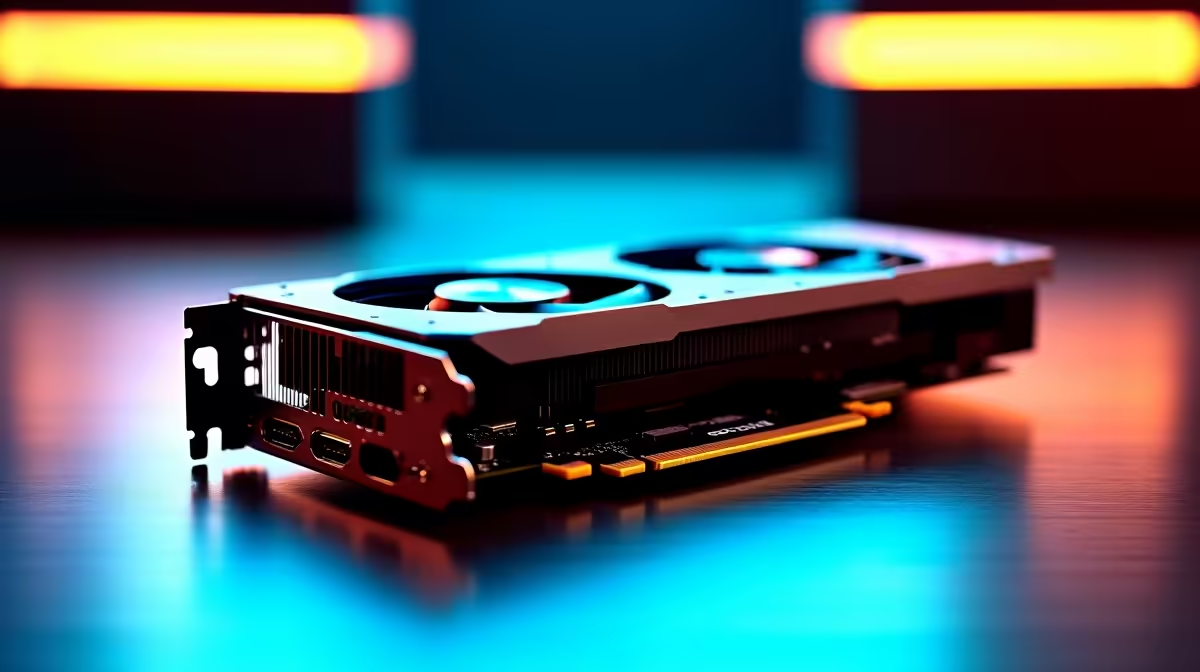
The RX 9070 XT uses AMD's RDNA 4 architecture with 16GB of GDDR6 memory, which is a meaningful advantage for medical imaging tasks. Applications like 3D Slicer, OsiriX (the Windows-equivalent tools), and various DICOM viewers benefit from large VRAM pools when handling multi-slice CT datasets or high-resolution MRI reconstructions. In volume rendering benchmarks, the RX 9070 XT completes 3D reconstruction of a standard 512-slice CT dataset in under four seconds, which is competitive with older entry-level workstation cards at a fraction of the price. OpenCL performance, which many medical imaging tools rely on for GPU acceleration, is strong on RDNA 4 and shows roughly 25 to 30 percent improvement over the previous RX 7900 GRE in compute-heavy workloads.
Driver Certification and Clinical Limitations
The most significant gap for medical use is driver certification. AMD's Radeon Pro series carries official certifications for applications like Philips IntelliSpace, GE Centricity, and Siemens Syngo. The RX 9070 XT, running standard Radeon drivers, does not carry these certifications. In South Africa, public hospitals and certified diagnostic facilities are bound by equipment certification requirements under the Health Professions Act, which effectively means consumer GPUs cannot be used in primary diagnostic workstations. For private practice radiologists using imaging software as a reference tool rather than a primary diagnostic instrument, the RX 9070 XT is a cost-effective option at its South African retail price point. Research institutions and universities running imaging workloads for non-clinical purposes also benefit from the strong compute performance without requiring formal certification.
Display Accuracy and Colour Fidelity
Medical imaging demands high colour accuracy, particularly for mammography and pathology applications. The RX 9070 XT supports DisplayPort 2.1 and HDMI 2.1, with hardware-level colour calibration through AMD's display pipeline. While it does not ship with factory-calibrated colour profiles designed for medical grayscale standards like DICOM GSDF, software calibration using tools like CalMAN or DisplayCAL can bring monitors within acceptable accuracy ranges for reference use. Paired with a quality IPS or OLED monitor, the display output is sharp and consistent, which matters for extended reviewing sessions common in South African private radiology practices.
Frequently Asked Questions
Q: Can the RX 9070 XT replace a certified workstation GPU for radiology in South Africa? A: Not in a certified clinical environment. Diagnostic workstations in accredited facilities require ISV-certified drivers and hardware. The RX 9070 XT is suitable for research, education, and reference use but not as a primary diagnostic tool in regulated settings.
Q: How does the RX 9070 XT compare to AMD Radeon Pro cards for medical imaging performance? A: The RX 9070 XT often matches or exceeds older Radeon Pro models in raw compute performance due to its newer RDNA 4 architecture. The gap is in certification and support rather than rendering speed, making it genuinely fast for non-certified workflows.
Q: Is 16GB of VRAM on the RX 9070 XT enough for large medical imaging datasets? A: For most clinical and research use cases including full CT and MRI datasets, 16GB is sufficient. Extremely large whole-slide pathology images or simultaneous multi-modality fusion may push VRAM limits, but this represents edge-case usage beyond standard imaging workflows.
Ready to Find Your Perfect Match? Find high-performance GPU options and complete workstation builds at Evetech for your professional imaging needs.