Quick Answer
The RX 9070 XT comprehensively beats the RTX 3060 in ray tracing performance in 2026. AMD's RDNA 4 architecture delivers 2-3x the ray tracing throughput of the RTX 3060's Ampere RT cores, making the RX 9070 XT the clear winner in ray tracing head-to-head comparisons across all current titles.
Ray tracing has historically been an area where NVIDIA's dedicated RT core hardware held a decisive advantage over AMD GPUs. With RDNA 4, AMD fundamentally redesigned their ray tracing hardware, and the RX 9070 XT closes or erases that gap in a meaningful way. For South African gamers considering either card - the RX 9070 XT sits at a significantly higher price tier in the SA market - this comparison focuses on whether the ray tracing premium is justified in 2026.
Architecture Differences in Ray Tracing Hardware
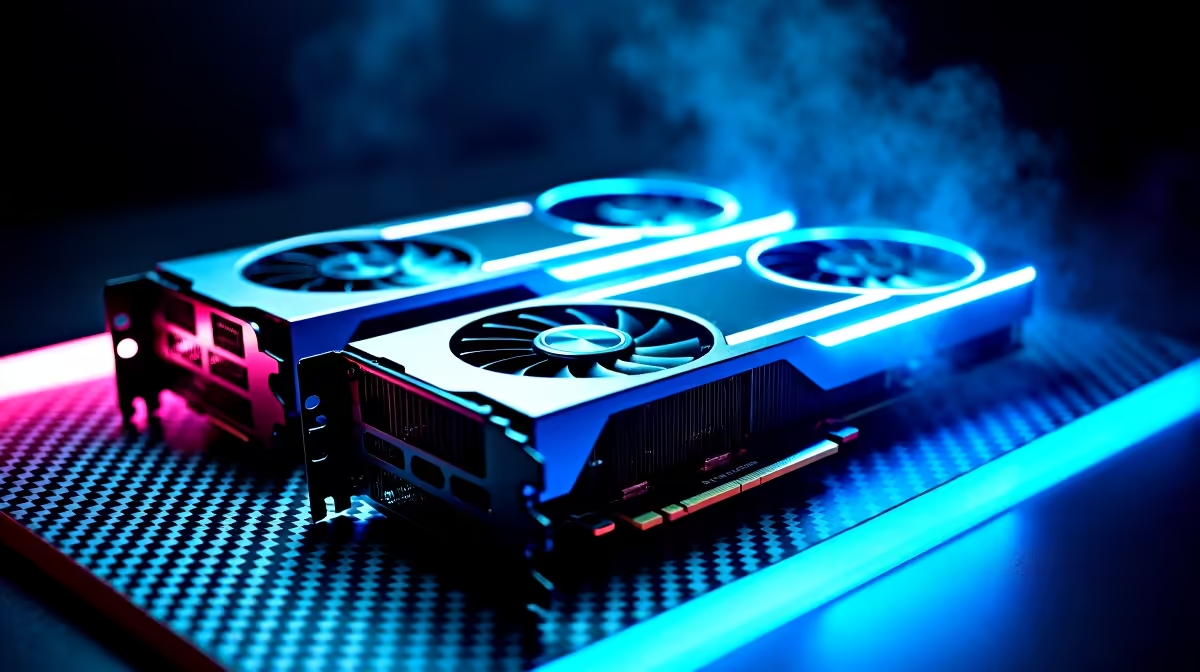
The RTX 3060 uses NVIDIA's second-generation RT cores from the Ampere architecture, which handle bounding volume hierarchy (BVH) traversal and ray-triangle intersection in dedicated hardware. This was a major leap over software ray tracing when it launched. The RX 9070 XT uses AMD's third-generation ray accelerators in RDNA 4, which AMD redesigned from the ground up compared to RDNA 3. The new ray accelerators in RDNA 4 deliver substantially higher rays-per-second throughput and improved efficiency per compute unit. In synthetic ray tracing benchmarks like those in 3DMark, the RX 9070 XT scores approximately 2.5 to 3 times higher than the RTX 3060, reflecting a genuine architectural generational difference rather than a marginal improvement.
Real Game Ray Tracing Performance
In games with ray-traced reflections and ambient occlusion - titles like Cyberpunk 2077, Alan Wake 2, Control, and newer 2025-2026 releases - the performance gap is substantial. At 1440p with ray tracing enabled at medium-high settings, the RX 9070 XT achieves 60-80 FPS in Cyberpunk 2077 path tracing with FSR 4 Quality upscaling, while the RTX 3060 struggles to maintain 30 FPS in the same scenario even with FSR. At standard ray tracing (not path tracing), the RX 9070 XT runs 1440p high ray tracing settings at 70-90 FPS, where the RTX 3060 manages 35-50 FPS. The RTX 3060 can run ray tracing in less demanding games at 1080p with medium ray tracing settings, but the RX 9070 XT handles every ray tracing scenario the RTX 3060 can manage and extends viability to workloads the older card cannot sustain.
Upscaling Support: FSR 4 vs DLSS 3
One important consideration in ray tracing comparisons is upscaling technology. NVIDIA DLSS 3 with Frame Generation is available on RTX 3060, though Frame Generation specifically requires RTX 40 series or newer - the RTX 3060 only has access to DLSS 2 (Super Resolution). AMD's FSR 4 is available on the RX 9070 XT and delivers competitive image quality to DLSS 3 Super Resolution. In ray tracing workloads, both cards benefit substantially from upscaling. The key difference is that the RX 9070 XT's higher native ray tracing performance means it enters upscaling at a higher base frame rate, resulting in a better quality and smoother output when FSR 4 is applied.
Value Consideration for SA Buyers
The RX 9070 XT commands a significant price premium over the RTX 3060 in South Africa in 2026 - these are not directly competitive price-tier cards. The RTX 3060 occupies the entry-to-mid range, while the RX 9070 XT is a mid-to-upper range GPU. The ray tracing comparison is therefore not just about raw performance but about whether a buyer stepping up from an RTX 3060 budget gets sufficient improvement to justify the outlay. For players who prioritise ray tracing in titles that support it well, the improvement is dramatic. For players who prefer competitive titles with ray tracing disabled entirely, the RX 9070 XT's rasterisation advantage is also meaningful but the ray tracing comparison alone does not capture the full picture.
Frequently Asked Questions
Q: Can the RTX 3060 run ray tracing at 1080p in newer games? A: Yes, the RTX 3060 handles ray-traced ambient occlusion and reflections at 1080p medium settings in most titles, though frame rates drop significantly compared to rasterisation-only modes. Path tracing is not practical on the RTX 3060 in demanding titles.
Q: Does the RX 9070 XT support ray tracing in all games that the RTX 3060 supports? A: Yes. DirectX Raytracing (DXR) and Vulkan ray tracing are industry standards supported by both cards. The RX 9070 XT does not support NVIDIA-specific ray tracing features like RTX Direct Illumination, but standard DXR ray tracing in all major titles is fully supported.
Q: Is ray tracing worth enabling in 2026 games if performance drops significantly? A: For most players, enabling ray tracing at a mode that maintains smooth frame rates (using upscaling to compensate) is worth it visually. Full path tracing requires very high-end hardware to run smoothly, but standard ray-traced reflections and shadows add meaningful visual quality at a more manageable performance cost on the RX 9070 XT.
Q: How does AMD FSR 4 compare to DLSS on these two cards for ray tracing scenarios? A: FSR 4 on the RX 9070 XT delivers competitive image quality to DLSS 3 Super Resolution. The RTX 3060 uses DLSS 2 which is older but still respectable. In practice, both upscaling solutions recover significant performance in ray tracing workloads, but the RX 9070 XT's higher native performance means FSR 4 has a stronger base to work from.
Ready to Find Your Perfect Match? Upgrade to next-gen ray tracing performance - explore Evetech's current gaming PC and GPU deals.