Quick Answer
The Ryzen 5 5500 paired with an RX 7600 is a well-matched mid-range combination with minimal bottleneck at 1080p. The CPU is capable enough to keep the RX 7600 fed with draw calls in most gaming scenarios, making this a cost-effective pairing for South African gamers building a budget-to-mid-range gaming PC in 2026.
Choosing compatible CPU and GPU combinations is one of the most important decisions when building a gaming PC. A mismatch - where one component significantly outpaces the other - means you are leaving performance on the table. The Ryzen 5 5500 and RX 7600 pairing is popular in South Africa because both components sit in the affordable segment of the market. Here is a realistic analysis of how well they work together.
Understanding Bottleneck in CPU-GPU Pairings
A bottleneck occurs when one component limits the other''s ability to perform at its potential. In gaming, a CPU bottleneck means the GPU is waiting idle for the CPU to finish processing game logic, physics, and AI before it can render the next frame. A GPU bottleneck means the CPU has finished its work and is waiting for the GPU to catch up. Some degree of GPU bottleneck is actually desirable in gaming - it means your GPU is fully utilised and is the limiting factor, which is what you want. A CPU bottleneck at gaming resolutions is where problems arise, as it caps your frame rates regardless of how powerful your GPU is.
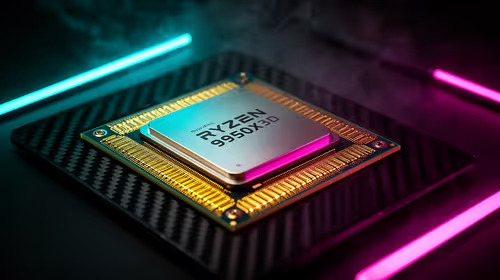
The Ryzen 5 5500 is a six-core, twelve-thread processor based on AMD''s Zen 3 architecture. It is a capable gaming CPU, particularly at 1080p where the GPU tends to do more of the work. At 1440p and 4K, the GPU workload increases further, making CPU bottleneck even less of a concern.
1080p Performance Expectations
At 1080p, the Ryzen 5 5500 and RX 7600 pairing performs well in most titles. The CPU can sustain the frame rates the RX 7600 produces in the majority of games without becoming a significant bottleneck. In some highly CPU-dependent titles - such as open-world games with many simulated NPCs or strategy games with complex AI - the Ryzen 5 5500''s core count and single-thread performance may become a mild limiting factor at higher frame rates above 100 FPS. In these scenarios, average frame rates may be slightly lower than what the RX 7600 could theoretically achieve with a faster CPU. However, for most SA gamers playing popular titles at 1080p high settings, the pairing is practical and well-balanced.
1440p Considerations
At 1440p, the GPU workload increases and the RX 7600 becomes the primary limiting factor rather than the CPU. This actually benefits the Ryzen 5 5500 + RX 7600 pairing - at 1440p, the CPU bottleneck concern essentially disappears, and performance is governed by the GPU. The trade-off is that the RX 7600 produces lower frame rates at 1440p generally, so FSR is recommended to maintain smooth gameplay.
Frequently Asked Questions
Q: Does the Ryzen 5 5500 bottleneck the RX 7600? A: At 1080p in most games, the bottleneck is minimal and within acceptable limits. In CPU-heavy titles at high frame rates, there may be a slight CPU limitation, but for typical gaming use this pairing is well-matched.
Q: Is the Ryzen 5 5500 still worth buying in 2026? A: It remains a solid value option for AM4 builds, particularly for gamers who already own an AM4 motherboard or are building on a tight budget. It delivers competitive gaming performance at its price point.
Q: Should I upgrade the CPU or GPU first if I want better performance from this build? A: In most cases, upgrading the GPU will yield more noticeable improvements in gaming frame rates. If you are experiencing CPU bottleneck specifically in open-world or simulation games, a CPU upgrade becomes more relevant.
Ready to Find Your Perfect Match? Shop gaming PC component deals at Evetech.