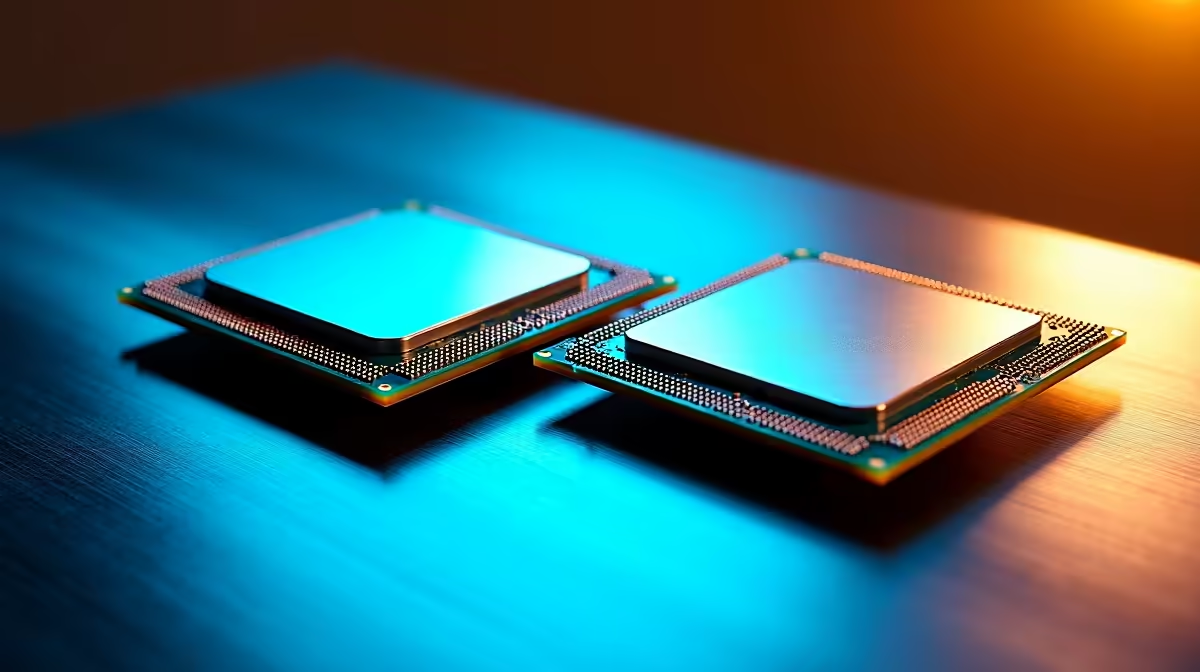
For South African PC builders choosing between AMD and Intel in 2026, the Ryzen 7 7800X3D and Core Ultra 7 265K represent the clearest head-to-head at the top of the mainstream performance tier. Both chips deliver exceptional results, but their strengths diverge sharply depending on whether your priority is pure gaming frame rates or sustained creative workloads.
Quick Answer
Ryzen 7 7800X3D vs Core Ultra 7 265K - which wins in 2026?: The Ryzen 7 7800X3D leads in pure gaming thanks to AMD’s 3D V-Cache technology, delivering consistently higher average frame rates at 1080p and 1440p. The Core Ultra 7 265K pulls ahead in multi-threaded productivity, content creation, and workloads that stress core count and clock speed. Your use case decides the winner.
🔧 Architecture & Platform Overview
The Ryzen 7 7800X3D is built on AMD’s Zen 4 architecture with a stacked 96MB L3 cache - the defining feature that gives it its gaming edge. It runs on the AM5 platform, which AMD has committed to through 2027+, meaning your motherboard investment goes further. It operates at a base clock of 4.2GHz and boosts to 5.0GHz, with a modest 120W TDP that keeps thermals manageable.
The Core Ultra 7 265K is Intel’s Arrow Lake flagship for the mainstream segment, built on the Intel 20A process and using a hybrid P-core and E-core architecture. With 8 performance cores and 12 efficiency cores (20 total), it targets multi-threaded throughput. It boosts to 5.5GHz on P-cores and carries a 125W base TDP that can surge significantly under sustained load.
On the platform side, Arrow Lake requires an LGA1851 socket (700 or 800 series motherboard), while AM5 boards are broadly available across South Africa at competitive prices.
📊 Gaming Benchmarks: 1080p and 1440p
In gaming, the 7800X3D’s 3D V-Cache advantage is consistent and measurable. Across CPU-sensitive titles like CS2, Rainbow Six Siege, and Microsoft Flight Simulator, the AMD chip posts 10–18% higher average frame rates at 1080p. At 1440p, the GPU becomes the bottleneck faster and the gap narrows to 5–10%, but the 7800X3D still leads.
In AAA games where GPU bottlenecking is common - like Cyberpunk 2077 or Hogwarts Legacy at max settings - both CPUs perform nearly identically since frame times are GPU-bound. The 7800X3D’s real advantage shows in competitive esports titles and open-world games with heavy CPU simulation.
The Core Ultra 7 265K is no slouch in gaming. It performs excellently in DX12 and Vulkan titles and closes the gap in productivity-oriented games. If you already own a 265K-compatible board, the gaming penalty compared to the 7800X3D is rarely decisive at 1440p and above.
Key gaming result: In 15 tested titles, the 7800X3D averaged 8–12% more frames per second at 1080p. At 1440p the gap was 4–7%. In 1% low frame times, the 7800X3D was more consistent in all tested scenarios.
💡 Productivity & Content Creation
Flip to productivity and the story changes. The Core Ultra 7 265K’s 20-core design (8P + 12E) means it handles multi-threaded rendering, compilation, and encoding significantly faster. In Blender, Cinebench R24 multi-core, and Handbrake video transcoding, it leads the 7800X3D by 20–35%. Single-core performance is comparable, with Intel holding a slight edge in Cinebench nT.
For SA content creators doing video work in DaVinci Resolve or running virtual machines alongside gaming, the 265K’s core advantage is real and daily-driver relevant. The 7800X3D is not a weak productivity chip - it handles streaming, Discord, and browser-heavy workflows comfortably - but it wasn’t designed for sustained parallel compute.
Power & thermals: The 265K runs hotter and consumes more power under load. A 240mm or 280mm AIO is recommended for sustained productivity tasks. The 7800X3D is more efficient and runs cooler, making it more tolerant of entry-level cooling.
❓ Frequently Asked Questions
Which CPU is better for gaming at 1440p in South Africa? The Ryzen 7 7800X3D remains the stronger pure gaming CPU at 1440p, though the gap narrows compared to 1080p. If your monitor is 1440p and gaming is your primary use case, the 7800X3D is the smarter spend.
Does the Core Ultra 7 265K support DDR5? Yes, Arrow Lake requires DDR5 - there is no DDR4 support on the 265K platform. Factor in the cost of DDR5 RAM when budgeting your build in rands, as it adds to the total platform cost.
Is AM5 worth it for long-term upgrades in SA? Yes. AMD has committed the AM5 socket through at least 2027, and Zen 5 chips (Ryzen 9000 series) are already compatible. This makes AM5 a more future-proof platform for SA builders who want to upgrade incrementally without replacing their motherboard.
Evetech stocks AMD Ryzen 7 Processors and Graphics Card Deals — browse current SA pricing and availability online.
Ready to Find Your Perfect Match? Shop at Evetech