Quick Answer
The Ryzen 7 9700X and Core Ultra 5 245K are both strong mid-to-high-end CPUs in 2026, but they suit different buyers. The 9700X delivers exceptional efficiency and strong all-core performance for gaming, while the 245K offers competitive gaming throughput with Intel''s latest hybrid architecture. Your choice hinges on platform, workload balance, and budget.
Choosing a CPU in 2026 means navigating two very different philosophies. AMD''s Ryzen 7 9700X sits on the mature and well-supported AM5 platform, while Intel''s Core Ultra 5 245K brings the Arrow Lake generation with a redesigned core layout. Both chips compete hard in the R8,000–R12,000 PC build bracket that many South African gamers and content creators target. Here''s a thorough breakdown so you can pick the right processor for your next build.
Architecture and Core Design
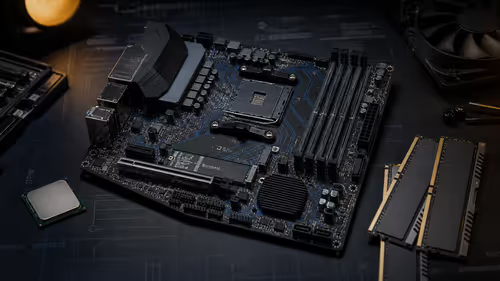
The Ryzen 7 9700X uses AMD''s Zen 5 architecture with eight performance cores, no efficiency cores, and a design philosophy centred on pure single-threaded and all-core throughput consistency. It runs on the AM5 platform, which is DDR5-native and will remain supported into future Ryzen generations - a meaningful long-term investment for SA builders who upgrade incrementally.
The Core Ultra 5 245K is part of Intel''s Arrow Lake lineup, featuring a hybrid arrangement of Performance cores and Efficient cores built on a disaggregated tile design. Intel shifted away from Hyper-Threading on its P-cores with Arrow Lake, a move that changes how threaded workloads are handled compared to previous generations. The 245K uses the LGA1851 socket and DDR5 exclusively.
For gaming, both chips deliver smooth high-framerate experiences at 1080p and 1440p when paired with a capable GPU. The Ryzen 7 9700X tends to shine in titles that reward low-latency, high single-core throughput, while the 245K''s hybrid core layout can be advantageous in games that offload background tasks to efficiency cores, keeping P-cores fully available for rendering.
Gaming Performance
In competitive gaming - fast-paced shooters, battle royale titles, and eSports games that push high frame rates - both CPUs perform at a level that will keep any modern GPU well-fed. The 9700X''s Zen 5 IPC improvements mean it regularly matches or edges ahead in latency-sensitive scenarios. The 245K is no slouch and trades blows depending on the title and memory configuration.
For the South African gaming community, where 1080p high-refresh-rate gaming remains dominant due to monitor pricing, the CPU difference between these two chips is rarely the bottleneck once your GPU is the right fit. What matters more is pairing either CPU with fast DDR5 memory - both platforms reward lower-latency kits. If you''re building around competitive gaming above all else, the 9700X''s consistent latency profile is a slight advantage.
Open-world games and simulation titles with heavy CPU draw threads benefit from both chips, though the 9700X''s eight full-power Zen 5 cores handle sustained loads with very low variance. The 245K''s E-cores absorb background system tasks effectively, which can reduce frame-time spikes in busy Windows environments.
Productivity and Content Creation
For video editing, 3D rendering, and software compilation, the thread count difference between these two chips becomes relevant. The 245K''s E-cores add parallel compute headroom for lightly-threaded background tasks running alongside a primary render job. The 9700X counters with superior per-core performance in applications that are highly optimised for high-IPC workloads - particularly professional creative apps.
SA content creators working in video production, graphic design, and game development will find either chip capable for most project types up to 4K timelines. If your workflow is render-heavy and benefits from more simultaneous threads, the 245K''s core structure offers headroom. If your software scales better with raw per-core speed and you want consistent all-day performance without thermal management concerns, the 9700X''s efficiency profile is easier to live with long-term.
Thermal behaviour is worth noting: the Ryzen 7 9700X has a lower default TDP and can be run effectively on mid-range air cooling. The Core Ultra 5 245K can also be managed on quality air cooling, but benefits from a generous thermal solution when pushed under sustained all-core loads.
Platform, Upgrade Path, and Value
Platform choice matters for SA builders who think a few years ahead. AM5 motherboards offer a clear upgrade path to future Ryzen chips without changing sockets. That reduces the total cost of a future upgrade, which matters when rand-dollar exchange rates affect hardware pricing significantly. Intel''s LGA1851 is newer and its roadmap beyond Arrow Lake is less defined at this stage.
From a value standpoint, both CPUs sit in a competitive price bracket in South Africa. AM5 motherboard pricing has matured and entry B650 boards are now very accessible. Intel Z890 boards for the 245K carry a premium for the feature set they offer. Factor in your cooling budget, memory kit, and whether you''re building from scratch or upgrading an existing platform.
Frequently Asked Questions
Q: Which CPU is better for competitive gaming in South Africa in 2026? A: Both perform excellently, but the Ryzen 7 9700X''s consistent low-latency output from its eight Zen 5 P-cores gives it a slight edge in competitive titles where frame-time consistency matters. Either will drive a high-refresh monitor without issue.
Q: Does the Core Ultra 5 245K support DDR4? A: No. Arrow Lake''s LGA1851 platform is DDR5 only, the same as AM5 for the Ryzen 7 9700X. Both require DDR5 memory, so budget accordingly when pricing your build.
Q: Is AM5 a better long-term platform than LGA1851 for SA buyers? A: AM5 currently has a clearer published upgrade roadmap with future Ryzen generations confirmed for the socket. For buyers who upgrade CPUs without changing motherboards, AM5 has a proven track record that LGA1851 is yet to match over multiple generations.
Q: Will either CPU bottleneck a high-end GPU at 1440p? A: At 1440p with a powerful GPU, neither the 9700X nor the 245K will be a meaningful bottleneck. Both chips supply enough throughput for high-end graphics cards to operate at full efficiency in the vast majority of games.
Ready to Find Your Perfect Match? Shop gaming PC deals at Evetech.