Quick Answer
The TP-Link Archer BE900 and ASUS ROG Rapture GT-BE98 are both flagship WiFi 7 routers suited for serious SA gamers, with the BE900 offering broader coverage and multi-device efficiency while the ROG Rapture prioritises gaming-specific traffic management and aesthetics.
WiFi 7 in 2026: Why It Matters for South African Gamers
WiFi 7 (802.11be) represents a meaningful generational leap over WiFi 6E for gaming households in South Africa. The key improvements - Multi-Link Operation (MLO), 320 MHz channel width support, and 4K QAM modulation - translate to lower latency, higher throughput, and more efficient handling of multiple connected devices simultaneously. For a South African home with 5-10 connected devices competing for bandwidth alongside gaming sessions, these improvements are tangible rather than theoretical.
In South Africa specifically, WiFi 7 adoption has accelerated in 2025-2026 as fibre penetration has grown in urban areas. With Openserve, Vumatel, and other fibre providers delivering 1 Gbps or higher residential connections to more homes in Johannesburg, Cape Town, and Durban, having a router that can actually maximise those speeds throughout the home has become a meaningful purchase decision. Both the TP-Link Archer BE900 and ASUS ROG Rapture GT-BE98 are positioned at the top of the WiFi 7 market and represent flagship choices for gamers with fibre connections.
An unexpected outage also plays into router choice in South Africa. Both routers draw significant power - typically 25-40 W - which is manageable for most home UPS setups. During an unexpected outage, your router staying online is as important as your PC staying powered, since online gaming and streaming require continuous connectivity. Smaller, lighter UPS units in South African homes often prioritise keeping routers running even when PCs must shut down.
TP-Link Archer BE900: Performance and Features Breakdown
The TP-Link Archer BE900 is a quad-band WiFi 7 router with a theoretical maximum throughput of 24 Gbps combined across its bands. In real-world testing at home scale, the BE900 excels at delivering consistent high speeds to multiple clients simultaneously, which makes it particularly effective in households where gaming, 4K streaming, video calls, and smart home devices all compete for bandwidth at the same time.
MLO on the BE900 allows compatible devices to connect across multiple frequency bands simultaneously, which reduces effective latency and improves connection stability. For gaming on WiFi, this is the most significant practical WiFi 7 benefit - the technology intelligently aggregates bandwidth and reduces the chance of a single band congestion event affecting your game session. The BE900's coverage area is also a strength, with its antenna array delivering reliable signal across larger South African homes and through multiple walls.
TP-Link's software ecosystem through the Tether app and HomeCare suite provides reasonable parental controls, QoS, and network management tools. The gaming-specific features are present but not as deeply developed as ASUS ROG's implementations. For households where gaming is one of many use cases rather than the primary driver, the BE900's well-rounded feature set and strong coverage make it a compelling choice.
ASUS ROG Rapture GT-BE98: Gaming-First Design
The ASUS ROG Rapture GT-BE98 is built with gaming households as the primary use case and this focus shows in its feature implementation. The ROG Rapture's Game Acceleration feature, which optimises gaming traffic routing through partnerships with major game servers, delivers lower effective ping for SA players connecting to Johannesburg and international servers. Adaptive QoS with gaming prioritisation ensures that even when other devices on the network are downloading large files, your game traffic is protected.
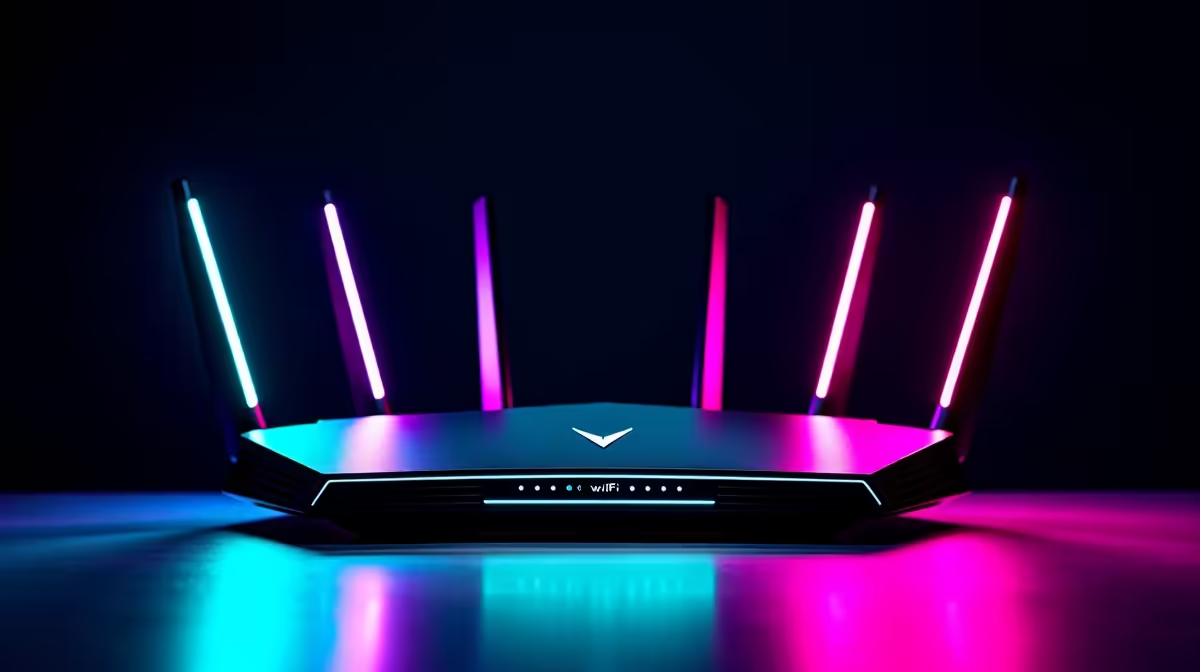
The GT-BE98's ASUS AURA sync RGB lighting and angular gaming aesthetic is a consideration for gamers who want their network hardware to match their gaming setup aesthetic. For South African gaming setups where the full desk and peripherals are themed around a visual style, the ROG Rapture fits the look in a way that the BE900 does not attempt to. This is cosmetic but relevant to many buyers in the gaming market.
On pure technical performance, the ROG Rapture GT-BE98 and BE900 are closely matched for throughput. The ROG Rapture's additional gaming-focused firmware features give it an edge for pure gaming households, while the BE900's superior coverage and more neutral design make it better suited to mixed-use family or professional environments.
Head-to-Head: Which WiFi 7 Router Wins for SA Gamers in 2026?
The right choice between these two routers depends on your specific SA household setup. For a dedicated gaming household or LAN setup where gaming latency is the top priority, the ASUS ROG Rapture GT-BE98's gaming optimisation features deliver a noticeable advantage. The game traffic prioritisation, ROG gaming acceleration features, and deeper gaming-specific QoS controls are genuinely useful for competitive SA gamers.
For a household where gaming shares bandwidth with work-from-home, streaming, and multiple family members, the TP-Link Archer BE900 is the better all-rounder. Its wider coverage, more balanced multi-device performance, and competitive pricing make it the pragmatic choice for households where gaming is important but not the sole use case.
Both routers represent significant investment in South African rands. At premium WiFi 7 router pricing, they are targeted at gamers with fibre connections who have already invested in high-end gaming hardware. If your connection is 500 Mbps or below, the performance ceiling of either router will not be meaningfully reached, and a mid-range WiFi 6E router may be a more cost-effective choice for most SA gaming needs.
Frequently Asked Questions
Q: Do WiFi 7 routers make a real difference for gaming in South Africa?
A: WiFi 7's Multi-Link Operation feature does provide measurably lower wireless latency compared to WiFi 6E, which is relevant for competitive online gaming. However, for most SA gamers, the bigger factors affecting ping are internet service provider quality and distance to game servers in Johannesburg. WiFi 7 eliminates wireless latency as a variable rather than solving network latency broadly.
Q: Can I use a WiFi 7 router with non-WiFi 7 devices?
A: Yes, both routers are fully backward compatible with WiFi 6E, WiFi 6, WiFi 5, and older devices. Non-WiFi 7 devices connect at their native supported standard. WiFi 7 benefits only apply to WiFi 7-capable client devices, which in 2026 includes newer smartphones, some gaming laptops, and WiFi 7 PCIe adapters for desktop gaming PCs.
Q: Which router has better parental controls for South African families?
A: Both routers offer parental control features, but TP-Link's HomeCare suite provides a more user-friendly implementation for non-technical users. ASUS's AiProtection Pro offers comparable features but with a more complex interface. For families prioritising ease of use alongside gaming performance, the BE900's parental controls are easier to set up and manage.
Q: Will these routers work with all South African fibre providers?
A: Yes, both routers are compatible with all major SA fibre providers including Openserve, Vumatel, Frogfoot, and others. They connect via the fibre ONT device installed by the ISP using standard WAN port configuration. No special South Africa-specific settings are required beyond the standard PPPoE or static IP configuration provided by your ISP.
Also at Evetech: All Graphics Cards | Networking & Routers