Quick Answer
Aspect ratio is the proportion of a screen's width to its height. 16:9 is the standard, 21:9 ultrawide adds horizontal real estate for immersion and productivity, and 32:9 super-ultrawide replaces a dual-monitor setup with a single curved panel for power users.
16:9: The Universal Default and Why It's Still King
Almost every laptop, TV, and monitor sold in SA uses 16:9 because it matches YouTube, Netflix, esports tournament feeds, and 99 percent of Steam library titles natively. No black bars, no scaling issues, no fiddling. For competitive games like Valorant, CS2, and Apex Legends, 16:9 is mandatory since pro players use it and game UI is balanced for that frame.
If you only buy one monitor and it has to do everything, 16:9 at 1440p or 4K is the safest pick. It's the format every developer designs for first and the format every video service streams to natively, with no compromises on either side.
21:9 Ultrawide: The Productivity Power-Up
21:9 panels at 3440x1440 give you roughly 33 percent more horizontal pixels than 16:9. The killer use case is productivity: three full-width Word documents side by side, or a timeline editor in Premiere with the preview window full size while your bin and effects panels remain visible.
In single-player games like Cyberpunk 2077, Forza, and Assassin's Creed Shadows, 21:9 transforms immersion. The peripheral vision matches what your eyes see in real life, and you spot enemies sooner. Be aware that some older or competitive titles letterbox 21:9 to 16:9, which is why pure esports players skip the format. Pricing in SA sits at R8,000 to R18,000 for a quality 21:9.
32:9 Super-Ultrawide: The Single-Panel Battlestation
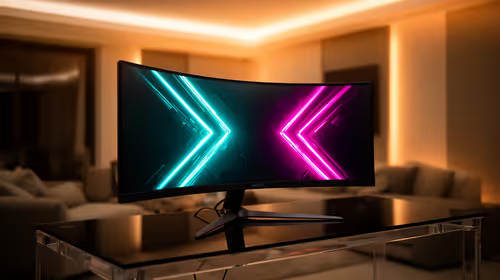
32:9 monitors at 5120x1440 are essentially two 1440p screens fused with no bezel between them. The 49-inch curved Samsung Odyssey G9 is the icon of this category. For productivity, you get genuine multi-window workflow without the bezel gap that splits dual-monitor setups.
Gaming on 32:9 is gorgeous in supported titles like Microsoft Flight Simulator and racing sims. Less supported in shooters where the field of view advantage is so large some games disable certain modes. Budget R20,000 to R30,000 for a quality 32:9 panel in SA, which is roughly the price of two high-end 27-inch panels combined.
Productivity Math: How Much Extra Real Estate
Here's the practical breakdown. A 27-inch 16:9 1440p panel is 100 percent baseline. A 34-inch 21:9 1440p adds about 33 percent more pixels horizontally. A 49-inch 32:9 doubles your horizontal pixels to roughly 200 percent of the 27-inch baseline.
For coders, traders, video editors, and 3D artists who routinely have many panels open, the 32:9 is genuinely more efficient than dual 27-inch monitors because you can resize windows to any width without bezel interruption. Stock traders running multiple charts are the user group that gets the most measurable productivity lift.
Loadshedding and Wattage Reality
Wider panels draw more power. A 27-inch 16:9 averages 30 watts. A 34-inch 21:9 sits around 50 watts. A 49-inch 32:9 can pull 90 watts under bright HDR scenes. If you run a small UPS, factor this in. A 1000VA UPS handles a 16:9 plus PC for 15 minutes, but it'll struggle with a 32:9 in the same setup. Step up to a 1500VA model for serious ultrawide builds in stage 4 areas.
Frequently Asked Questions
Will my games support 21:9 or 32:9?
Most modern AAA games do, with PCGamingWiki tracking compatibility for free. Older esports titles often don't, and even some 2024 releases like League of Legends still letterbox to 16:9. For 32:9, support is patchier than 21:9 but improving as super-ultrawides become more common in mainstream builds.
Is 21:9 better than dual 16:9 monitors for productivity?
Yes for most users. No bezel split means fluid window arrangement. Dual monitors still win if you need totally separate workspaces, like one for work and one for streaming, where the bezel actually helps mentally compartmentalise tasks.
Can my GPU drive 32:9 at high refresh rates?
A 5120x1440 panel at 240Hz needs serious GPU horsepower. RTX 4070 or higher is the floor for modern games at high settings. Older GPUs run fine at 144Hz with reduced settings, but you're losing the value of the panel's spec sheet.
Ready to Find Your Perfect Match? See ultrawide and super-ultrawide options in current PC bundles. Explore PC deals now