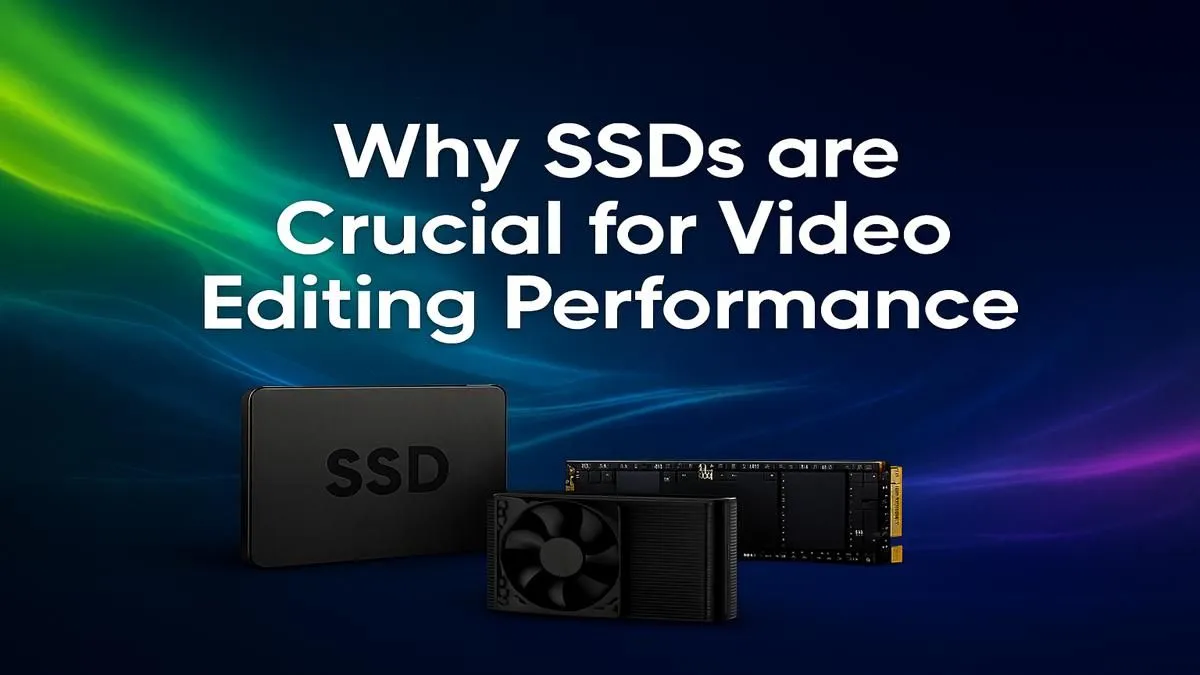
Staring at a sluggish timeline, waiting for clips to load, or watching a render progress bar crawl at a snail's pace… sound familiar? For South African content creators and video editors, these aren't just minor annoyances; they're creative roadblocks. You might have a beast of a processor and a top-tier graphics card, but if your storage can't keep up, you're driving a Ferrari with bicycle wheels. The secret weapon you're missing? A high-speed SSD for video editing. 🚀
Why Your Old Hard Drive is a Major Bottleneck
For years, the trusty Hard Disk Drive (HDD) was the king of storage. It's a mechanical device with a spinning platter and a read/write head that physically moves to find your data. Think of it like a vinyl record player. While great for storing massive files cheaply, this physical movement creates a massive speed bottleneck, especially when you're trying to access multiple files at once—like a typical video editing project.
An SSD (Solid-State Drive), on the other hand, has no moving parts. It uses flash memory, working more like a supercharged USB stick. This means data access is almost instantaneous. When you choose the right SSD for video editing, you're not just getting a minor speed bump; you're fundamentally changing how your entire system responds.
The Real-World Impact: How an SSD Transforms Your Workflow
Upgrading to an SSD isn't just about faster boot times. For video editors, the benefits are tangible and immediate, impacting every stage of your creative process.
Blazing Fast Project & Media Loading
Remember waiting minutes for your 4K project to load, with all its assets, effects, and audio tracks? With an SSD, that wait time is slashed dramatically. Your software launches faster, and your media files are ready to go in seconds, getting you into the creative zone without delay.
Silky-Smooth Timeline Scrubbing 🎬
This is where an SSD for video editing truly shines. Scrubbing through your timeline on an HDD often results in stuttering, dropped frames, and low-resolution previews. An SSD can feed data to your CPU and RAM so quickly that you can skim through complex timelines, even with multiple 4K streams and colour grades, with fluid, real-time playback.
Quicker Renders & Exports
While your CPU and GPU do the heavy lifting during rendering, they constantly need to read source files and write the new video file. A slow HDD can starve them of data, leaving them waiting. An SSD ensures they are fed a constant, high-speed stream of data, significantly cutting down your final export times.
Pro Storage Strategy 🔧
For an optimal setup, use a three-tiered approach. Install your operating system and editing software on a super-fast NVMe SSD. Use a second, large NVMe or SATA SSD as a 'scratch disk' for your active projects and media cache. Finally, use a large, affordable HDD for long-term storage and archiving completed projects.
NVMe vs. SATA SSDs: Choosing Your Weapon
Not all SSDs are created equal. The two main types you'll encounter are SATA and NVMe.
- SATA SSDs: These use the same connector as traditional hard drives. They are a massive leap from an HDD, offering speeds around 550MB/s. They are a fantastic, cost-effective choice for a boot drive or for storing your project files.
- NVMe SSDs: These drives plug directly into the motherboard's M.2 slot, using the PCIe bus to communicate. This direct line offers mind-blowing speeds—often 5 to 10 times faster than SATA SSDs. For professionals working with 6K/8K RAW footage or complex visual effects, an NVMe SSD for video editing is essential for a lag-free experience.
Building the Ultimate Editing Rig Starts with Balanced Components
A fast SSD is a critical part of the puzzle, but it works best as part of a balanced system. To truly eliminate bottlenecks, you need a powerful processor to handle encoding and effects. Whether you lean towards multi-core AMD Ryzen PCs known for their rendering prowess or the robust single-core performance found in powerful Intel-based systems, the CPU is your engine.
Your graphics card is just as important, accelerating effects, colour grading, and playback. Both NVIDIA GeForce graphics cards with their CUDA core advantage in programs like Adobe Premiere Pro, and the excellent value offered by AMD Radeon GPUs are brilliant choices.
Putting it all together can be daunting. That's why considering one of our expertly configured pre-built PC deals can save you time and ensure all your components work in perfect harmony, giving you a machine optimised for performance right out of the box.
Ready to Stop Waiting and Start Creating? A powerful PC is more than just a CPU or GPU; it's a balanced system. The right SSD for video editing can unlock your machine's true potential. Explore our range of purpose-built workstation PCs and find the perfect rig to bring your vision to life.