Quick Answer
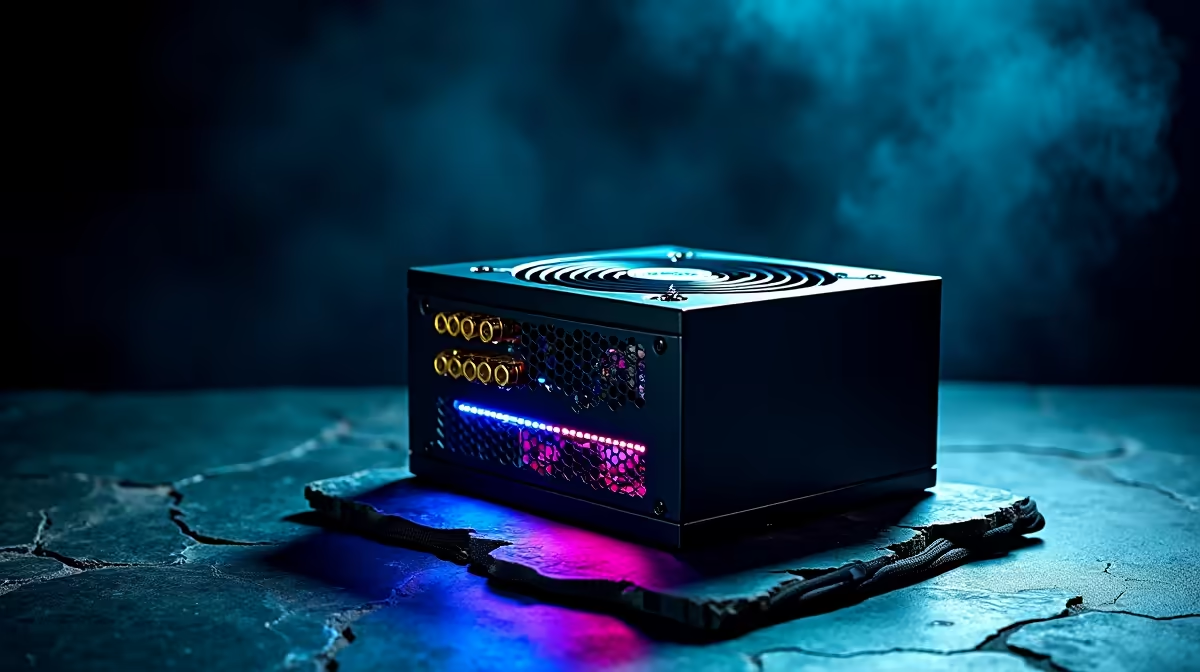
Yes, a quality 700W PSU can handle the RX 9070 comfortably - AMD's card has a 220W TDP and a 700W unit provides sufficient headroom for a complete system.
RX 9070 Power Requirements: What You Actually Need
AMD's RX 9070 is one of the more power-efficient options in its performance class, with a rated Total Graphics Power (TGP) of around 220W depending on the specific model and manufacturer. Reference and base-clocked AIB variants tend to sit right at that figure, while factory-overclocked models may pull closer to 240-250W under heavy gaming loads.
A typical gaming PC built around the RX 9070 - including a mid-range Ryzen or Intel CPU, DDR5 RAM, NVMe SSD, a few case fans, and a motherboard - will draw somewhere between 350W and 450W from the wall under full gaming load. This puts a 700W PSU in a very comfortable position, leaving 250W-350W of headroom. That headroom is important because PSUs run most efficiently and coolest at 50-70% of their rated load.
When a 700W PSU Becomes a Concern
There are scenarios where a 700W PSU starts to feel tighter with the RX 9070. If you pair the card with a high-end CPU that itself has a high TDP - such as an Intel Core i9-14900K running without power limits - that CPU alone can consume 200W or more under load. Add the GPU's 220-250W and you are already at 450W before accounting for the rest of the system. In this scenario, 700W still works but your headroom shrinks significantly.
Another consideration is PSU quality. Not all 700W units are created equal. An 80 Plus Bronze unit from an obscure brand may not reliably deliver its rated 700W continuously, especially under the thermal stress of extended gaming sessions during South African summer heat. Load shedding events followed by power restoration cause voltage spikes that low-quality PSUs handle poorly. Investing in an 80 Plus Gold or Platinum 700W unit from a reputable brand is the smarter approach for longevity.
Recommended PSU Strategy for the RX 9070
For most RX 9070 builds using mainstream CPUs like a Ryzen 5 7600, Ryzen 7 7700X, or Intel Core i5-13600K, a good quality 700W 80 Plus Gold PSU is the right call. It hits the efficiency sweet spot, provides adequate headroom, and avoids the unnecessary cost of stepping up to 850W.
If you are building with a high-TDP CPU, planning to overclock, or running multiple storage drives and a liquid cooling pump, stepping up to an 850W unit gives you proper breathing room without going overboard. In SA where load shedding can cause inconsistent power delivery, having a quality PSU with a good surge protection rating protects your investment. Many SA builders also consider a UPS alongside the PSU for this reason - the RX 9070 is not a cheap component to replace.
Frequently Asked Questions
Q: Does the RX 9070 require a specific PCIe power connector?
A: The RX 9070 typically uses standard 8-pin PCIe connectors, with most AIB models requiring two 8-pin connectors. Some higher-end variants may use a 16-pin 12VHPWR connector. Check the specific card's requirements before purchasing and ensure your PSU has the matching connectors.
Q: Is 650W enough for the RX 9070?
A: A quality 650W PSU can technically power an RX 9070 system with a mid-range CPU, but the headroom is tighter. If you plan to upgrade your CPU later or run any peripherals from the system, a 700W or 750W unit is the safer choice and does not cost significantly more.
Q: How does load shedding affect my PSU and GPU?
A: Frequent power cuts and restoration cycles can cause voltage spikes that stress PSU components over time. Pairing your RX 9070 build with a quality 80 Plus Gold PSU and a UPS is strongly recommended for South African users to protect both the GPU and the rest of the system.
Also at Evetech: All Graphics Cards | All Power Supplies