


650W PSU Planning for RTX 5090 Builds in SA
650W for RTX 5090 needs a full-build check, not a simple yes. Review GPU guidance, CPU draw, transient load, connectors, PSU quality, and upgrade plans before deciding.
Read moreCan a 750W PSU Handle the RTX 5090? Power. Wattage requirements, recommended PSU models & efficiency ratings for SA buyers at Evetech.
The RTX 5090 is NVIDIA's most powerful consumer GPU to date, with a TDP that sets it apart from anything in previous generations. Whether a 750W PSU can handle it depends on your full system build - and the answer is more nuanced than a simple yes or no.
Can a 750W PSU handle the RTX 5090? Generally no - the RTX 5090 has a TDP of approximately 575W, and a full gaming system with a high-end CPU can push total draw to 750W or beyond. A quality 1000W or 1200W PSU is the recommended choice for an RTX 5090 build. Running a 750W unit risks instability, crashes, and potential PSU damage under sustained full load.
The RTX 5090 (Blackwell) carries a total graphics power of around 575W - considerably higher than the RTX 4090's 450W. This alone makes 750W a tight proposition before even accounting for the rest of the system.
A typical RTX 5090 build pairs the GPU with a flagship or high-end CPU. Consider these power budgets:
Total: 795–825W sustained, with transient spikes potentially exceeding 900W. A 750W PSU running at 90–100% of rated capacity continuously is operating outside its efficiency curve, generating excess heat, and placing maximum stress on components. This scenario shortens PSU lifespan dramatically and risks shutdowns during demanding scenes.
Minimum Viable: 1000W, 80 Plus Gold, from a reputable manufacturer. This provides modest headroom and is the floor for a responsible RTX 5090 build.
Recommended: 1200W, 80 Plus Gold or Platinum. Keeping the PSU at 70–80% of rated load during gaming extends its lifespan, reduces thermal output inside the unit, and provides headroom for brief transient spikes without tripping OCP (Over Current Protection).
For overclocked builds: 1500W, 80 Plus Platinum. Power limit override on the RTX 5090 can push GPU draw beyond the stock 575W. Combined with an overclocked CPU, 1200W becomes tight quickly.
The RTX 5090 uses the 16-pin 12VHPWR (or 12V-2x6 per the updated ATX 3.0/3.1 specification) connector. Use ATX 3.0 or later compliant PSUs for full transient load support - older PSUs can fail OCP tests during GPU power spikes even if their rated wattage appears sufficient.
The RTX 5090's power draw can spike to multiples of its base TDP for microseconds during frame transitions and complex compute tasks. ATX 3.0 specification requires PSUs to handle transient loads of 2–3x the connector's rated continuous power for brief durations without tripping protection or dropping voltage rails.
A budget 1000W PSU built to older ATX 2.4 specifications may actually perform worse on an RTX 5090 than a premium 1000W ATX 3.1 unit, because the older unit lacks the capacitor hold-up time and transient headroom the 5090 demands. Buy a PSU that explicitly carries ATX 3.0 or 3.1 certification when building around the RTX 5090.
In the SA market where premium PSUs carry significant import costs, factor the PSU as a long-term investment. A quality 1200W unit outlasts multiple GPU generations and prevents the hidden cost of a blown unit taking other components with it.
What PSU wattage does NVIDIA officially recommend for the RTX 5090? NVIDIA recommends a minimum 1000W system PSU for the RTX 5090. This assumes a typical mid-to-high-end CPU and standard peripherals. For builds with power-hungry CPUs or overclocking, 1200W is the practical recommendation.
Will a 750W PSU damage itself or the RTX 5090 if pushed to its limits? Modern PSUs have OCP (Over Current Protection) and OPP (Over Power Protection) circuits that should trigger a shutdown before catastrophic failure. However, running persistently at or near 100% load degrades PSU components rapidly and increases the risk of unstable voltage delivery that can cause data corruption, crashes, and in worst cases damage downstream components. Don't run a 750W unit in an RTX 5090 build.
Is an 850W PSU sufficient for an RTX 5090 if I only do light gaming? Even during light gaming, the RTX 5090 can draw 200–350W at lower utilisation, plus CPU draw, which keeps total system consumption in the 400–600W range. An 850W PSU technically handles this scenario but leaves minimal headroom for workload spikes. Given the cost of an RTX 5090 build, buying a 1000W or 1200W quality PSU to protect the investment is strongly recommended over the marginal savings of an 850W unit.
Evetech stocks RTX 5090 Gaming PCs and RTX 5090 Graphics Cards — browse current SA pricing and availability online.
Ready to Find Your Perfect Match? Shop at Evetech
Can a 750W PSU Handle the RTX 5090? Powe available at Evetech.co.za with local warranty and fast delivery.
Can a 750W PSU Handle the RTX 5090? Powe - check Evetech for latest stock and SA pricing.
Depends on your use case. Can a 750W PSU Handle the RTX offers good value at current Rand pricing.
650W for RTX 5090 needs a full-build check, not a simple yes. Review GPU guidance, CPU draw, transient load, connectors, PSU quality, and upgrade plans before deciding.
Read more
How to fix FPS drops Windows 11 RX 9070 XT starts with GPU drivers, overlays, power plans, and frame pacing checks. For SA gaming PCs, verify chipset updates, HAGS, refresh rate, thermals, and per-game graphics settings.
Read more
How to fix FPS drops on X870E motherboard starts with BIOS, chipset drivers, PCIe settings, and memory stability. SA gamers can check EXPO, resize BAR, thermals, display refresh, and background apps before replacing components.
Read more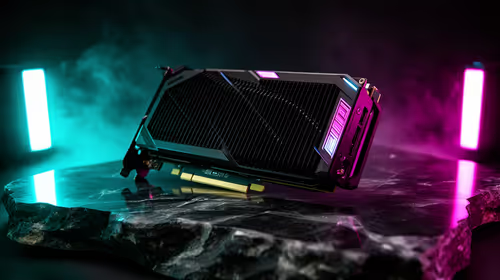
RTX 5060 is popular with SA students because it can fit gaming, coursework, and creative app needs in one setup. Compare total system price, cooling, RAM, storage, and screen quality before picking a desktop or laptop.
Read more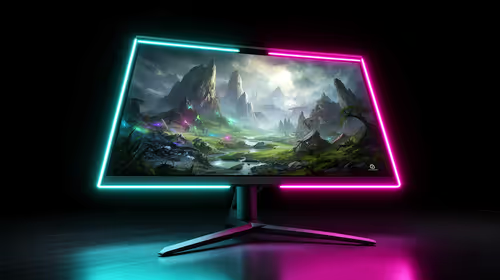
1440p is the sweet spot for SA gamers because it balances sharp visuals, high frame rates, and GPU cost better than 4K. It is a practical monitor target for players who want smoother upgrades without the heavier hardware demands of 4K.
Read more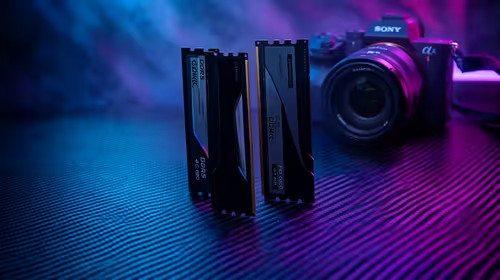
RAM pricing for Midrand gamers can shift with exchange rates, supply, specs, and model tier. Treat the title as a buying prompt, then compare SA warranty, timing, and build priorities.
Read more
From 1 October 2026, WhatsApp Business Platform service replies in South Africa are expected to cost about $0.0076, or 12 cents, per delivered message.
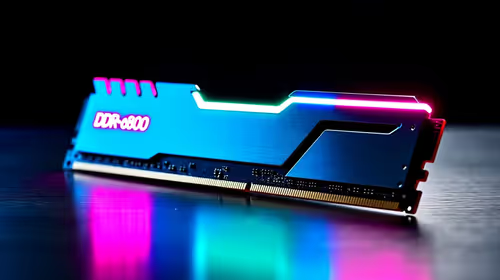
DDR5-8000 RAM Kits pros and cons depend on the build, budget, and workload. Weigh gaming needs, platform fit, power, cooling, warranty support, and South African pricing context before shortlisting it.
Wi-Fi 6E vs Wi-Fi 6 depends on AAA single-player gaming needs, platform limits, and budget fit. Compare compatibility, latency, upgrade path, and real setup constraints before choosing for an SA build.
Ryzen 9 9950X3D dead pixel checks should isolate the panel first. Run colour fills, inspect the monitor menu, test another cable or input, and capture proof before linking it to the SA CPU upgrade.

YouTube will count public views from the first frame across video formats from 24 August, while earnings and eligibility remain tied to engaged viewing.
Canonical expects Ubuntu on WSL users to outnumber native Ubuntu desktop users before the end of 2026. The software is open source and runs inside supported Windows PCs.
Telkom's daily bundles pair WhatsApp access with 10 all-network voice minutes. The R15 option includes 300MB, while the R17 option uses a fair-use threshold.
A 10,000-hour test found similar image retention across older and newer OLED TVs, while newer panels were brighter and more efficient. Local OLED monitors started at R9,999.

Windows 11 update KB5121003 is linked to crashes in several multiplayer games on versions 24H2 and 25H2. Check the build, report the fault and avoid risky file or update changes unless the problem is confirmed on your PC.

Comsol's standalone 5G network covers about one million Gauteng homes and starts commercial ISP service in September. Early packages range from R275 to R875 a month, but coverage and fair-use rules still decide the real value.

Sennheiser's Momentum True Wireless 5 adds user-replaceable batteries, 12-hour playback and a $299.95 launch price. There is no confirmed South African date, so compare longevity with live earbuds from R199 to R2,999.

AVerMedia's GC531 and GC535 are professional HDMI capture devices for continuous streaming, with RGB24 capture up to 2K30 and 4K30. South African creators should compare them with live 4K capture cards from R2,099.