Quick Answer
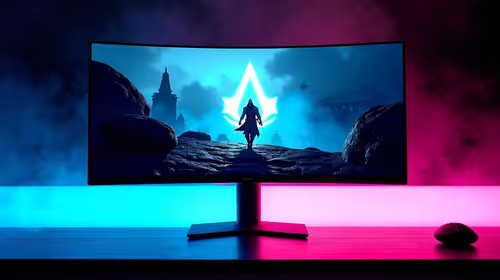
Choosing the right gaming monitor comes down to matching panel type, refresh rate, and resolution to your GPU''s output capability and the games you play. Prioritise refresh rate for competitive gaming and resolution for immersive single-player experiences, always ensuring your PC can actually drive your chosen spec.
A monitor is the window through which every gaming experience is delivered, and a mismatched display can undermine even a powerful GPU. South African gamers working within a budget need to make deliberate trade-offs - this guide walks through every key decision so you land the right screen for your setup.
Panel Type: IPS, VA, or TN?
The three dominant panel technologies each suit different gaming priorities. TN (Twisted Nematic) panels offer the fastest pixel response times and the lowest input lag at an accessible price, making them popular for competitive players where pure speed matters more than colour quality. However, their viewing angles and colour accuracy are noticeably limited.
IPS (In-Plane Switching) panels deliver excellent colour accuracy, wide viewing angles, and strong contrast - ideal for gamers who also use their monitor for content creation, streaming setup, or general productivity. Modern IPS panels have improved response times significantly and are now competitive for fast-paced gaming. VA (Vertical Alignment) panels sit between the two, offering deeper native contrast ratios - great for dark cinematic games - but can exhibit motion blur in very fast scenes due to slower grey-to-grey response.
For SA gamers, IPS has become the dominant recommendation across price brackets because it balances gaming performance with everyday usability.
Refresh Rate and Resolution: Getting the Balance Right
Refresh rate and resolution must be matched to what your GPU can realistically deliver. A 240Hz monitor is only valuable if your system pushes frame rates that high in your target games. Running a 240Hz panel at 80 frames per second provides no advantage over a 144Hz display in practice.
For competitive gaming at 1080p, target a 144Hz or 165Hz display - these are well-supported by mid-range GPUs and represent excellent value in South Africa. For immersive single-player gaming with a higher-end GPU, a 1440p 144Hz or 1440p 165Hz monitor delivers noticeably sharper visuals without demanding the extreme GPU power that 4K requires. 4K gaming monitors exist and are stunning, but demand top-tier GPU investment to drive smoothly.
Adaptive sync technology - either NVIDIA G-Sync compatible or AMD FreeSync - is strongly recommended regardless of which tier you choose. It eliminates screen tearing and smooths out frame-rate variation, making the experience feel more consistent than a fixed refresh rate alone.
Size, Ergonomics, and Connectivity
Monitor size interacts with resolution: a 27-inch display at 1080p shows noticeably lower pixel density than the same panel at 1440p. For 1080p, 24–25 inches is the sweet spot where pixel density remains sharp. For 1440p, 27 inches is the standard recommendation. Ultrawide 21:9 monitors are compelling for immersive games but require GPU headroom and compatible game support.
Check connectivity before buying: confirm the monitor has DisplayPort 1.4 or HDMI 2.1 inputs matching your GPU''s outputs, especially for high refresh rate operation at higher resolutions. USB-C with DisplayPort Alt Mode is a bonus for dual-use setups. Height-adjustable stands, pivot capability, and VESA mount compatibility add ergonomic flexibility for long gaming sessions.
Frequently Asked Questions
Q: Should I prioritise refresh rate or resolution for gaming in South Africa? A: It depends on your GPU and game genre. Competitive multiplayer players should prioritise refresh rate (144Hz+) at 1080p. Players of single-player story games with a capable GPU will appreciate 1440p resolution more than extra refresh rate headroom beyond 144Hz.
Q: Is a 4K gaming monitor worth it in South Africa right now? A: Only if you have a GPU powerful enough to drive 4K at playable frame rates in your target games. Without the GPU to match, a 4K monitor will force you to run games at lower resolutions anyway, negating the benefit.
Q: What does adaptive sync do and do I need it? A: Adaptive sync (FreeSync or G-Sync compatible) synchronises your monitor''s refresh rate to your GPU''s actual output frame rate, eliminating tearing and reducing stutter. It is strongly recommended for any gaming monitor - the technology is now widely available across all price brackets.
Ready to Find Your Perfect Match? Shop gaming monitors and PC deals at Evetech.