

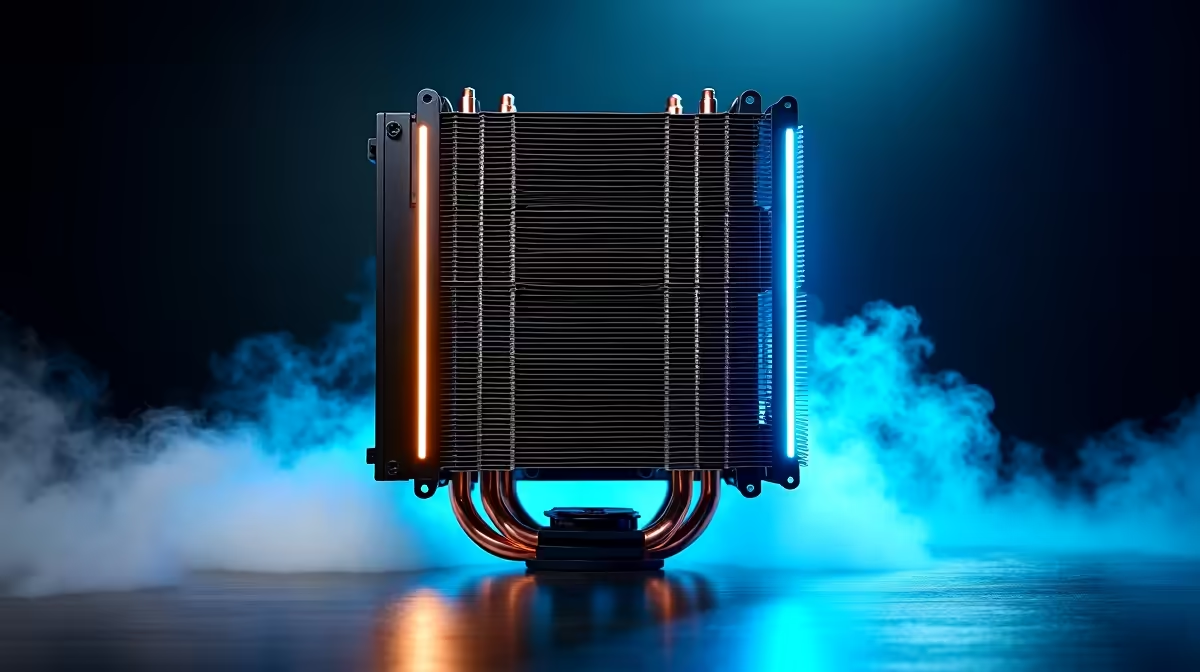
Quick Answer
Choosing the right tower air cooler comes down to matching TDP rating to your CPU, ensuring clearance in your case, and deciding between single and dual-fan tower designs based on your noise and thermal priorities. A well-chosen tower air cooler can rival low-end AIO liquid cooling at a fraction of the cost and with better long-term reliability.
TDP Rating: The First Number to Match
Every CPU has a thermal design power (TDP) rating that indicates how much heat the cooler must dissipate under sustained load. Ryzen 9 and Core i9 processors can sustain 150W or more during heavy workloads, while mid-range Ryzen 5 and Core i5 chips typically sit in the 65 to 95W range.
Tower air coolers list a TDP handling capacity in their specifications. Always choose a cooler rated at least 20 to 30W above your CPU's TDP to account for ambient temperature differences, overclocking headroom, and real-world thermal variance. A 125W TDP CPU should ideally pair with a cooler rated for 150W or higher.
Single Tower vs Dual Tower: Which Do You Need?
Single tower coolers are compact, lighter, and easier to install. They suit mid-range CPUs and cases with tighter clearance restrictions. For Ryzen 5 7600X, Core i5-14600K, or equivalent chips, a quality single tower with a 120mm or 140mm top-fan delivers excellent thermal control without the bulk.
Dual tower coolers with two heatsink stacks and a fan sandwich between them move significantly more air over a larger surface area. They suit high-performance CPUs like the Ryzen 9 9900X or Core i9-14900K where sustained workloads push temperatures consistently high. The trade-off is size: dual towers are tall and wide, can obstruct RAM slots requiring low-profile DIMMs, and add considerable weight to the motherboard.
Case Clearance: Measure Before You Buy
Tower height is one of the most overlooked specifications. Cases list a maximum CPU cooler clearance in their specifications, and exceeding it means the side panel will not close. Measure from the top of your motherboard's CPU socket to the top of your case's interior before selecting a cooler.
Most mid-tower cases accommodate coolers up to 160mm. Compact mini-tower cases often cap at 130 to 145mm. Some full-tower cases have no practical clearance concern. The cooler's listed height is measured from the base of the mounting bracket, not from the motherboard surface, so factor in the height of your CPU socket as well.
Fan Noise: RPM and Blade Design
Tower air coolers run quieter than smaller coolers because larger fans move the same volume of air at lower RPM. A 140mm fan running at 800 RPM is significantly quieter than a 92mm fan running at 1800 RPM while achieving similar airflow. For a bedroom setup or a shared space in res, choosing a cooler with large, low-RPM fans and a PWM connector keeps noise manageable during idle and light use while ramping up only when needed.
RAM Compatibility and Clearance
Tower air coolers overhang the CPU socket toward the first RAM slots in many builds. Some coolers include an offset mount or adjustable bracket to shift the cooler away from the RAM. Check the RAM clearance specification in the cooler's listed dimensions, particularly if you plan to use tall heatspreader DIMMs. Low-profile RAM modules eliminate this concern entirely.
Build Budget Context for SA
Tower air coolers in South Africa range from around R400 for entry-level 120mm options to R1,500 or more for premium dual-tower units. For the vast majority of SA gaming builds, a mid-range 140mm single tower in the R600 to R1,000 range delivers performance that comfortably handles modern gaming CPUs without the complexity or long-term maintenance considerations of AIO liquid cooling.
Frequently Asked Questions
Do tower air coolers perform as well as AIO liquid coolers?
High-end dual-tower air coolers like the Noctua NH-D15 match or exceed the thermal performance of 240mm AIO liquid coolers in most CPU workloads. Air coolers also have no pump failure risk, making them more reliable over a five-year ownership period. For extreme overclocking or compact builds, AIOs have specific advantages, but for most SA builds, a good tower air cooler is the practical choice.
Is a 140mm fan tower cooler worth it over a 120mm version?
Yes, in almost every case. A 140mm fan moves more air at lower RPM, which directly translates to lower noise at equivalent cooling performance. The price difference between comparable 120mm and 140mm models is usually small, making the larger fan a straightforward value upgrade.
Does the cooler mounting bracket work with both AMD and Intel sockets?
Most modern tower air coolers include brackets for both AMD AM5 and Intel LGA 1700/1851 sockets in the box. Confirm socket compatibility in the product specifications before buying, particularly for older AM4 systems, which may require a different bracket than AM5. Universal mounting kits mean one cooler typically covers both ecosystems.
Ready to Find Your Perfect Match? Find the right CPU cooler for your build at Evetech. Shop CPU Coolers











