


1000W PSU Planning for RTX 5090 Builds in SA
1000W for RTX 5090 needs a full-build check, not a simple yes. Review GPU guidance, CPU draw, transient load, connectors, PSU quality, and upgrade plans before deciding.
Read moreSet Up CCTV With Your Office PC. Step-by-step instructions with SA-specific tips, common pitfalls to avoid & expert recommendations.
To set up CCTV with your office PC in South Africa, install IP cameras, connect them to a PoE switch or NVR, and use software like Blue Iris, iSpy, or Agent DVR on your PC to record and monitor footage. Budget R1,500 to R3,500 per camera, plan for a dedicated SSD or HDD for storage, and pair with a UPS to survive loadshedding cuts.
Start with IP cameras rather than analogue. SA-friendly options include 4MP and 8MP PoE cameras from brands like Hikvision, Dahua, and Reolink, ranging from R1,500 to R3,500 each depending on resolution and night-vision range. You'll need a PoE switch (R1,200 for an 8-port unit) so cameras get power and data over a single Cat6 cable. Cat6 cable runs at roughly R10 per metre, plus RJ45 connectors and a crimping tool if you're terminating yourself. Your office PC will need a dedicated 2TB to 4TB hard drive (R1,200 to R2,200) for footage. Total entry-level setup for 4 cameras: roughly R12,000 to R16,000 including cabling.
Blue Iris is the gold standard at around R1,400 once-off licence (USD pricing converted). It supports up to 64 cameras, motion detection with AI filtering, mobile alerts, and runs on Windows. iSpy and Agent DVR are excellent free alternatives with paid upgrade tiers. For Hikvision or Dahua native integration, the iVMS-4200 and SmartPSS desktop clients are free but more limited. If you want to keep things simple, most modern IP cameras include a vendor app and basic recording, which works directly on the PC without third-party software. Make sure your PC has at least 16GB RAM and a current-gen Core i5 or Ryzen 5 for smooth multi-camera decoding.
First, plan your camera positions: entrances, parking, server room, and any cash-handling area. Run Cat6 cable in conduit or trunking to keep things tidy and protect against rats and weather. Connect each camera to your PoE switch, then connect the switch to your office router. Power on, and your cameras will pull DHCP IPs. Use the vendor's discovery tool (SADP for Hikvision, Config Tool for Dahua) to find them, set static IPs, and update firmware. Install your chosen software on your PC, add each camera using its IP and credentials, configure motion zones and recording schedules, and point recording storage to your dedicated drive. Finally, set up remote access via the software's mobile app or a secure VPN, never by exposing camera ports directly to the internet.
Loadshedding is your biggest enemy. Pair your PC, PoE switch, and router with a 1500VA UPS (around R2,500) which gives 30 to 60 minutes of recording during Stage 4 cuts. For longer outages, an inverter battery setup is worth considering. Keep cameras themselves on the PoE switch (which is on the UPS) so they stay powered. Backup footage off-site weekly using a NAS or cloud sync, especially for businesses where insurance or POPIA compliance matters. POPIA also requires you to display CCTV signage clearly at every entrance and have a documented data retention policy. Don't store footage longer than necessary for your stated purpose, typically 30 to 60 days.
A shared office PC works for 2 to 4 cameras with light recording, but a dedicated machine is strongly recommended for 6+ cameras or 24/7 recording. Continuous video processing wears HDDs and consumes CPU cycles, which slows down regular office work. A small mini-PC or refurbished tower (R6,000 to R9,000) makes an excellent dedicated CCTV server.
The biggest mistakes are exposing cameras directly to the internet (huge security risk), using consumer-grade WiFi instead of wired PoE, skipping the UPS for loadshedding, and not displaying POPIA-compliant signage. Also avoid cheap no-brand cameras; firmware support and image quality are usually poor.
You'll need a Cat6 crimping tool (R350), a network cable tester (R250), and basic hand tools for mounting brackets. Most installs don't require an electrician unless you're cutting into existing trunking or working at heights. A 5m fibreglass ladder and an extra pair of hands speeds the job up considerably.
Ready to Find Your Perfect Match? Ready to build your office security setup? Browse Evetech's PC and tech deals
How to Set Up CCTV With Your Office PC i available at Evetech.co.za with local warranty and fast delivery.
How to Set Up CCTV With Your Office PC i - check Evetech for latest stock and SA pricing.
Depends on your use case. How to Set Up CCTV With Your O offers good value at current Rand pricing.
1000W for RTX 5090 needs a full-build check, not a simple yes. Review GPU guidance, CPU draw, transient load, connectors, PSU quality, and upgrade plans before deciding.
Read more
RTX 5080 Super with a 750W PSU is more comfortable than lower wattage if the unit is quality. SA builders should still confirm GPU guidance, CPU draw, connector type, airflow, and upgrade room.
Read more
How to fix FPS drops after a RX 9070 XT starts with driver cleanup, chipset updates, thermals, and power checks. For SA gaming PCs, confirm PCIe seating, monitor refresh, frame caps, and per-game graphics settings before replacing parts.
Read more
How to fix low FPS Windows 11 Wi-Fi 7 issues starts by checking whether the problem is frame rate or network lag. Test ping, drivers, power settings, Ethernet, and game FPS before adjusting visuals.
Read more
AM5 is smart for SA builders because it supports newer Ryzen CPUs, DDR5 memory, and a longer upgrade path. Compare board cost, cooling, gaming needs, and local part availability before choosing your next PC platform.
Read more
AM5 gives Randburg gaming builders a longer upgrade path. For SA buyers, DDR5 support, newer board features, and future CPU options can justify the platform. Weigh board cost, cooler support, BIOS maturity, and upgrade timing before choosing.
Read more
RTX 5090 on a 550W PSU leaves almost no practical room for OC plans. Treat the setup as constrained, with CPU draw, power spikes, cable quality, thermals, and stability checks more important than chasing extra clocks.
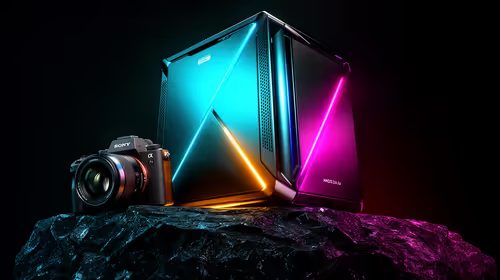
FPS drops on a Ryzen 9 9950X3D build often have a fixable cause. Check settings, drivers, thermals, background tasks, network conditions, and bottlenecks before assuming a part must be replaced.

The difference between PCIe 5.0 and PCIe 4.0 for SA gamers is mostly bandwidth headroom. Compare GPU slot needs, NVMe speed, motherboard support, and upgrade timing before paying extra for a newer platform.

Gaming PC stuck pixel checks in South Africa should confirm the monitor fault first. Use colour tests, screenshot comparison, cable swaps, display menu checks, and clear photos before deciding on support.

AMD's current driver now lists a Radeon RX 9050 4GB, while product coverage details a narrowed memory system. SA buyers should weigh the low VRAM ceiling against current local Radeon options.

Samsung Display has demonstrated a 16-inch 2.5K OLED laptop panel running at 300Hz. SA buyers should wait for a named notebook, full panel specifications and a local price before planning an upgrade.

Microsoft says some Windows 11 game crashes after recent updates are linked to RGB-related drivers. Affected SA gamers should confirm the update and driver before using the published registry workaround.
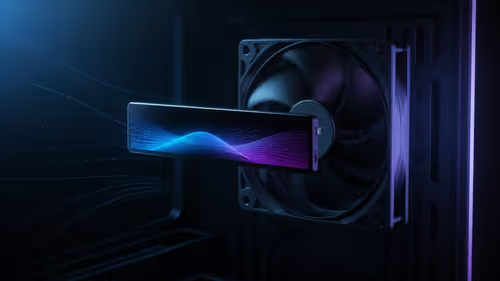
Thermalright's Fan Frame Vision-1 adds a 640x172 status screen to a standard 120mm fan. SA builders should check clearance, USB routing and local support before treating it as an easy upgrade.
1000W for RTX 5090 needs a full-build check, not a simple yes. Review GPU guidance, CPU draw, transient load, connectors, PSU quality, and upgrade plans before deciding.

Wi-Fi 6E vs Wi-Fi 6 matters for 4K video editing when files move across a network. The real-world difference between Wi-Fi 6E and Wi-Fi 6 for video editing in 4K depends on NAS access, cloud uploads, router range, and SA creator workflows.
RTX 5080 Super with a 750W PSU is more comfortable than lower wattage if the unit is quality. SA builders should still confirm GPU guidance, CPU draw, connector type, airflow, and upgrade room.
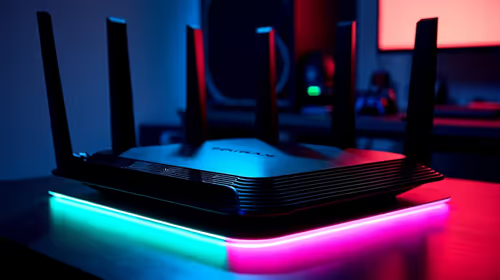
Wi-Fi 6E vs Wi-Fi 6 for Video Editing in 4K comes down to router support, latency, client devices, band support, and home network layout. SA buyers should match the choice to their setup instead of assuming one option always wins.