Quick Answer
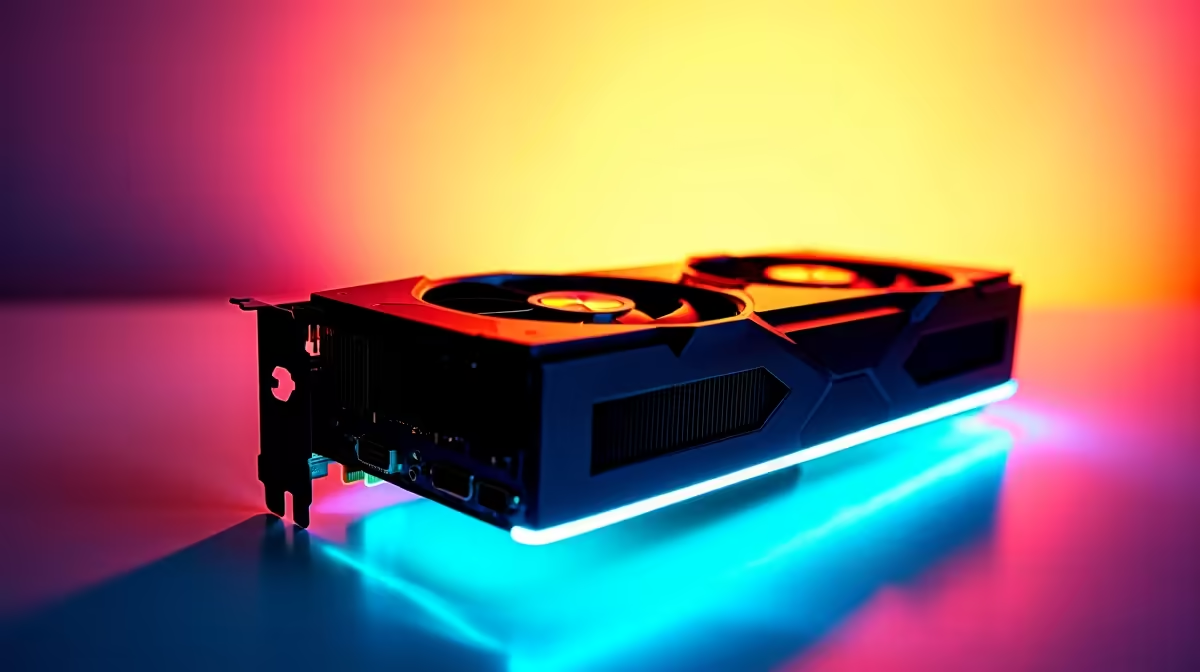
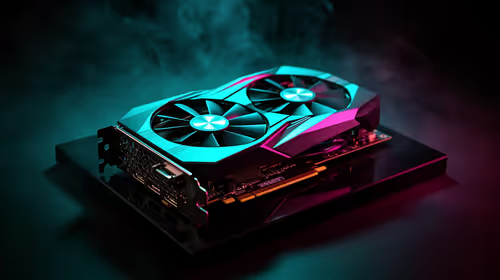
Setting up the RTX 5090 for competitive gaming requires prioritising low latency over maximum visual fidelity. Key steps include enabling NVIDIA Reflex, using DLSS Frame Generation carefully (with caution around added latency), setting power management to maximum performance, and pairing the card with a high-refresh-rate monitor. The RTX 5090's raw performance means native resolution at high framerates is achievable in most competitive titles without relying on upscaling.
Initial RTX 5090 Configuration for Competitive Play
The RTX 5090 is NVIDIA's flagship, and for competitive gaming its most important characteristic is that it can render most esports and competitive titles at extremely high framerates natively without needing DLSS upscaling as a crutch. This is important because native rendering eliminates any upscaling artefacts that could obscure distant targets in games like Valorant, CS2, or Apex Legends.
Start with these driver-level settings in NVIDIA Control Panel:
- Power Management Mode: Set to Prefer Maximum Performance. This prevents the GPU from throttling in scenes with lower visual complexity, maintaining consistent framerates.
- Low Latency Mode: Enable Ultra. This reduces pre-rendered frames and tightens the input-to-display pipeline.
- Texture Filtering Quality: Performance. Competitive gaming does not benefit from high-quality anisotropic filtering the way single-player cinematic titles do.
- Vertical Sync: Off in NVIDIA Control Panel. Use in-game VSync off as well and rely on G-Sync or your monitor's variable refresh instead.
For South African players, also check that your GPU drivers are current via GeForce Experience or the NVIDIA website. Outdated drivers on a flagship card leave performance on the table.
In-Game Settings for Competitive Titles on the RTX 5090
The RTX 5090's capability means competitive game settings should be tuned for maximum framerate and minimum input latency rather than maximum visual quality:
- Shadows: Low or very low. Shadow rendering is one of the highest-cost settings and provides no competitive advantage. Most pro players run shadows at minimum.
- Anti-Aliasing: Use game-native TAA at lowest setting or disable entirely if the game supports it without visual distortion. The RTX 5090 at native 1080p or 1440p does not need upscaling AA.
- Effects Quality: Medium or lower. Particle effects from explosions and abilities can obscure enemy positions. Reducing this is both a performance gain and a visibility advantage.
- NVIDIA Reflex: Enable with Boost in all supported titles. This is the single most impactful latency reduction setting available on RTX hardware and works in Valorant, Apex, CoD, and many other competitive titles.
- Frame Rate Cap: Cap at your monitor's refresh rate minus 3-5 FPS (e.g., 237 FPS on a 240Hz panel). Uncapped framerates above your monitor's refresh generate heat and power draw without any visible benefit.
Pairing the RTX 5090 With the Right Setup in SA
The RTX 5090's competitive gaming value is only fully realised when paired appropriately. A 60Hz or 144Hz monitor is a bottleneck that wastes this GPU's capability in competitive scenarios. For serious competitive play, a 240Hz or 360Hz monitor is the correct pairing.
For South African buyers, the RTX 5090 sits at the very top of the GPU price bracket. Ensure your supporting hardware matches it: a high-refresh monitor, a CPU that will not bottleneck in CPU-limited competitive titles (Ryzen 7 9700X or i9-14900K and newer), and at least 32GB of DDR5 RAM.
A quality UPS is essential for protecting this level of hardware investment from loadshedding damage. Sudden power loss under GPU load is one of the more hardware-damaging scenarios possible.
FAQs
Does the RTX 5090 support NVIDIA Reflex?
Yes. NVIDIA Reflex is supported across the RTX 50 series and works in all titles that have implemented it, including Valorant, Apex Legends, CS2, Fortnite, and many others.
Should I use DLSS Frame Generation on the RTX 5090 for competitive gaming?
Generally no. Frame Generation adds synthetic frames which introduce a small amount of latency. On the RTX 5090, native framerate is high enough that Frame Generation is not needed for competitive titles and the added latency is a disadvantage.
What monitor refresh rate should I pair with the RTX 5090 for competitive gaming?
A 240Hz or 360Hz monitor maximises the RTX 5090's competitive gaming value. At 1080p competitive settings, the RTX 5090 can sustain framerates well above 300 FPS in most esports titles.
Ready to Find Your Perfect Match?
View the RTX 5090 and high-end GPU options available for South African competitive gamers. Shop Graphics Cards at Evetech