Quick Answer
Strange noises from a PC usually indicate a failing fan, loose case panel, coil whine from the GPU or PSU, or a hard drive showing early failure symptoms. Identifying the sound type and location is the first step: grinding or clicking points to spinning components, while buzzing or whining often comes from electrical components under load.
Common PC Sounds and What They Mean
Different noises point to different hardware problems. Here is how to identify the most common ones:
Grinding or scraping: Almost always a fan with a failing bearing or a cable making contact with a fan blade. Check CPU cooler, case fans, GPU fan, and PSU fan one by one by temporarily stopping each fan blade with a pencil eraser while the PC is running (never touch a spinning blade with your finger). The grinding that stops when you hold a specific fan is your culprit.
Clicking: A regular clicking pattern, especially at startup or during file access, strongly suggests a failing hard drive. This is the classic sign of a mechanical HDD's read/write head struggling. Back up your data immediately if you hear hard drive clicking, and run a SMART health check using CrystalDiskInfo to confirm drive status.
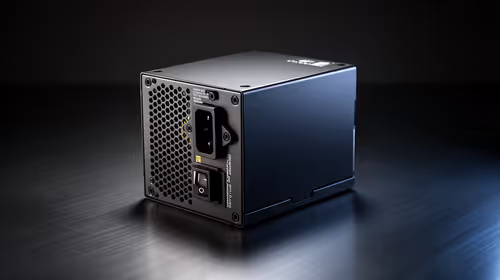
High-pitched buzzing or whining under load: This is coil whine, caused by electrical inductors vibrating at audible frequencies when power draw increases rapidly. It commonly comes from the GPU during intense gaming or from the PSU under heavy load. Coil whine is generally harmless but annoying. It often appears when frame rates are uncapped in menus or desktop, as the GPU draws power in rapid, irregular bursts.
Rattling: Loose case panels, unsecured drive trays, or cable ties vibrating against the case. Press gently on different panels while the PC is running to identify which surface is resonating. A small piece of foam tape between the panel and case frame usually eliminates the rattle permanently.
How Loadshedding Affects Hardware Noise
For South African PC owners, loadshedding creates specific noise-related stress on hardware. When power returns after a Stage 4 or Stage 6 cut, the sudden voltage surge before a UPS stabilizes can cause fans to spin up to maximum RPM momentarily. Repeated surge exposure over months can degrade fan bearings faster than normal, leading to earlier-than-expected grinding noises.
If you do not have a UPS with automatic voltage regulation (AVR), the power cycling from loadshedding is genuinely hard on mechanical components. PSU fan bearings and case fans are the most common early casualties. Replacing an affected fan costs between R150 and R600 locally depending on size and brand, which is far cheaper than ignoring the problem until a failing fan destroys a CPU cooler or allows thermal throttling damage.
When to Replace vs When to Repair
Most noise issues are resolved by replacing a single component. Fan replacements are inexpensive and straightforward. A failing HDD showing SMART errors should be replaced without delay and the data restored to a new drive. Coil whine from a GPU is usually not a warranty defect in South Africa's consumer landscape, but severe coil whine from a PSU can sometimes indicate a component failing inside the power supply, which is worth flagging to the supplier.
For a system under loadshedding stress without surge protection, investing in a quality UPS with AVR is the single most effective way to reduce noise-causing wear on all spinning and electrical components simultaneously.
FAQs
How do I tell if the noise is coming from the GPU or PSU?
Remove the GPU from the system temporarily and run integrated graphics if your CPU has them. If the whining or buzzing disappears, the GPU was the source. If it persists, check the PSU by swapping to a known-good replacement if one is available.
Is coil whine a reason to return or RMA my GPU?
In most South African retail contexts, coil whine alone is not considered a functional defect and is generally not grounds for a return unless the supplier's policy explicitly covers it. Check your warranty terms with the retailer before initiating a return request.
Can I silence a noisy fan without replacing it?
Temporarily, yes. A drop of sewing machine oil on the fan bearing can quiet a squeaking fan for several weeks. However, a fan with worn bearings will fail eventually and the oil treatment is a temporary measure only. Budget for a replacement.
Ready to Find Your Perfect Match?
Build or upgrade a reliable gaming rig with components backed by local warranty and fast delivery. Shop Gaming PC Deals