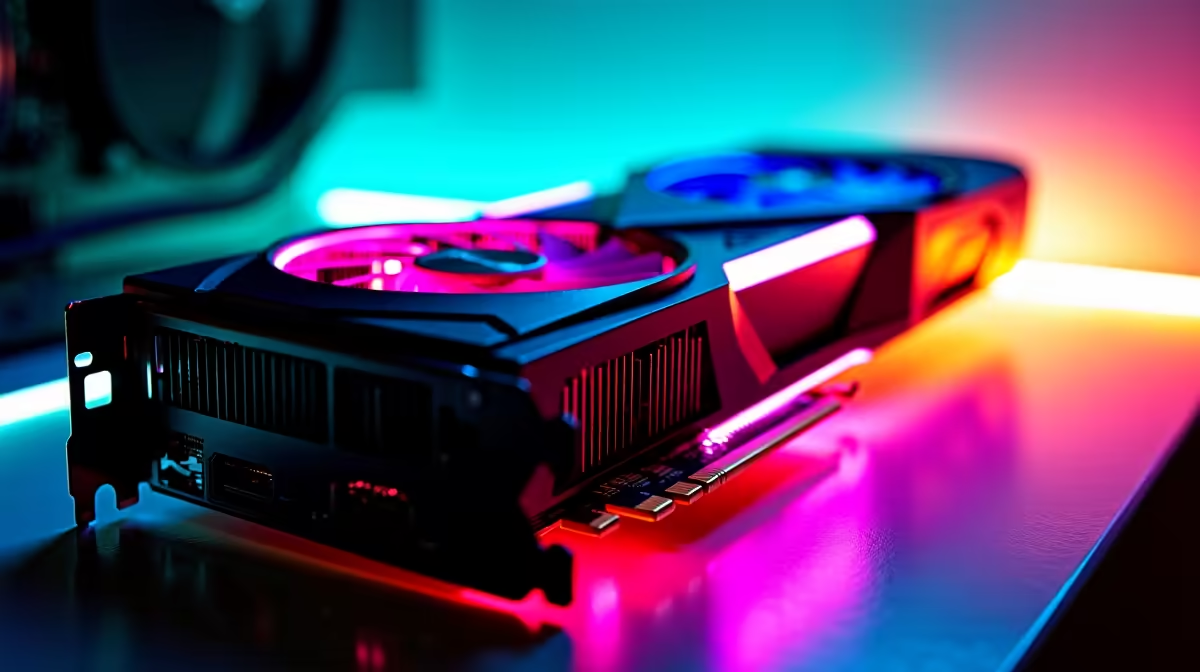
The RTX 5070 Ti sits at one of the most competitive price-to-performance points in NVIDIA's Blackwell lineup, but raw benchmark numbers only tell part of the story. For South African PC builders who spend long sessions gaming or rendering, how hot the card runs and how loud it gets under sustained load matters as much as frame rates.
Quick Answer
The RTX 5070 Ti typically reaches GPU temperatures of 72–80°C under sustained full load with stock cooling, which is within NVIDIA's safe operating range. Fan noise under load sits at approximately 35–42 dBA depending on the AIB partner cooling solution - audible in a quiet room but not intrusive. Cards with triple-fan coolers from major AIB partners run noticeably cooler and quieter than reference designs.
🌡️ Temperature Performance: What the Numbers Mean
Under sustained gaming load at 1440p or 4K, most RTX 5070 Ti models settle between 72°C and 80°C. NVIDIA's thermal throttle threshold sits at 90°C, so there's meaningful headroom even in warmer South African environments. Reference-style blower designs push temperatures slightly higher - typically 78–83°C - because they exhaust all heat out the back of the case rather than into the chassis. This makes them better for airflow-challenged cases but inherently louder under load. Triple-fan AIB designs from the major manufacturers run 4–8°C cooler on average, which translates directly into lower fan speeds and quieter operation. Case airflow matters significantly too - a well-ventilated PC case can drop GPU temperatures by 5–10°C compared to a poorly ventilated enclosure.
🔊 Fan Noise: Real-World Listening Experience
At idle and light loads, the RTX 5070 Ti's fans on most AIB models stop entirely (zero RPM mode), making them inaudible. Under moderate gaming load, fans spin up to around 1,200–1,500 RPM, producing roughly 30–35 dBA - comparable to a quiet office environment. At sustained maximum load (heavy rendering, stress testing), fan speeds reach 1,800–2,200 RPM on most models, which measures around 38–42 dBA at one metre. Whether that's acceptable depends on your setup: with headphones or a headset, you'll barely notice it; in a silent room with open-back headphones, it's perceptible. Pairing the 5070 Ti with a case that has sound-dampening panels and good CPU cooling creates an overall system noise profile that most users find perfectly liveable.
🛠️ Optimising Thermals for SA Conditions
South African ambient temperatures can be higher than the 21°C lab conditions used in international reviews, which affects real-world GPU thermals. In summer months, ambient temperatures of 25–30°C indoors are not uncommon, adding directly to your GPU's operating temperature. Practical optimisations include: ensuring at least two case intake fans and one exhaust fan for positive/neutral airflow pressure, mounting an aftermarket cooler on high-end AIB cards if temperatures breach 80°C consistently, and ensuring the GPU isn't starved of fresh air by cable clutter or drive bays blocking airflow paths. Undervolting the RTX 5070 Ti via NVIDIA's performance overlay can also reduce temperatures by 6–10°C with minimal impact on frame rates.
❓ FAQ
Q: Is 80°C too hot for the RTX 5070 Ti? A: No. NVIDIA's thermal throttle threshold is 90°C, and 80°C is a normal operating temperature for a high-performance GPU under sustained load. Long-term reliability is not compromised at this temperature.
Q: Which AIB partner makes the coolest RTX 5070 Ti? A: Triple-fan designs with large heatsink arrays consistently outperform dual-fan models. Cards with 3.5-slot coolers tend to run 5–8°C cooler than dual-slot equivalents under the same load conditions.
Q: Does the RTX 5070 Ti need a lot of case airflow? A: Yes. The 5070 Ti is a high TDP card, and adequate case airflow makes a meaningful difference. Aim for at least two front intake fans and one rear exhaust fan as a minimum configuration.
Evetech stocks RTX 5070 Ti Gaming PCs and RTX 5070 Gaming PCs — browse current SA pricing and availability online.
Ready to Find Your Perfect Match? Build a thermally efficient gaming PC around the RTX 5070 Ti with components matched for South African conditions.