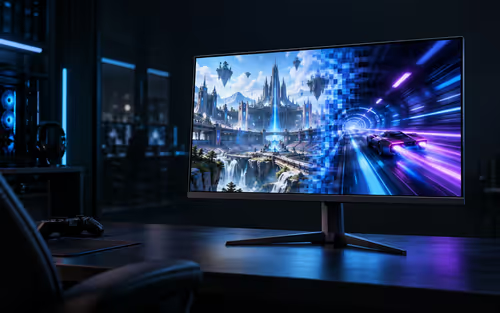
So, you’re chasing that 1440p gaming sweet spot. It’s the perfect resolution for crisp visuals without needing a supercomputer that dims the neighbourhood lights. But here's the kicker: buying a new graphics card in South Africa feels like a massive commitment. You want a beast that will crush today's AAA titles and won't start wheezing when next year's blockbusters drop. This guide will help you choose a truly future-proof GPU for 1440p gaming.
What "Future-Proof" Really Means for a GPU
Let's be clear: no component lasts forever. "Future-proofing" isn't about buying a card that will run games in 2035. It’s about investing smartly today to ensure you get excellent performance, high frame rates, and stunning visual quality for the next three to five years without feeling forced to upgrade.
A genuinely long-lasting card balances three key pillars:
- Sufficient VRAM: To handle increasingly complex game textures.
- Modern Feature Support: Like AI upscaling and efficient ray tracing.
- Raw Horsepower: The fundamental ability to push pixels, fast.
Key Factors for Your Future-Proof 1440p GPU
Navigating the sea of specs can be tricky, but focusing on a few critical areas will make your decision much easier. Choosing the right future-proof GPU for 1440p gaming comes down to understanding how these elements work together.
VRAM: Your Card's Short-Term Memory
Video RAM, or VRAM, is where your GPU stores the game's assets, like textures and models, for quick access. In 2024, 8GB is the absolute minimum for 1440p, but it's already showing its limits in titles like Alan Wake 2 and Hogwarts Legacy.
To be truly future-proof, you should be looking at cards with 12GB or preferably 16GB of VRAM. This extra memory gives your GPU the breathing room it needs to handle high-resolution texture packs and complex scenes without stuttering, ensuring a smoother experience for years to come.
Upscaling Tech is Your Secret Weapon 🚀
This is perhaps the single most important factor for future-proofing. AI upscaling technologies like NVIDIA's DLSS and AMD's FSR render your game at a lower internal resolution and then intelligently scale it up to 1440p. The result? A massive frame rate boost with minimal loss in visual quality.
A card with strong upscaling support will stay relevant for much longer. It's the reason why a modern card can outperform older, theoretically powerful hardware. Both major players offer fantastic solutions, so it's worth exploring the latest AMD Radeon graphics cards and their NVIDIA counterparts to see which ecosystem suits you best. Even new contenders are making waves with their own tech, which you can see in the latest Intel Arc graphics cards.
Don't Forget Your Power Supply! ⚡
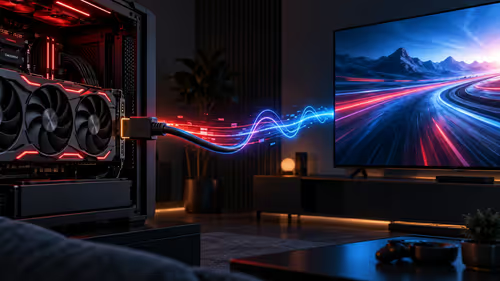
Before you buy that shiny new GPU, pop open your case and check your Power Supply Unit (PSU). A powerful new graphics card needs enough wattage and the correct PCIe power connectors (e.g., 8-pin or the newer 12VHPWR). A PSU upgrade is much cheaper than dealing with system instability or a card that won't even turn on!
Raw Performance and Architecture
While VRAM and features are crucial, the core performance of the GPU still matters immensely. A newer architecture often brings significant improvements in efficiency (performance-per-watt) and support for the latest technologies like advanced ray tracing.
Looking back, the once-mighty NVIDIA GeForce GTX graphics cards were fantastic for their time, but they lack the dedicated hardware for ray tracing and AI that defines modern gaming. When you're browsing the full range of NVIDIA and ATI graphics cards, pay attention to the generation—a newer mid-range card often provides a better long-term value than an older high-end one.
A Common Pitfall: Gaming vs. Workstation Cards
You might see some professional cards with huge amounts of VRAM and assume they'd be amazing for gaming. It's a logical thought, but it's a trap! Cards like NVIDIA's Quadro or AMD's Radeon Pro are powerful, but they are not the right tool for this job.
These workstation graphics cards have drivers that are highly optimised for professional applications like CAD, 3D rendering, and scientific modelling... not Call of Duty. You'll pay a premium for features you'll never use and get disappointing gaming performance in return. Stick to consumer gaming cards. ✨
Making the Final Call
Choosing the best future-proof GPU for 1440p gaming is a personal journey based on your budget and the games you love.
To summarise, here’s your checklist:
- VRAM: Aim for 12GB as a solid baseline, 16GB for ultimate peace of mind.
- Features: Ensure it has robust support for DLSS, FSR, or XeSS.
- Performance: Check independent reviews and benchmarks for the 1440p performance in games you actually play.
By balancing these factors, you won’t just be buying a graphics card; you’ll be investing in years of high-quality PC gaming.
Ready to Secure Your 1440p Future? Finding the perfect balance of power, features, and price is the key to long-term gaming happiness. Explore our massive range of graphics cards and find the perfect engine for your rig.