You’ve heard the hype about 5G in South Africa. Blazing-fast downloads, lag-free streaming… but that’s just the start. The real revolution is quieter, happening in labs and workshops across the country. It’s the powerful combination of 5G and Artificial Intelligence. This high-speed duo isn’t just a tech buzzword; it’s the engine building a smarter, faster, and more connected Mzansi. Let's dive into how 5G AI South Africa is already changing our world.
The High-Speed Handshake: Why 5G and AI are a Perfect Match
Think of 5G as a brand-new, 16-lane highway with no speed limit, while AI is a fleet of supercomputers on wheels. For AI to work its magic, it needs a constant, massive flow of data. Older networks like 4G were like a busy two-lane road… reliable, but prone to traffic jams (high latency) and not wide enough (low bandwidth) for the huge datasets AI models require.
5G solves this. Its ultra-low latency means there’s virtually no delay between sending and receiving information. This allows AI systems to make decisions in real-time, which is crucial for everything from self-driving cars to remote surgery. The massive bandwidth means billions of devices can be connected simultaneously, feeding AI with the data it needs to learn and improve. This synergy is the core of the 5G AI South Africa evolution.
How 5G AI is Already Reshaping South Africa
This isn't just futuristic theory; practical applications are already taking shape locally. The combination of 5G and AI in South Africa is creating tangible benefits across key sectors.
Smarter Farming in the Karoo
Imagine drones flying over vast farmlands, equipped with AI-powered cameras. They analyse crop health, soil moisture, and pest infestations in real-time. Thanks to 5G, this high-definition video and sensor data is instantly sent to a central AI system that tells farmers exactly where to water or apply pesticide. This optimises resources and boosts food security.
Next-Generation Healthcare
In a country with vast distances between cities and rural areas, 5G-powered AI can be a lifesaver. A paramedic in a remote clinic could use an AR headset to get real-time guidance from a specialist in Johannesburg, with AI helping to analyse patient data instantly. High-resolution medical scans can be sent for AI-assisted diagnosis in seconds, not hours.
Gaming and Creative Industries ✨
For gamers, 5G means cloud gaming services can finally deliver a console-quality experience with near-zero input lag. But it goes deeper. Local game developers can use AI to create incredibly realistic and responsive worlds, with smart NPCs that learn from player behaviour. This level of AI development demands serious computational power.
The Hardware Powering South Africa's AI Revolution
While 5G provides the network, the heavy lifting of AI—training models, running simulations, and processing data—happens on powerful local hardware. The brain of any AI operation is a high-performance computer, and the GPU is its most critical component.
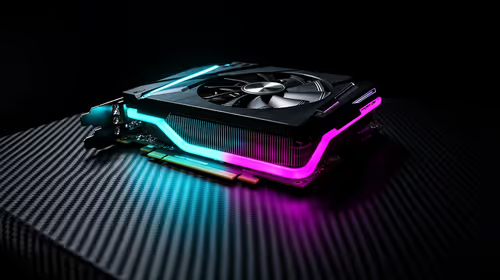
For years, developers have relied on the parallel processing capabilities of graphics cards to accelerate machine learning tasks. Many of the most powerful NVIDIA GeForce gaming PCs are not just for playing the latest titles; they are formidable tools for aspiring AI engineers and data scientists. Their CUDA cores are industry-standard for a wide range of AI frameworks.
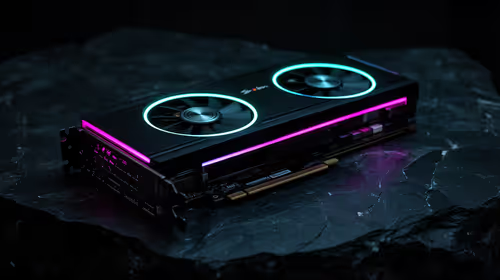
Of course, the market is competitive, and that's great for innovation. The latest generation of cutting-edge AMD Radeon gaming PCs also offers incredible multi-core performance, making them excellent platforms for running complex algorithms and creative AI workloads, from image generation to video analysis.
For businesses and researchers tackling large-scale AI projects, even a top-tier gaming rig might not be enough. Training massive language models or running complex industrial simulations requires sustained, 24/7 performance and certified components. This is where professional-grade Workstation PCs become essential, providing the rock-solid stability and immense power needed for serious AI development in South Africa.
The Future of 5G and AI in Mzansi 🚀
So, what’s next? The rollout of 5G is accelerating, and with it, the potential for AI innovation is exploding. We're on the cusp of seeing truly smart cities with AI-managed traffic flow, autonomous delivery drones becoming commonplace, and hyper-personalised educational tools for students.
The barrier to entry for contributing to this future is lower than ever. With the right hardware and a passion for technology, anyone can start experimenting and building the next big thing.
Your Gaming Rig, Your AI Lab 🔧
Your powerful gaming PC is an excellent starting point for AI development. With a modern NVIDIA or AMD GPU, you can start learning frameworks like TensorFlow or PyTorch. Use tools like Jupyter Notebooks to run experiments and even train small models right from your desk. It's the perfect way to get hands-on experience in the 5G AI South Africa scene without needing a massive server.
The journey of 5G AI in South Africa is just beginning. It’s a thrilling time for tech enthusiasts, developers, and businesses alike, promising a more efficient, connected, and intelligent future for all of us.
Ready to Build the Future?
The fusion of 5G and AI in South Africa is creating incredible opportunities. To be a part of it, you need the right tools. From entry-level development to heavy-duty machine learning, having the right hardware is the first step. Explore our range of custom-built PCs and find the perfect machine to bring your ideas to life.