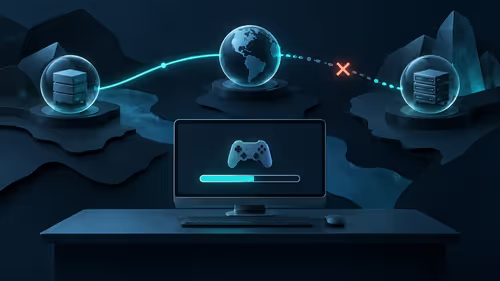
Keen to dive into the world of AI but worried that South Africa’s internet will let you down? Between an unexpected outage, high data costs, and dodgy signal in some areas, relying on a constant cloud connection feels risky. What if you could harness the power of AI right on your own machine, no fibre line needed? Exploring AI with limited internet isn't just a backup plan… it's a powerful, private, and surprisingly practical solution for today's data hurdles.
Why Local AI is a Big Deal for South Africans
Running AI models on your own PC, often called "local AI" or "edge computing," flips the script. Instead of sending your data to a massive server overseas, all the processing happens on your hardware. This approach to AI with limited internet offers some massive advantages.
First, privacy. Your prompts, documents, and creative ideas stay on your machine. No third-party servers, no data mining. Second, speed. There's zero latency because you're not waiting for a response from the cloud. The only limit is your PC's horsepower. Finally, it's reliable. When the internet goes down (and we know it does), your AI tools keep working perfectly. It’s a true offline solution.
The Hardware You Need for AI Without Constant Internet
The magic of running AI with limited internet depends on having the right gear. Your PC becomes your personal data centre, so the components inside matter… a lot. Think of it as an investment that pays off in performance and independence.
The CPU: Your AI's Command Centre
While the GPU does most of the heavy lifting for AI, a powerful CPU is crucial for managing the whole process, preparing data, and running smaller models. A processor with plenty of cores and threads ensures your system remains responsive and efficient. For tasks like these, both modern powerful Intel PCs and the latest AMD Ryzen systems offer incredible multi-threaded performance, making them excellent choices for a local AI setup.
The GPU: The Real Star of the Show 🚀
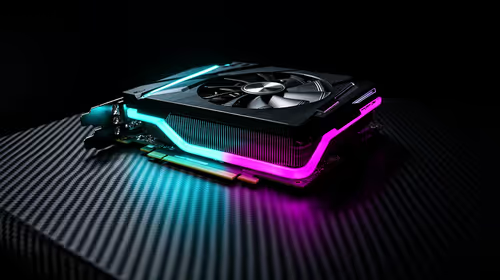
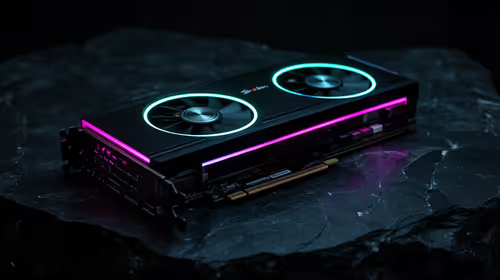
This is where the real power lies. For running large language models (LLMs) or generating images with tools like Stable Diffusion, the graphics card is everything. The most important spec? VRAM (video memory). The more VRAM you have, the larger and more complex the AI models you can run.
Top-tier NVIDIA GeForce gaming PCs have long been the go-to choice due to their CUDA cores and massive VRAM options. However, the competition is heating up, with AMD Radeon gaming PCs offering fantastic performance-per-rand, and even the new Intel Arc gaming PCs making a strong case for entry-level AI experimentation.
RAM & Storage: The Unsung Heroes
Don't neglect your system memory and storage. You'll want at least 16GB of RAM, but 32GB or more is ideal for a smooth experience. AI models are also massive files, so a fast NVMe SSD is non-negotiable for quick loading times. You can find well-balanced systems with these specs among our best gaming PC deals, ensuring you have a solid foundation.
Practical Solutions for Your Data Hurdles
Getting started with local AI is easier than ever. You don't need a computer science degree… just the right tools and a willingness to experiment. Applications like LM Studio and Ollama provide simple, user-friendly interfaces for downloading and running various open-source LLMs directly on your machine.
VRAM Saver Tip ⚡
Many local AI models come in different sizes, often using 'quantization'. A 'Q4' or '4-bit' quantized model uses significantly less VRAM than a full '16-bit' version, with only a minor drop in quality. This lets you run powerful AI on more modest hardware, a perfect strategy for anyone starting with AI on a budget.
This means that even if you're not ready for a top-of-the-line rig, you can still get your feet wet. Many of today's budget-friendly gaming PCs have enough power to run smaller, quantized models effectively.
Getting Started on Your Local AI Journey ✨
The path to mastering AI with limited internet starts with a single step: choosing the right hardware. You don't have to build it from scratch. Our range of pre-built PC deals offers a hassle-free way to get a balanced, optimised system delivered to your door.
For those serious about creative or professional AI work—like coding assistants, data analysis, or high-resolution image generation—investing in a more robust machine is wise. These tasks demand sustained performance, and our high-performance workstation PCs are specifically designed to handle these demanding workloads without breaking a sweat. The power is in your hands, not at the mercy of your internet connection.
Ready to Build Your Personal AI Powerhouse?
Stop letting a spotty connection limit your potential. By running AI locally, you gain speed, privacy, and control. Explore our powerful range of workstation PCs and find the perfect machine to conquer your data hurdles.