Thinking about building a monster AI rig in South Africa? Awesome. But before you dream of generating mind-blowing art or training complex models, let's talk about the elephant in the room: Eskom. The sheer electricity cost can turn your dream machine into a financial nightmare. Understanding AI workstation power consumption isn't just a technical detail anymore; it's a crucial part of your budget, especially with our unpredictable grid and rising tariffs. Let's dive in. ⚡
Why AI Workstation Power Consumption is a Big Deal in SA
It’s easy to focus on the upfront cost of a GPU or CPU, but the running cost is a long-term commitment. A high-performance AI workstation, especially one running intensive tasks for hours, can easily draw more power than all your other household appliances combined.
When your machine is pulling 600-800 watts (or more) for an 8-hour workday, the numbers on your electricity bill start climbing fast. This sustained demand also puts a strain on your hardware and home wiring. Add an unexpected outage into the mix, and you realise that a powerful UPS (Uninterruptible Power Supply) isn't a luxury... it's a necessity to protect your expensive components from sudden outages.
The bottom line? The total cost of ownership for a powerful rig in South Africa goes way beyond the price tags you see online.
The Power-Hungry Duo: Your GPU and CPU
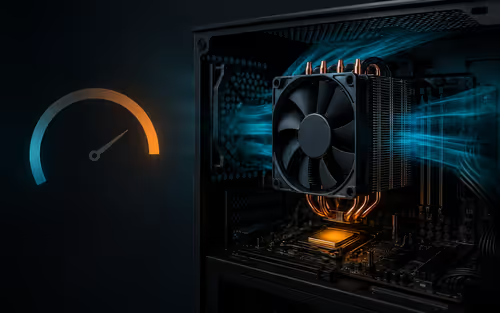
The heart of any AI machine is its graphics card (GPU) and processor (CPU), and they are by far the thirstiest components. The power draw from these two parts dictates the size of your power supply, the cooling you'll need, and ultimately, your monthly electricity spend.
The Unstoppable GPU
Modern GPUs are the undisputed kings of AI processing, but they demand a royal tribute in watts. For instance, a top-tier GPU found in many NVIDIA GeForce gaming PCs can have a Total Graphics Power (TGP) of 350W to 450W under full load. When you're training a machine learning model, that GPU is running at or near its peak for extended periods.
The Hard-Working CPU
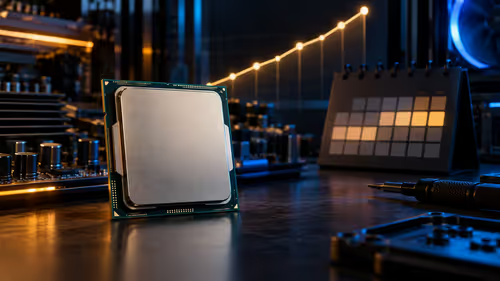
While the GPU does the heavy lifting for parallel tasks, the CPU manages the entire system. High-core-count processors from Intel and AMD, essential for multitasking and data preparation, can also be surprisingly demanding. It's not uncommon for a flagship CPU to pull over 200W at full tilt. When building a system around powerful components like those in modern AMD Radeon gaming PCs, balancing CPU and GPU power is key to a stable, efficient machine.
Monitor Your Wattage 💡
Use free software like HWiNFO64 to monitor the real-time power draw of your individual components. This gives you a clear picture of your PC's actual power consumption during different tasks, like gaming versus training an AI model. You'll be surprised how much it can vary!
Smart Ways to Optimise Your AI Rig's Power Draw
Thankfully, high performance doesn't have to mean an outrageous electricity bill. By making smart choices, you can significantly lower your AI workstation power consumption without sacrificing too much muscle.
1. Choose Components Wisely
The most powerful component isn't always the most efficient. Look at performance-per-watt metrics when comparing GPUs. Sometimes, a slightly less powerful card offers 90% of the performance for only 60% of the power draw—a huge saving in the long run.
2. Don't Skimp on the Power Supply (PSU)
Your PSU's efficiency rating is critical. An "80 Plus Gold" or "Platinum" rated PSU converts more power from the wall into usable power for your PC, wasting less as heat. A cheap, inefficient PSU will cost you more in wasted electricity over its lifetime. It's a classic case of "pay now or pay much more later."
3. Tweak Your Settings 🔧
For the more technically inclined, undervolting your GPU and CPU can lead to massive efficiency gains. This process involves supplying the component with slightly less voltage, which reduces power consumption and heat output, often with a minimal impact on performance. It’s a fantastic way to fine-tune your machine for the South African climate and grid.
The Evetech Advantage: Balanced and Built for SA
Trying to balance all these power considerations can be daunting. Mismatched components can lead to an inefficient system that wastes power and generates excess heat. This is where getting a professionally configured machine makes all the difference.
Our experts ensure that every component, from the motherboard to the PSU, is perfectly matched to create a balanced and optimised system. We build workstation PCs designed to deliver maximum performance without unnecessary waste, giving you a powerful, reliable tool that's ready for South Africa's unique challenges. 🚀
Ready for a Smarter, More Powerful Rig? Taming your electricity bill doesn't mean compromising on AI power. It's about building smart. Explore our range of expertly configured AI Workstations and let us build you a machine that's both powerful and efficient.