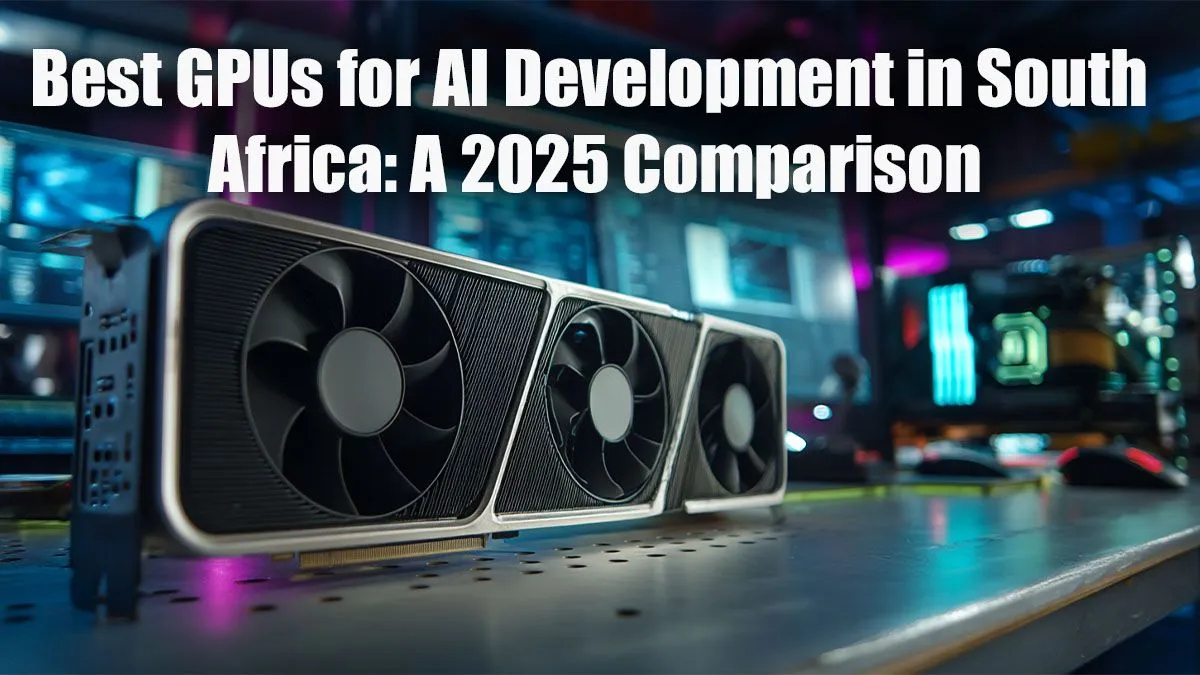
So, you're diving into the world of artificial intelligence from right here in South Africa? Lekker! But you've hit a wall: your PC grinds to a halt when training models. That's because AI development isn't about CPU speed... it's about raw graphical power. Choosing the best GPU for AI development is the single most important decision you'll make, turning your machine from a simple computer into a powerful deep-learning beast. 🚀
Why Your GPU is the Heart of Your AI Rig
Unlike a CPU, which handles tasks one by one, a Graphics Processing Unit (GPU) is a master of parallel processing. It can juggle thousands of simple calculations simultaneously, which is exactly what training a neural network requires. This is the core reason finding the right GPU for AI development in South Africa is so crucial.
Here’s what truly matters:
- VRAM (Video RAM): This is your number one priority. VRAM is the dedicated memory on your graphics card where your AI models and datasets live while being processed. If you run out, your training process will fail or slow down dramatically. More VRAM = bigger, more complex models.
- CUDA & Tensor Cores (NVIDIA): NVIDIA's CUDA platform is the industry standard for AI. Their RTX cards also feature Tensor Cores, which are specialised hardware designed to accelerate the specific math used in deep learning, offering a massive performance boost.
- Memory Bandwidth: Think of this as the highway between your GPU's processor and its VRAM. Higher bandwidth allows data to move faster, speeding up training times significantly.
Choosing the Best GPU for AI Development in South Africa
The "best" GPU depends entirely on your budget and project scale. Let's break down the top contenders for 2025, from entry-level heroes to professional powerhouses.
The Unbeatable Champions: NVIDIA's High-End RTX Series
For those who need maximum performance without compromise, NVIDIA's top-tier cards are the undisputed kings. Cards like the GeForce RTX 4090 and RTX 4080 SUPER offer a massive VRAM pool (up to 24GB) and the most advanced Tensor Cores available. They can handle large language models (LLMs), complex computer vision tasks, and extensive datasets with ease. These are often the heart of high-performance NVIDIA GeForce gaming PCs, which double as incredible AI development machines. ✨
The Smart Value Play: Mid-Range Powerhouses
You don't need to spend a fortune to get started. An NVIDIA GeForce RTX 4060 Ti 16GB or RTX 4070 SUPER provides an excellent balance of price and performance. With a solid amount of VRAM and current-generation architecture, these cards are perfect for students, researchers, and developers in South Africa learning the ropes or working on moderately sized projects. They deliver serious AI muscle without requiring a top-tier budget.
Pro Tip: Manage Your Environment 🔧
AI development involves a lot of libraries and dependencies. Use a tool like Anaconda (Conda) or Docker to create isolated environments for each project. This prevents software conflicts and makes it easy to manage specific versions of frameworks like TensorFlow or PyTorch, ensuring your powerful new GPU is always running optimally.
What About Team Red? AMD GPUs for AI
AMD has made significant strides, and their GPUs, like the Radeon RX 7900 XTX, offer an incredible amount of VRAM for the price. While their hardware is potent, the software ecosystem (ROCm) is still maturing and isn't as universally supported as NVIDIA's CUDA. For tinkerers and those who love an open-source challenge, custom-built AMD Radeon gaming PCs can offer fantastic value, but be prepared for a bit more setup.
Beyond Gaming: Professional Workstation GPUs
When stability, certified drivers, and massive VRAM are non-negotiable, it's time to look beyond gaming cards. Professional GPUs from NVIDIA's RTX Ada Generation line are built for 24/7 reliability and can be configured with up to 48GB of VRAM per card. For serious commercial AI work, data science, or research institutions, investing in one of these is a wise long-term decision. They form the backbone of the most powerful and reliable dedicated AI-ready workstation PCs available locally.
Ultimately, the best GPU for your AI journey in South Africa is the one with the most VRAM you can comfortably afford, preferably from NVIDIA for the smoothest software experience. This investment is the key to unlocking your potential in the exciting field of artificial intelligence.
Ready to Build Your AI Future? Choosing the right hardware is the first step to success. Whether you're a student, a researcher, or a professional developer, the right GPU makes all the difference. Explore our range of powerful workstation PCs and find the perfect machine to bring your AI projects to life.