So, you’re diving into the incredible world of AI art with Stable Diffusion? It’s a wild ride, but your creative flow can be instantly throttled by one key component… your graphics card. Picking the wrong one in South Africa means slow renders and frustrating "out of memory" errors. Forget the jargon. We’re breaking down real-world performance to help you find the best GPU for Stable Diffusion in SA, whether you're a curious hobbyist or a pro. 🤖
Why VRAM is Your Most Important Stat
Before we talk about specific models, let's get one thing straight: for Stable Diffusion, VRAM (Video RAM) is king. Think of it as your digital canvas. The more VRAM your GPU has, the larger and more complex the images you can create without your system grinding to a halt.
While raw processing power (measured in FLOPS) determines how fast you generate an image, VRAM determines if you can generate it at all.
- 8GB VRAM: The absolute minimum. You'll be able to generate standard 512x512 images, but will struggle with higher resolutions or complex models.
- 12GB VRAM: The sweet spot for enthusiasts. This opens the door to higher-resolution outputs (like 1024x1024) and more advanced techniques.
- 16GB+ VRAM: Pro territory. This allows for training your own models, using multiple extensions simultaneously, and generating very high-resolution art with ease.
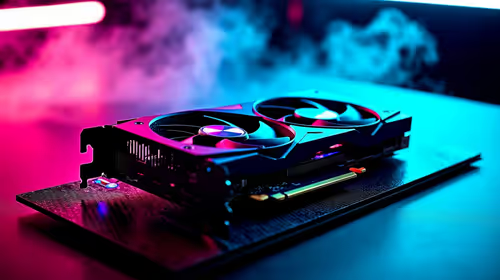
Getting this right is the first step in building a capable AI machine, so it's always worth browsing the latest graphics cards to see what fits your budget.
NVIDIA vs. AMD: The CUDA Software Battle
This might be the most critical decision you make. While both companies make powerful hardware, the AI software ecosystem is heavily biased. Stable Diffusion and most other popular AI tools are built using NVIDIA's CUDA platform.
What does this mean for you?
With an NVIDIA GeForce card, you get a near plug-and-play experience. Installation is straightforward, performance is optimised, and community support is massive.
While it's possible to run Stable Diffusion on latest AMD Radeon cards using alternatives like ROCm, the process is often more technical, less stable, and can yield slower performance. For a hassle-free creative workflow, NVIDIA is currently the undisputed champion.
Real-World GPU Benchmarks for South Africans
Let's get to the hardware. Finding the best GPU for Stable Diffusion in SA comes down to balancing price, performance, and that all-important VRAM.
The Budget Champion: RTX 3060 12GB
Don't let its "60" series number fool you. The NVIDIA GeForce RTX 3060 with 12GB of VRAM is arguably the best entry-point for AI art. It has more VRAM than the more expensive RTX 3060 Ti (8GB) and even the newer RTX 4060 Ti (8GB). That extra VRAM makes a huge difference, allowing you to work on more ambitious projects without errors. It’s a true workhorse for the price.
The Prosumer Powerhouse: RTX 4070 Super 12GB
Stepping up a level, the RTX 4070 Super offers a fantastic blend of modern architecture, 12GB of VRAM, and a significant speed boost over the 30-series. You'll generate images much faster, and it doubles as an exceptional gaming card. If you're serious about AI and want a card that will last for years, this is a top contender.
The Ultimate AI Beast: RTX 4090 24GB 🚀
When budget isn't a concern and you just want the best… the RTX 4090 is in a league of its own. With a colossal 24GB of VRAM and unmatched processing power, it chews through any task you throw at it. Generating huge batches of images, training custom models, or working with AI video... the RTX 4090 handles it all without breaking a sweat. It is the definitive choice for professionals.
VRAM-Saving Tip ⚡
Running low on memory? If you're using the popular AUTOMATIC1111 web interface, you can add command-line arguments to your startup file. Use --medvram or --lowvram to reduce VRAM usage at a slight cost to speed. For NVIDIA 30 and 40-series cards, adding --xformers can provide a significant speed boost and lower VRAM consumption.
Are Professional Workstation Cards Worth It?
You might see professional workstation graphics cards like the NVIDIA RTX 6000 Ada with even more VRAM (48GB!) and wonder if they're better. For pure Stable Diffusion image generation, not really. Their high price is for certified drivers, enterprise-level stability, and specific scientific computing tasks. For most creators, a high-end GeForce card offers far better performance for your rand.
Your Final Verdict ✨
Choosing the best GPU for Stable Diffusion in SA is clearer when you prioritise VRAM and the NVIDIA ecosystem.
- For Beginners: The RTX 3060 12GB is the undisputed value king.
- For Serious Hobbyists: The RTX 4070 Super delivers excellent performance and future-proofing.
- For Professionals: The RTX 4090 is the ultimate tool, limited only by your imagination.
No matter your choice, focusing on the right tool will spend less time waiting and more time creating. All the best NVIDIA GeForce graphics cards provide a solid foundation for your AI journey.
Ready to Unleash Your AI Creativity? Choosing the right hardware is the first step to creating incredible AI art. The best GPU for Stable Diffusion depends on your budget and ambition, but the power is within your reach. Explore our massive range of graphics cards and find the perfect engine for your imagination.