Quick Answer
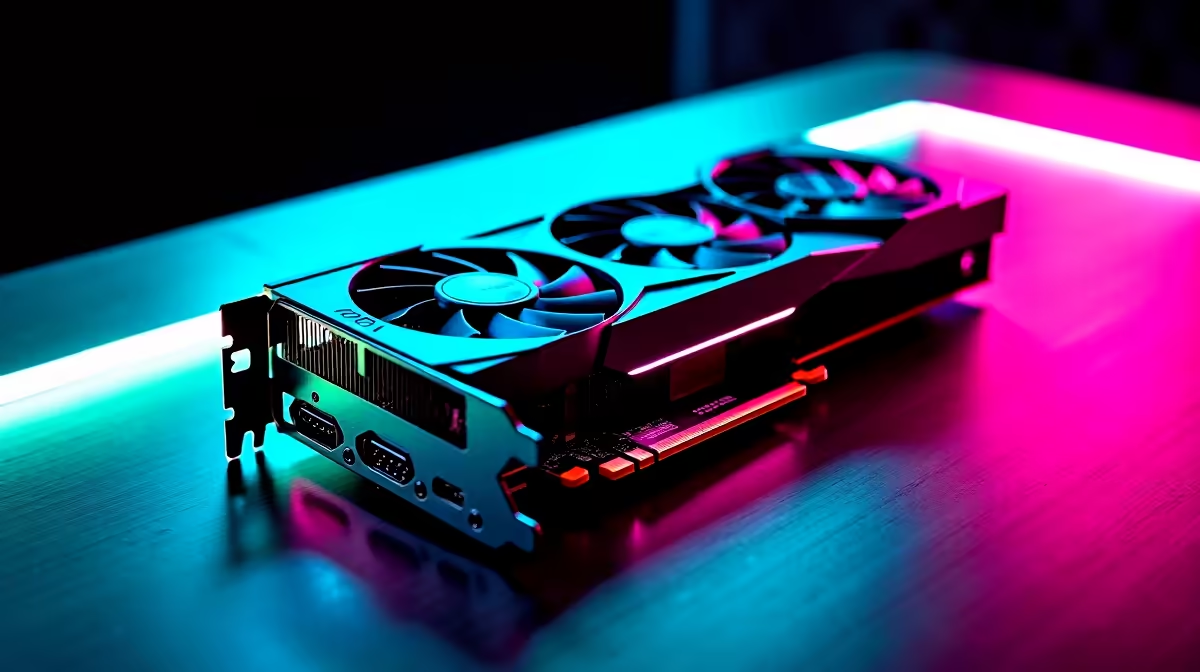
The RTX 5060 can handle AI and machine learning workloads, particularly inference tasks and smaller model training runs. It carries 8GB of GDDR7 VRAM with strong CUDA core throughput and Tensor Core acceleration, which makes it genuinely useful for local AI work, though it has clear memory capacity limits compared to higher-tier cards.
What the RTX 5060 Brings to AI Workloads
The RTX 5060 is built on Blackwell architecture, which brings significant improvements to Tensor Core throughput compared to Ampere-era mid-range cards. The 5th-generation Tensor Cores support FP8 precision, which accelerates inference for quantised models like GGUF-format LLMs running in tools such as LM Studio or Ollama. For inference at INT4 and INT8 quantisation levels, the RTX 5060 performs well above what its price tier would suggest. CUDA core count and memory bandwidth are the two primary specs that matter for ML work, and the RTX 5060 offers substantially higher bandwidth than its Ampere predecessor thanks to GDDR7. Bandwidth-hungry tasks like stable diffusion image generation at 512x512 and 1024x1024 run smoothly, and upscaling pipelines such as ESRGAN handle well.
VRAM Limitations and What They Mean
The 8GB VRAM ceiling is the RTX 5060's defining constraint for serious ML work. Fine-tuning even a 7B parameter model in FP16 requires more than 8GB, which pushes these tasks out of reach without aggressive quantisation. Running inference on a 7B model at Q4 quantisation fits comfortably in 8GB. Running a 13B model at Q4 is borderline and requires careful memory management. For stable diffusion specifically, SDXL works well at 8GB with the right attention optimisation settings. Flux models at full precision push beyond 8GB, but quantised versions run acceptably. ComfyUI and Automatic1111 both have options to manage VRAM offloading, which extends what you can run at the cost of some speed. If your primary use case is training models from scratch or fine-tuning models larger than 3 to 7 billion parameters, the RTX 5060 will frustrate you with VRAM errors. The RTX 5070 with 12GB or the RTX 5080 with 16GB are better fits for those tasks. ## Practical Use Cases Where the RTX 5060 Excels
Local LLM chatbots and coding assistants running quantised models are an excellent fit. Code generation tools using Deepseek Coder or similar 7B models run at very usable token generation speeds on the RTX 5060. Image generation workflows for hobbyists and small creators using SDXL or SD 1.5 based models work without compromise. Video upscaling and AI-enhanced video processing for content creators are smooth and much faster than CPU-based alternatives. For South African users who cannot rely on constant internet connectivity during loadshedding stages, having a capable local inference card means AI tools remain functional offline. The RTX 5060 covers the majority of consumer-grade local AI use cases comfortably. ## Frequently Asked Questions
Can the RTX 5060 run local LLMs like Llama 3 or Mistral? Yes, at Q4 or Q5 quantisation levels, 7B parameter models including Llama 3.1 8B and Mistral 7B run well on the RTX 5060's 8GB VRAM with good token generation speeds. Is 8GB VRAM enough for stable diffusion in 2026? For SD 1.5 and SDXL base models with attention optimisation enabled, 8GB is sufficient. Full-precision Flux and some newer SDXL variants exceed 8GB but work with quantised versions or VRAM offloading enabled. Does the RTX 5060 support CUDA for Python ML frameworks? Yes. PyTorch and TensorFlow both support Blackwell architecture through CUDA 12.x. All standard ML libraries that leverage CUDA acceleration work with the RTX 5060.
Ready to Find Your Perfect Match? Find the RTX 5060 and other AI-capable graphics cards at Evetech with fast delivery across South Africa.