Quick Answer
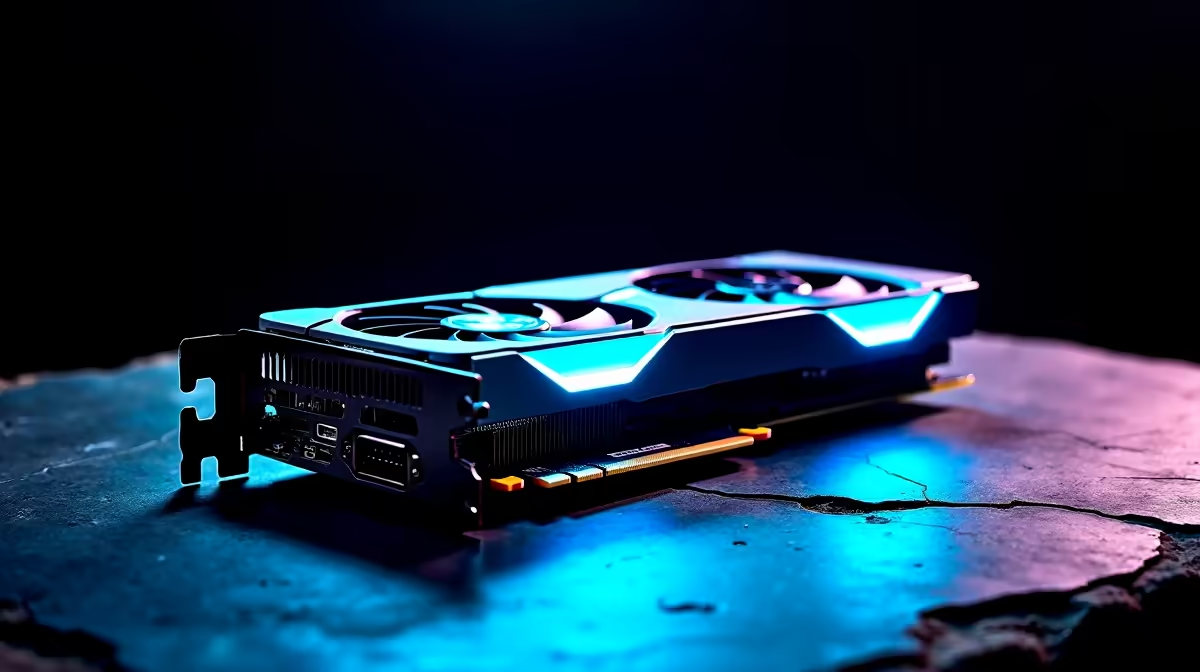
Yes, the RTX 5090 is exceptionally capable for AI and machine learning workloads. With 32GB of GDDR7 memory, a massive 1,792 GB/s memory bandwidth, and NVIDIA's fifth-generation Tensor Cores, it delivers performance that rivals dedicated data centre cards for local inference, fine-tuning, and model training tasks.
When South African researchers, developers, and content creators ask whether a gaming GPU can genuinely handle AI workloads, the RTX 5090 changes the conversation entirely. At its price point in the SA market - typically above R35,000 for the card alone - it sits in serious professional territory, and the AI compute credentials back that up.
Tensor Core Performance for AI Inference
The RTX 5090 packs 680 fifth-generation Tensor Cores, delivering up to 3,352 AI TOPS (tera operations per second) in FP8 precision. For local LLM inference, this translates into running 70B parameter models quantised to 4-bit at practical speeds on a single consumer card. Models like LLaMA 3, Mistral, and Stable Diffusion run locally without cloud API costs - a significant saving for SA developers who face steep USD-to-ZAR conversion on cloud compute bills. The Blackwell architecture's FP4 support also opens doors for even larger context windows and faster token generation compared to previous Ada Lovelace cards.
Memory Capacity and Bandwidth
For machine learning, VRAM is often the real bottleneck rather than raw shader performance. The RTX 5090's 32GB of GDDR7 memory operates at 1,792 GB/s bandwidth - roughly double what an RTX 4090 offered. This allows fine-tuning of models with billions of parameters without aggressive quantisation, and enables multi-modal pipelines that combine vision and language processing in a single pass. Batch sizes that would overflow a 16GB or 24GB card fit comfortably here, which directly accelerates training iteration time for custom datasets.
Practical Workloads: What It Handles Well
The RTX 5090 excels at local LLM inference and chat, image generation with Stable Diffusion XL and FLUX models, video diffusion tasks, fine-tuning smaller models using LoRA or QLoRA techniques, and running frameworks like PyTorch and TensorFlow with CUDA acceleration. It is not a replacement for multi-GPU server clusters when training frontier models from scratch, but for the majority of AI practitioners - developers building applications, researchers fine-tuning existing models, and creative professionals running generative pipelines - it covers almost every local workload without bottlenecks.
Frequently Asked Questions
Q: Can the RTX 5090 run large language models locally? A: Yes. With 32GB of GDDR7 VRAM it can run 70B parameter models at 4-bit quantisation using tools like llama.cpp or Ollama, with reasonable token generation speeds for both development and personal use.
Q: Is the RTX 5090 better than a dedicated AI accelerator for local workloads? A: For most individual developers and researchers it is more practical. Dedicated data centre accelerators like H100s offer more raw throughput for large-scale training, but the RTX 5090 combines gaming and AI capabilities in a single card with full CUDA ecosystem support and consumer driver compatibility.
Q: Does NVIDIA DLSS 4 affect AI workload performance on the RTX 5090? A: DLSS 4 is a gaming feature and does not directly affect ML framework performance. The same Tensor Core hardware handles both, but AI frameworks access them through CUDA and cuDNN independently of the gaming driver stack.
Ready to Find Your Perfect Match? Build your AI-capable workstation around RTX 5090 performance - explore Evetech's best PC deals today.