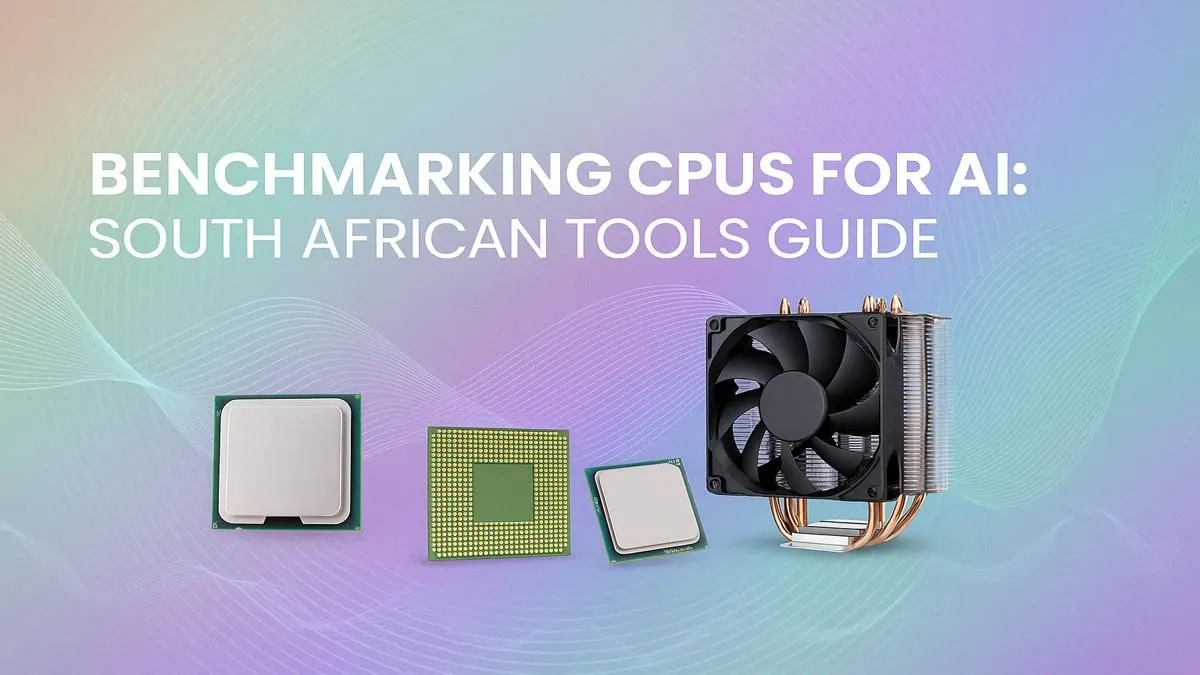
So, you're diving into the world of AI right here in South Africa. Awesome! 🤖 Whether you're generating incredible art with Stable Diffusion, training a local model, or just want your coding assistant to feel instantaneous, your computer's processor (CPU) is doing the heavy lifting. But a standard gaming benchmark won't cut it. To avoid bottlenecks and wasted rands, you need a proper CPU benchmark for AI, and this guide will show you exactly how to do it.
Why Your Gaming Benchmark is Misleading for AI
You might have a CPU that crushes the latest titles at 144Hz, but it could still struggle with artificial intelligence tasks. Why? Because they demand different things from your hardware.
Gaming performance often hinges on:
- High Clock Speeds: How fast a single core can run.
- Low Latency: Quick communication between the CPU and RAM.
- Strong Single-Core Performance: Many game processes still rely heavily on one or two powerful cores.
AI workloads, however, are a different beast entirely. They thrive on parallel processing and specialised mathematical calculations. A good CPU benchmark for AI focuses on metrics that reflect this, like multi-core throughput and support for specific instructions that accelerate machine learning tasks.
Key CPU Features That Boost AI Performance
When you're looking to benchmark a CPU for AI, you need to know what features actually move the needle. It’s not just about the gigahertz number on the box.
More Cores, More Power
For many AI tasks, especially compiling code, rendering, or running virtual machines, more cores mean more work gets done simultaneously. A 16-core CPU can often demolish an 8-core CPU with a slightly higher clock speed in these scenarios. When you start exploring the right CPU processors online, you'll see that core count is a primary differentiator.
Specialised Instruction Sets (The Secret Sauce 🤫)
This is where things get technical, but it's super important. Modern CPUs have built-in instruction sets designed to speed up specific types of math. For AI, the big ones are:
- AVX-512 (Advanced Vector Extensions 512-bit): This allows the CPU to process huge chunks of data in a single instruction, which is a massive boost for scientific computing and AI model inference. Many modern Intel CPUs have excellent support for this.
- NPU (Neural Processing Unit): The new kid on the block. An NPU is a dedicated part of the processor designed to run AI tasks efficiently and with very low power consumption. You'll find these in the latest chips, with AMD's latest Ryzen CPUs featuring powerful "Ryzen AI" engines.
Real-World AI Benchmark Tip ⚡
For a practical test, download a tool like HandBrake. Try encoding a short 4K video file using a CPU-intensive codec like AV1. Time the process. Then, run a Stable Diffusion image generation task (e.g., a batch of 10 images). Comparing these two results gives you a great real-world view of your CPU's multi-core and specialised AI capabilities.
Top Tools for Your Own CPU Benchmark for AI
Ready to get some real numbers? You don't need a fancy lab. Here are a few tools you can use right now to see how your processor stacks up.
Geekbench 6
A household name in benchmarking, Geekbench 6 includes specific CPU tests that measure both single-core and multi-core performance using relevant, modern workloads. Its results are easy to compare with thousands of other systems online, giving you a solid baseline.
Cinebench R23/2024
While traditionally a 3D rendering benchmark, Cinebench is fantastic for testing a CPU's raw multi-threaded power. It maxes out every single core and thread you have for a sustained period. If a CPU scores well here, it's a good sign it can handle heavy, parallel AI tasks without breaking a sweat.
The Ultimate Test: Your Own Workflow
The best CPU benchmark for AI is your own daily work.
- Artists & Designers: How long does it take to generate a complex image in Stable Diffusion or a similar tool? Time it.
- Developers: How quickly does your code compile? How responsive is GitHub Copilot or another AI assistant inside your IDE?
- Data Scientists: Measure the time it takes to train a small model or run an inference task on a dataset.
These real-world tests are more valuable than any synthetic score because they measure what truly matters: your productivity.
Ready to Supercharge Your AI Workflow? 🚀
Finding the perfect processor for your AI ambitions doesn't have to be complicated. Whether you're training models or just speeding up your creative tools, the right CPU is key. Explore our massive range of CPUs and find the perfect core for your new AI-powered rig.