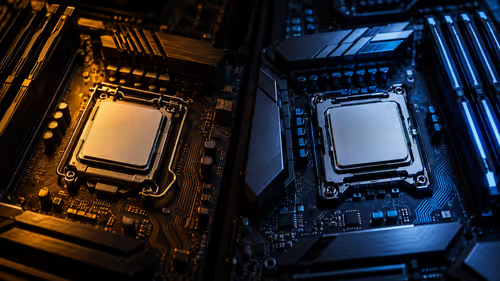
Ever asked an AI a question and felt that digital pause? While GPUs get the spotlight, the secret to snappy local AI performance often lies in your processor. The number of CPU cores for LLM tasks is a critical factor, directly influencing how quickly you get a response. Whether you're a developer, creator, or just a curious tech enthusiast in South Africa, understanding this connection is key to building a future-proof machine.
How CPU Cores Affect Local AI Speed
Think of your CPU cores as cashiers at a busy supermarket. If you have one massive task (one shopper with a full trolley), a single, fast cashier (high clock speed) is great. But Large Language Models (LLMs) break down their "thinking" into thousands of smaller, parallel tasks. This is like having hundreds of shoppers with just a few items each.
In this scenario, more cashiers (cores) are far more efficient. Each core can handle a piece of the puzzle simultaneously. This parallel processing is why a higher core count impacts AI speed so dramatically for inference tasks—the process of running a pre-trained model to get an answer. More cores mean more parallel data streams, leading to faster generation of text, code, or images. ⚡
Many modern NVIDIA GeForce gaming PCs are already equipped with multi-core CPUs that are surprisingly capable for entry-level AI experimentation.
Finding the Sweet Spot: More Cores or Faster Cores?
So, is the answer just to cram as many cores as possible into your rig? Not quite. It's a balance.
For running local LLMs, a healthy number of cores is king. A 12-core or 16-core processor will generally outperform a 6-core chip with a slightly higher clock speed for these specific parallel workloads. The ability to process more things at once outweighs the ability to process a single thing slightly faster.
This is why CPUs like AMD's Ryzen 9 series have become so popular with developers and creators. Their high core counts provide a massive advantage. Today's AMD Radeon gaming PCs often feature these powerful, multi-threaded processors, making them excellent all-rounders for both gaming and productivity.
Check Your Core Count 🔧
Curious about your current setup? On Windows, press Ctrl + Shift + Esc to open Task Manager. Go to the "Performance" tab and click on "CPU". You'll see "Cores" and "Logical processors" (threads) listed on the right. This gives you a quick baseline for how well your machine might handle parallel tasks like local AI.
Beyond Cores: What Else Boosts AI Performance?
While the number of CPU cores for LLM processing is a primary concern, it isn't the only piece of the puzzle. To build a truly optimised system, you also need to consider:
- RAM: LLMs are memory-hungry. Running larger models locally requires a significant amount of RAM—32GB is a good start, but 64GB or more is often recommended for serious work.
- Cache Size: A larger L3 cache on your CPU allows it to store more frequently accessed data, reducing the time it spends waiting for information from the RAM. This results in a snappier, more responsive system.
- GPU Acceleration: For the heaviest AI tasks, especially training new models, a powerful GPU is non-negotiable. But even for inference, offloading layers of the model to the GPU's VRAM can massively accelerate performance.
This is where building a balanced system becomes crucial. For professionals who can't afford bottlenecks, specialised workstation PCs are designed with these factors in mind, ensuring every component works in harmony for maximum throughput. ✨
Ultimately, choosing the right CPU is about matching the hardware to your ambition. Whether you're dabbling with a small open-source model or running complex simulations, understanding how core count impacts AI speed is your first step towards building a smarter, faster machine.
Ready to Build Your AI Powerhouse? 🚀 From gaming to generative AI, the right processor makes all the difference. Stop guessing and start building. Use our PC Builder to configure the perfect machine with the ideal core count for your needs.