Feeling the AI buzz across South Africa? From generating wild images with Stable Diffusion to speeding up your creative workflow, artificial intelligence is here. But before you can dive in, your PC needs the right brain for the job. Choosing the best CPU for AI can seem daunting, but don't stress... we're here to break it down for you, whether you're in Cape Town or Jozi. Let's get you sorted. 🚀
Why Your CPU is Crucial for AI Tasks
While graphics cards (GPUs) get all the hype for heavy-duty AI training, your Central Processing Unit (CPU) is the unsung hero of your AI setup. Think of it as the project manager. It handles everything from preparing data and managing system resources to running smaller AI models directly. For many entry-level and intermediate AI tasks, a powerful CPU is not just important… it's essential for a smooth, responsive experience.
Without a capable processor, even a top-tier GPU can be left waiting for instructions, a bottleneck that slows your entire workflow down. That's why choosing the right CPU processor is the foundational first step.
What Makes a Good CPU for AI?
When you're browsing for an AI-ready processor, a few key specs matter more than others. Forget the marketing jargon; here’s what you actually need to look for.
More Cores, More Power 🧠
Many AI operations involve running multiple calculations at the same time (parallel processing). A CPU with a higher core count can handle more tasks simultaneously, which is a massive advantage for tasks like data processing and model inferencing. For a starter CPU for AI, aiming for 6 to 8 cores is a great baseline, while 12 or more will give you serious headroom.
Clock Speed and Instructions Per Clock (IPC)
Clock speed, measured in gigahertz (GHz), tells you how many cycles a CPU can perform per second. A higher number is generally better, meaning faster calculations. IPC refers to how much work the CPU can do in each cycle. A modern CPU with a slightly lower clock speed can often outperform an older one with a higher clock speed because its architecture is more efficient.
Check Your Software First! 🔧
Before you buy, check the recommended specs for the AI tools you plan to use. Some applications are heavily optimised for a higher core count, while others might rely on specific features found only in the latest CPUs. A quick search can save you a lot of ZAR and ensure smooth performance.
Team Red vs. Team Blue: Choosing Your AI CPU in South Africa
The classic AMD vs. Intel debate is just as relevant in the AI space. Both brands offer fantastic options, but they have different strengths.
AMD Ryzen CPUs
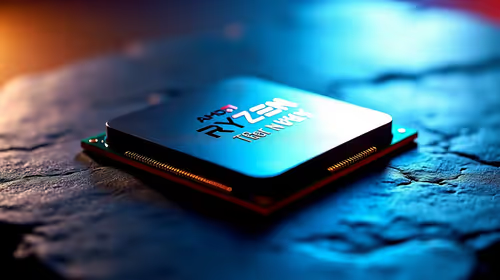
AMD has made a name for itself by offering impressive core counts for the price. Processors in AMD's powerful Ryzen CPUs range, particularly the Ryzen 7 and Ryzen 9 series, are multi-threading beasts. This makes them an excellent choice for AI workloads that can take advantage of many cores running at once, like compiling code or working with large datasets. ✨
Intel Core CPUs
Intel has historically led in single-core performance, which is crucial for tasks that can't be easily split across multiple cores. More recently, Intel's latest Core processors have started including dedicated hardware like Neural Processing Units (NPUs) on some models. These are designed to accelerate specific, low-power AI tasks right on the chip, making your system more efficient.
Ultimately, there’s no single "best" brand. Your choice depends on your specific software, workflow, and budget. Both teams offer a brilliant processor for AI at various price points in South Africa.
Ready to Power Your AI Journey? Choosing the right CPU for AI is the first step to unlocking incredible creative and productive power. Whether you need AMD's massive core counts or Intel's specialised AI features, we have the perfect processor for your build. Explore our massive range of CPUs and find the engine for your next big idea.