Jumping into the AI craze? 🤖 From generating wild images with Stable Diffusion to training a custom model, South Africans are diving in headfirst. But here’s the hard truth: that magic doesn't happen without rock-solid hardware. When you’re hours into a render, the last thing you need is a system crash. Ensuring top-notch CPU stability for AI workloads isn't just a nice-to-have; it's the foundation of your success. Let's get it right.
Why CPU Stability for AI is Non-Negotiable
Unlike a quick gaming session, AI tasks push your processor to its absolute limit for hours, sometimes even days. This sustained, intense pressure is where weaknesses in a system show up. An unstable CPU can lead to:
- Corrupted Results: Imagine a 12-hour model training run failing at the 11th hour, leaving you with unusable data.
- Wasted Time & Electricity: In a country where every watt counts, a system crash means starting over, doubling your power consumption and losing valuable time.
- Silent Errors: Sometimes, instability doesn't cause a crash but introduces tiny, undetectable errors into calculations, compromising the accuracy of your AI model.
Every single CPU processor on the market is tested for these demanding scenarios, but achieving true stability depends on the entire system working in harmony.
The Three Pillars of a Rock-Solid AI System
Achieving perfect CPU stability for AI workloads isn't about one magic component. It's about a balanced system where three key areas work together seamlessly.
1. Clean Power Delivery ⚡
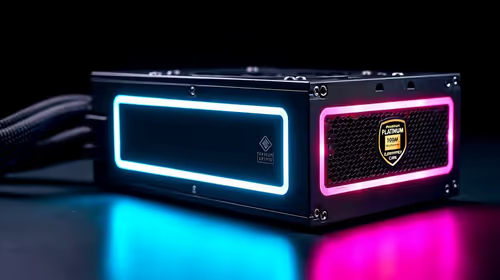
Your CPU is thirsty for power under load. A cheap motherboard with a weak Voltage Regulator Module (VRM) or an inadequate Power Supply Unit (PSU) can't deliver the consistent, clean voltage required. This "dirty" power causes fluctuations that can make even the best CPU stumble. Think of it as trying to run a marathon on a diet of fizzy drinks… you just won't make it.
2. Serious Cooling
South Africa's climate adds an extra challenge. Sustained AI tasks generate a massive amount of heat. If your cooling can't keep up, your CPU will "thermal throttle"—aggressively slowing itself down to prevent damage. This kills performance and, in worst-case scenarios, leads to a system shutdown. A high-quality air cooler or an All-in-One (AIO) liquid cooler is not a luxury; it's a necessity.
Stability Check Pro Tip 🔧
Before starting a multi-hour AI task, run a stability test. A tool like Prime95 (using the 'Small FFTs' test) or AIDA64's system stability test can simulate a maximum CPU load. If your system can survive 30 minutes of that without overheating or crashing, you've got a much better chance of completing your AI workload successfully. Monitor your temperatures closely!
3. The Right Processor Choice
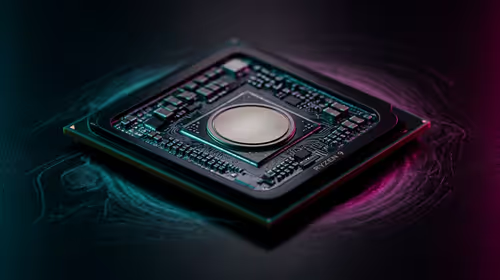
The CPU itself is, of course, the star of the show. Different architectures handle long, parallel tasks differently.
- Intel's Hybrid Architecture: The Performance-core and Efficient-core design in modern Intel CPUs offers incredible flexibility. For AI, you want those P-cores firing on all cylinders, providing raw computational power for complex algorithms.
- AMD's Core Density: The chiplet design used in powerful AMD CPUs often provides a higher number of full-performance cores at a competitive price point. This is a massive advantage for workloads that can be split across many threads simultaneously, like rendering or data processing.
Ultimately, the best choice depends on your specific AI software and budget.
Fine-Tuning Your Setup for AI Dominance 🚀
Once you have the right hardware, a few final tweaks in your BIOS/UEFI can lock in that stability. Avoid aggressive, automated overclocks. Instead, focus on enabling a stable memory profile (like XMP or EXPO) and ensuring your motherboard's power limits are set appropriately for your cooler.
A stable system is a productive system. By focusing on quality power, cooling, and the right processor for the job, you ensure your PC is a reliable partner in your AI journey, not a frustrating bottleneck.
Ready to Build Your AI Powerhouse? Achieving peak CPU stability for AI workloads starts with the right foundation. Don't let hardware hold you back. Explore our massive range of CPU processors and find the perfect core for your next big project.