Artificial Intelligence is no longer sci-fi... it's right here in South Africa, running on our gaming rigs. From generating incredible art to smart features boosting your FPS, AI is everywhere. But when you’re building a PC to handle it, what matters more? This guide settles the CPU vs GPU for AI debate, helping you invest your hard-earned Rands wisely. Let's dive in and see which component truly powers the revolution.
The Core Difference: What Does Each Do for AI?
Thinking about the CPU vs GPU for AI in South Africa can feel complicated, but it's simpler if you imagine building a house.
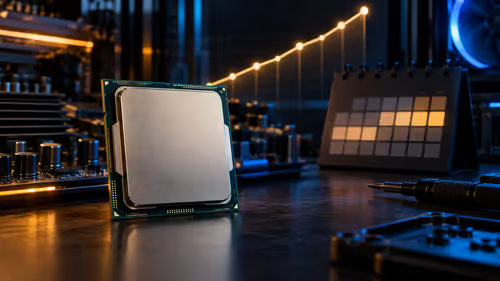
Your CPU (Central Processing Unit) is the project manager or foreman. It’s brilliant at handling a few complex, sequential tasks at once. It runs your operating system, manages instructions, and keeps everything organised. It's the brain of the operation, ensuring the entire PC works smoothly. Without a decent CPU, the whole project grinds to a halt.
Your GPU (Graphics Processing Unit), on the other hand, is the massive crew of specialised labourers. It was originally designed to render graphics, which involves performing the same simple calculation across millions of pixels simultaneously. This skill, known as parallel processing, just so happens to be exactly what modern AI and machine learning workloads need. ⚡
The CPU's Role in an AI World
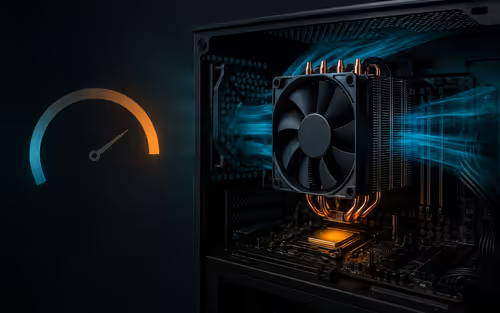
While the GPU gets most of the AI hype, the CPU is far from retired. A powerful processor is still the backbone of any high-performance PC, and it plays a few critical roles in AI tasks.
For starters, the CPU handles all the data preparation and loading before the GPU can even begin its work. It also executes the parts of the AI code that can't be easily parallelised. For smaller AI models or tasks that require instant responses (low-latency inference), a fast CPU can sometimes be more important. A weak CPU will bottleneck your powerful GPU, meaning your graphics card will be sitting around waiting for instructions.
Ultimately, a balanced system is key, and ensuring you have one of the latest powerful CPU processors is the first step to building a capable AI machine.
GPU for AI: The Undisputed Heavyweight Champion 🥊
When it comes to the heavy lifting of AI—especially deep learning and generative AI like Stable Diffusion or Midjourney—the GPU is the undisputed champion. Training an AI model involves performing billions of mathematical operations. A GPU, with its thousands of cores, can chew through these calculations hundreds of times faster than a CPU.
This is why companies like NVIDIA have invested so heavily in technologies like CUDA and Tensor Cores, which are specifically designed to accelerate AI workloads. For a gamer or content creator in South Africa, this translates to tangible benefits:
- Generative Art: Running models like Stable Diffusion locally to create unique images in seconds.
- AI-Powered Tools: Using features like NVIDIA Broadcast for crystal-clear audio during streams or the AI-driven tools in Adobe Photoshop and Premiere Pro.
- Smarter Gaming: Benefiting from technologies like DLSS (Deep Learning Super Sampling), where AI boosts your frame rates with incredible quality.
Check the VRAM! 🧠
Before you start downloading a new AI model to play with, check its VRAM (Video RAM) requirements. Many cutting-edge models need at least 8GB or 12GB of VRAM to run effectively. A GPU with more VRAM can handle larger, more complex models, giving you more creative freedom. This spec is just as important as the core processing power for serious AI work.
Building Your AI Rig in South Africa: A Practical Guide
So, how do you balance the CPU vs GPU for AI when planning your build? It depends on your primary use case.
For Serious AI Development & Content Creation
Here, your priority should be the GPU. Invest the largest portion of your budget in a graphics card with as much VRAM as you can afford (think NVIDIA RTX 40-series or a high-end AMD equivalent). To support it, a capable multi-core CPU is essential to feed the GPU data without causing a bottleneck. Whether you're looking at the raw power of the latest Intel CPUs or the excellent multi-core value of AMD's Ryzen lineup, pairing it with a top-tier GPU is the winning formula. Also, aim for at least 32GB of system RAM.
For AI-Enhanced Gaming & General Use
A more balanced approach works perfectly. A modern 6 or 8-core CPU paired with a mid-to-high-range GPU (like an RTX 4060 or 4070) will provide a fantastic experience. This combination will crush modern games, take full advantage of DLSS, and still have enough power to let you experiment with most consumer-level AI applications without breaking the bank.
The Verdict: A Partnership, Not a Rivalry
The "CPU vs GPU for AI" debate isn't about one component replacing the other. It's about understanding their specialised roles. The CPU is the indispensable manager, and the GPU is the powerhouse workforce.
For anyone in South Africa serious about diving into the world of AI, the conclusion is clear: while a strong CPU is vital for a responsive system, the GPU is where you should focus your investment for maximum performance. ✨ It's the engine that will drive your creative and analytical ambitions forward.
Ready to Build Your AI Powerhouse? The CPU vs GPU for AI debate shows it's a team effort, but the right components make all the difference. Explore our massive range of PC components and find the perfect hardware to bring your AI ambitions to life in South Africa.