Input latency - the delay between pressing a key or moving a mouse and seeing the result on screen - is one of the most impactful but least visible performance variables in gaming and even general PC use. If you have already addressed the obvious causes (Issue #1 covered USB polling rates and wireless interference), this guide tackles the next tier of latency culprits that are harder to identify but equally fixable.
Quick Answer
What causes delayed input beyond basic peripheral settings? Deeper input latency sources include GPU render queue depth, display response time misconfiguration, Windows scheduling conflicts, and background process CPU contention. Addressing these can reduce system latency by 10–40ms in measurable scenarios.
🔧 GPU-Side Latency: Render Queue and Low Latency Mode
NVIDIA's Reflex Low Latency Mode and the equivalent in AMD drivers directly control the GPU render queue - the number of frames the GPU prepares ahead of actual display output. A deep queue smooths frame pacing but adds latency between your input and the frame that reacts to it.
For competitive gaming, set NVIDIA Low Latency Mode to "Ultra" in the NVIDIA Control Panel under Manage 3D Settings. This caps the render queue to one frame, ensuring the GPU renders and sends each frame as soon as possible. Games with built-in NVIDIA Reflex support (Valorant, Apex Legends, CS2, Fortnite) should have Reflex enabled within the game settings as well - in-game Reflex is more precise than the driver-level setting.
AMD Anti-Lag+ works similarly for RDNA-architecture GPUs. Enable it in AMD Software: Adrenalin Edition for supported titles.
Pre-rendered frames (found in older NVIDIA Control Panel versions as "Maximum pre-rendered frames") should be set to 1 for competitive gaming. Higher values help smooth performance in less demanding scenarios but add latency.
📊 Display Pipeline Latency
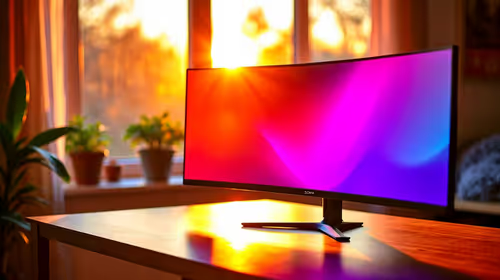
Your monitor itself introduces latency in its image processing pipeline. Most modern gaming monitors list a response time (1ms GtG, 0.5ms MPRT) but this is distinct from input lag measured from signal received to pixel illuminated.
Check your monitor's OSD (on-screen display) settings for:
- Game Mode / Low Input Lag Mode: Most gaming monitors have a dedicated mode that disables post-processing to minimize display latency. Enable this.
- Overdrive / Response Time: Setting overdrive too aggressively causes pixel overshoot (ghosting halos). Find the sweet spot - typically "Medium" or the second-highest setting - for clean transitions without overshoot artifacts.
- Variable refresh rate (G-Sync/FreeSync): These technologies reduce tearing but can add 1–2ms latency compared to fixed-rate operation at your monitor's native refresh. For competitive play at consistently high frame rates (above your monitor's refresh rate), disabling VRR and using NVIDIA Fast Sync or uncapped frames can reduce latency.
💡 Windows and System Configuration
Process priority and CPU scheduling: Windows 11 introduced efficiency cores (E-cores on Intel systems) that background tasks use. Ensure your game's process is set to high priority - most modern games do this automatically, but you can verify in Task Manager under Details.
Background process audit: Record a 30-second GPU-Z or MSI Afterburner overlay while gaming. If GPU usage spikes are irregular (dropping below 95–98% in GPU-bound scenarios), a background process may be interrupting the render pipeline. Common culprits: antivirus real-time scanning, Windows Update, cloud backup syncing, and browser-based notifications. Schedule heavy background tasks for non-gaming periods.
USB power management: Windows may suspend USB devices to save power. Disable USB selective suspend in Power Options > Advanced Settings > USB Settings. This prevents the system from briefly dropping polling on your mouse or keyboard during low-activity windows.
High performance power plan: Ensure your power plan is set to "High Performance" or "Ultimate Performance" (if unlocked) when gaming. Balanced power plans allow CPU frequency to throttle, adding scheduling latency in CPU-demanding moments.
❓ Frequently Asked Questions
How much input latency is noticeable to human perception? Most players begin perceiving input delay at around 16ms (one frame at 60 Hz). Competitive players are sensitive to changes as small as 5–8ms. Reducing total system latency below 10ms from input to display output is the target for elite competitive setups.
Does the resolution I play at affect input latency? Yes indirectly - lower resolutions reduce the GPU's rendering workload, allowing it to complete frames faster and keep the render queue shorter. Many competitive players drop to 1080p or lower even on 1440p monitors specifically to maximize frame rate and reduce latency.
Can a gaming mouse with a higher polling rate reduce latency? Yes. A 1000 Hz polling rate reports position every 1ms; an 8000 Hz polling rate reports every 0.125ms. High-polling-rate mice (1000–8000 Hz) are now standard in professional esports and provide measurably more responsive cursor tracking, especially at lower DPI settings.
Evetech stocks Graphics Card Deals and Evetech Best Sellers — shop online with fast delivery across South Africa.
Ready to Find Your Perfect Match? Shop at Evetech