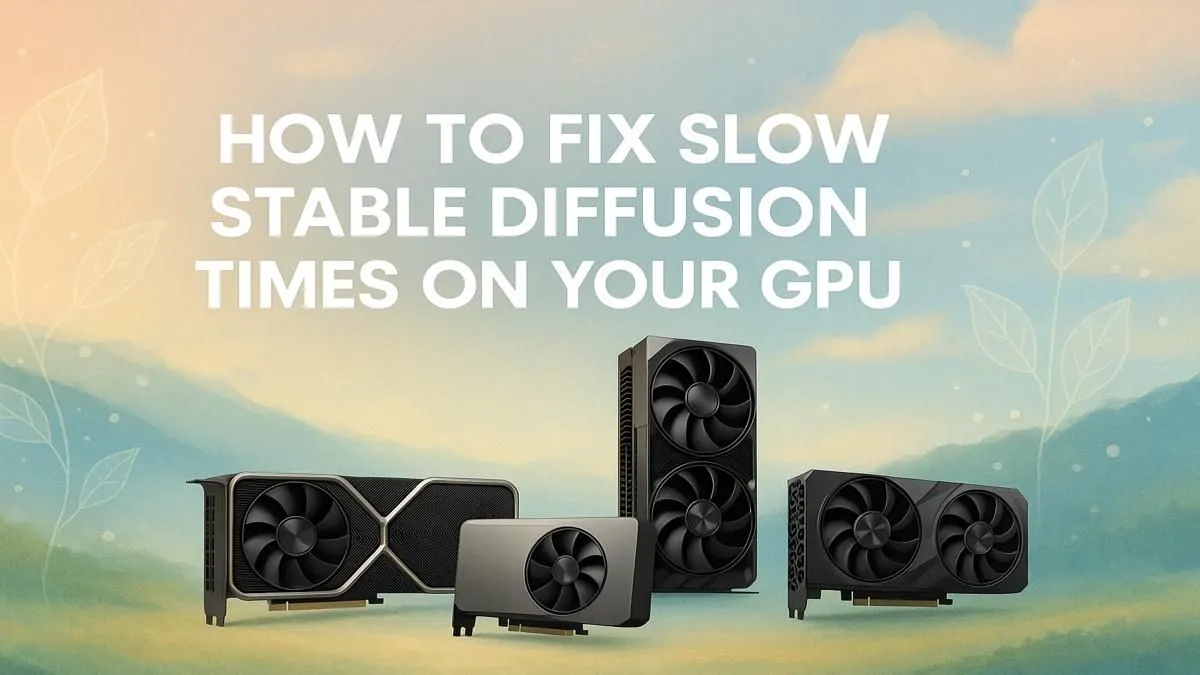
Staring at the progress bar as Stable Diffusion slowly cooks up your masterpiece? We've all been there. In South Africa, where every minute of creativity counts, a slow AI workflow is more than just annoying… it's a bottleneck. The good news? The lag is almost always your GPU, and you can absolutely speed it up. Whether through clever software tweaks or a hardware boost, faster AI image generation is within reach. 🚀
Why is My Stable Diffusion So Slow?
If you're experiencing slow Stable Diffusion generation times, the answer almost always lies with your graphics card (GPU). AI image generation is one of the most demanding tasks you can throw at a modern PC, and it relies heavily on three key things:
- VRAM (Video RAM): This is the single most important factor. Think of it as your GPU's dedicated workspace. The more VRAM you have, the larger and more complex the images you can create without your system slowing to a crawl. 8GB is a workable minimum, but 12GB+ is where the magic really happens.
- Processing Cores (CUDA/Tensor Cores): These are the tiny engines inside your GPU that do the heavy lifting. NVIDIA's CUDA and Tensor Cores are the industry standard for AI, offering broad support and optimised performance.
- Memory Bandwidth: This determines how quickly your GPU can access its VRAM. Higher bandwidth means faster processing of the data needed to generate your image.
A bottleneck in any of these areas will lead to a frustratingly slow Stable Diffusion experience.
Quick Fixes to Speed Up Stable Diffusion Right Now 🔧
Before you reach for your wallet, there are several software-side optimisations you can try to get a speed boost. These tweaks can make a massive difference, especially on hardware with limited VRAM.
Optimise Your Generation Settings
The easiest way to get faster results is to ask your GPU to do less work.
- Lower the Resolution: Generating a 512x512 image is exponentially faster than a 1024x1024 one. Start small, then use AI upscalers later.
- Reduce Step Count: A setting of 20-25 steps often produces excellent results. Pushing it to 50 or 100 adds significant time for diminishing returns.
- Generate Single Images: Creating a batch of four images takes roughly four times as long. Generate one at a time to iterate on your prompts faster.
VRAM-Saving Trick ⚡
For users with less than 8GB of VRAM, launching your Stable Diffusion web UI with the --medvram or --lowvram command-line arguments can be a lifesaver. It trades a little bit of speed for the ability to generate images at all, preventing those dreaded 'Out of Memory' errors. It's a must-try before you consider upgrading!
Update Your Graphics Drivers
This sounds simple, but it's crucial. Both NVIDIA and AMD regularly release driver updates that include performance optimisations for AI and machine learning tasks. A quick update could give you a noticeable performance lift for free.
When Is It Time for a GPU Upgrade?
If you've tried the software fixes and your Stable Diffusion is still painfully slow, it might be time to consider a hardware upgrade. Ask yourself:
- Are you constantly running into "Out of Memory" errors?
- Does a single 512x512 image take several minutes to generate?
- Do you want to experiment with training your own models or generating high-resolution art?
If you answered "yes" to any of these, a new GPU will fundamentally change your creative workflow. Exploring the latest NVIDIA and AMD graphics cards is the best place to start your journey towards instant creation. Even mid-range NVIDIA GeForce cards with 8GB or 12GB of VRAM can provide a monumental speed increase over older hardware.
Choosing the Right GPU for Faster Stable Diffusion ✨
When shopping for a new card specifically to speed up your GPU for AI, VRAM is king.
VRAM: Your Top Priority
- 8GB VRAM: The entry point. Good for 512x512 generation and learning the ropes.
- 12GB-16GB VRAM: The sweet spot. This allows for higher resolutions, bigger batches, and even some light model training without constant memory issues.
- 20GB+ VRAM: The pro-tier. This is for serious artists and developers who want to train complex models and generate massive 4K+ images in seconds.
While NVIDIA has historically dominated the AI space, the latest AMD Radeon graphics cards are becoming more competitive, offering great value for those comfortable with a bit more setup. However, for plug-and-play performance, NVIDIA's ecosystem is currently hard to beat. For professionals where time is literally money, dedicated workstation graphics cards offer unparalleled performance and stability for the most demanding AI workloads.
Ultimately, fixing a slow Stable Diffusion setup comes down to giving it the hardware resources it craves. A capable GPU doesn't just make you faster; it unlocks new creative possibilities.
Ready to Stop Waiting and Start Creating? A slow Stable Diffusion experience is almost always a hardware problem. If you're tired of tweaking settings and just want speed, a GPU upgrade is the answer. Explore our massive range of graphics cards and find the perfect engine for your AI art.