You’ve heard all about GPUs revolutionising artificial intelligence. But what if we told you there’s another piece of hardware, a reconfigurable chameleon, that’s quietly powering some of the most advanced AI systems in South Africa? We're talking about FPGAs. Forget rigid processors; imagine a chip you can rewire on the fly for maximum efficiency. This is a glimpse into the future of custom computing, and it’s happening right here, providing a unique angle on FPGA in AI development.
Unpacking FPGAs for AI Development
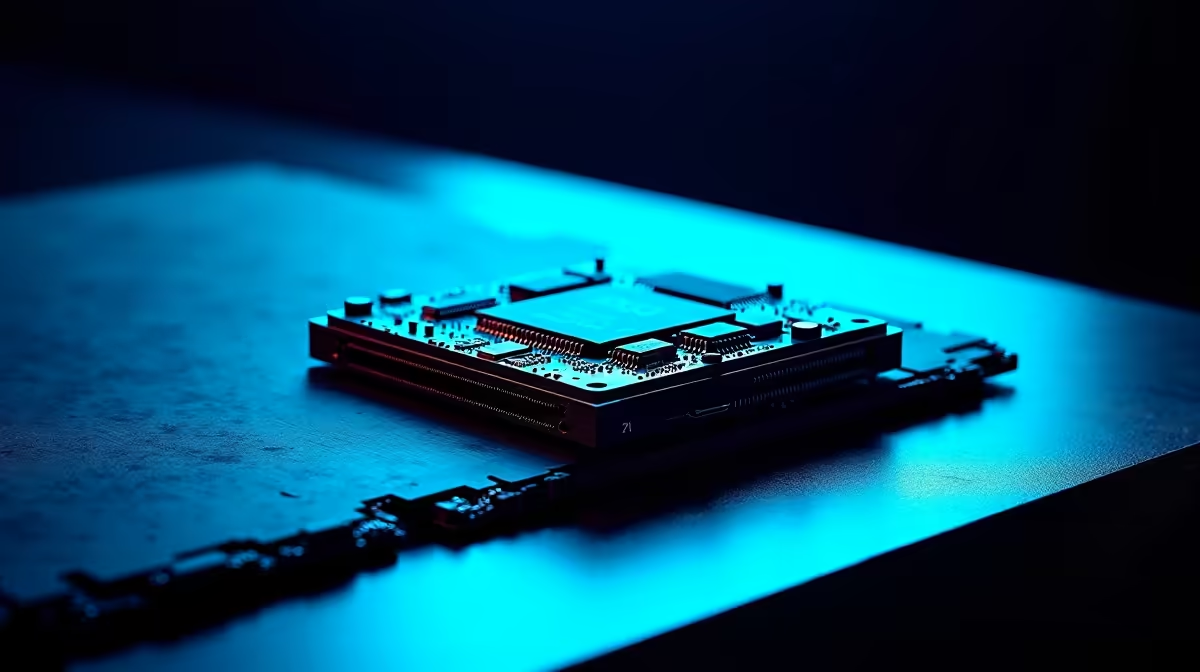
So, what exactly is an FPGA? The acronym stands for Field-Programmable Gate Array. Think of it less like a standard CPU or GPU and more like a box of digital LEGOs. While a CPU is a generalist and a GPU is a specialist for parallel tasks, an FPGA is a blank slate. Developers can program its internal logic gates to create a hardware circuit perfectly optimised for a single, specific task. ⚡
For artificial intelligence, this is huge. It means you can design a chip that does one thing—like recognise a specific object in a video feed—with incredible speed and ridiculously low power consumption. This level of customisation is where the potential for FPGA in AI truly shines, especially for edge computing devices where both performance and efficiency are critical.
The Great Hardware Debate: FPGA vs. GPU for AI
When people think of AI hardware, they almost always picture a powerful graphics card. The massive parallel processing capabilities found in modern graphics cards are fantastic for training the large, complex models that underpin today's AI. A high-end rig, like one of our NVIDIA GeForce Gaming PCs, has the raw computational horsepower needed to chew through massive datasets during the learning phase.
But training is only half the story. The other half is inference—using the trained model to make real-time decisions. This is where FPGAs can have an edge.
Where FPGAs Shine
- Low Latency: Because the hardware is custom-built for the task, FPGAs can offer lower and more predictable latency than GPUs, which is vital for applications like autonomous driving or high-frequency trading.
- Power Efficiency: An FPGA configured for a specific AI task uses significantly less power than a general-purpose GPU running the same workload, making them ideal for battery-powered devices.
- Flexibility: Need to update your AI model? You can re-flash the FPGA with a new hardware configuration. This adaptability is something fixed-function chips can't offer.
While the architectures differ, the core concept of handling many tasks at once is something gamers understand well. The technology powering today's immersive experiences in AMD Radeon Gaming PCs shares a philosophical lineage with the high-throughput processing needed in AI.
How FPGAs are Shaping South Africa's Tech Future 🚀
The conversation around using FPGA in AI isn't just theoretical; it has practical implications for South African industries. Imagine smart traffic systems in Johannesburg that adapt in real-time to reduce congestion, or advanced diagnostic tools in rural clinics that can analyse medical images instantly without relying on a cloud connection. These edge AI applications are where FPGAs excel.
For local developers and businesses venturing into this space, the journey begins with a powerful development environment. Building and simulating FPGA designs, or training the AI models they will eventually run, requires serious computational muscle. This is where robust, high-performance Workstation PCs become the essential foundation for innovation, providing the power needed to compile complex hardware designs and run demanding software.
Which Hardware for Your AI Project? 🧠
For training large AI models, the parallel processing power of a high-end GPU is usually your best bet. But for deploying a trained model for real-time inference (like in a smart camera), an FPGA can offer lower latency and better power efficiency. Always match the hardware to the specific stage of your AI workflow for optimal results.
As South Africa continues to grow as a tech hub, embracing specialised hardware like FPGAs will be key to creating efficient, world-class AI solutions that solve local problems. It's an exciting frontier, moving beyond off-the-shelf components to truly bespoke performance.
Ready to Power Your Ambition? The world of FPGA in AI is cutting-edge, but the need for raw processing power is universal. Whether your next project demands a GPU-heavy rig for deep learning or a robust CPU for complex simulations, the journey starts with the right foundation. Explore our massive range of PC specials and find the perfect machine to bring your ideas to life.