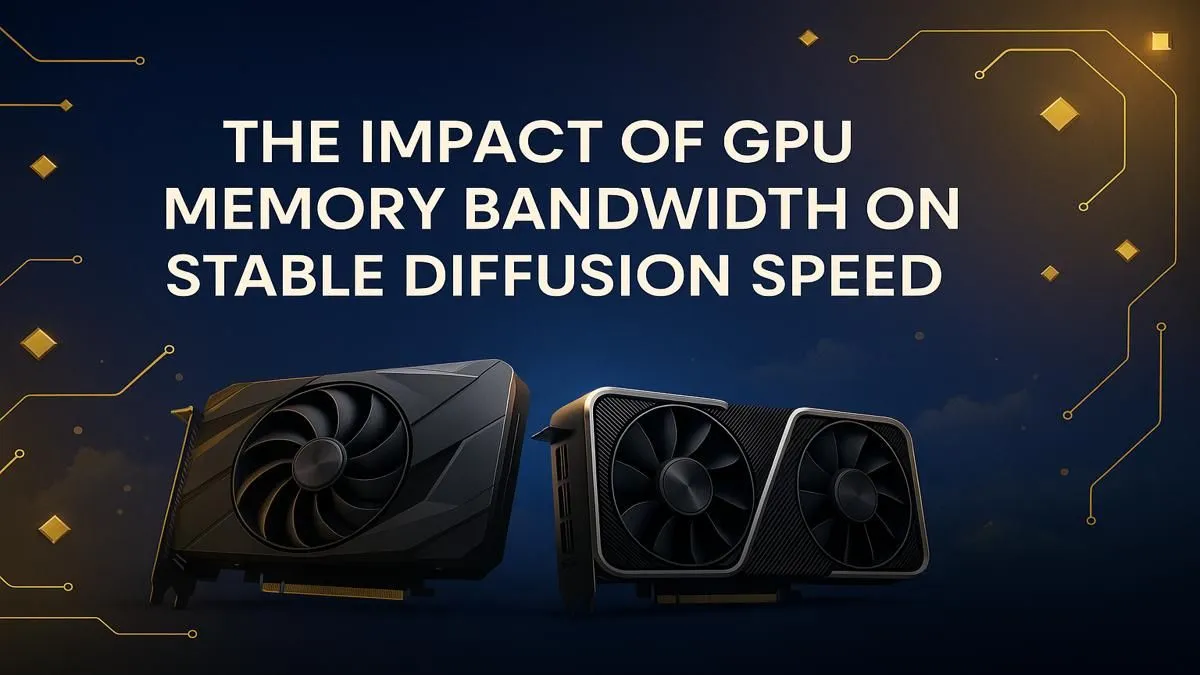
You've got a beast of a gaming rig, but firing up Stable Diffusion feels... slow. Your prompts take ages to generate, killing your creative flow. What gives? While we often focus on core clocks and VRAM size, the unsung hero of AI image generation is GPU memory bandwidth. It’s the secret sauce that dictates how fast your GPU can churn through data, turning your text prompts into stunning visuals. ⚡
Understanding GPU Memory Bandwidth for AI
Think of it like a highway. VRAM size is the number of parking spots available, but GPU memory bandwidth is the number of lanes on the highway itself. A 16-lane highway moves far more traffic (data) per second than a 4-lane one, even if the parking spots are the same size.
For Stable Diffusion, which constantly shuffles massive model files and image data between the GPU core and its memory, more lanes mean faster generation times. It's the critical factor that prevents your powerful processing cores from sitting idle, waiting for data.
VRAM Size vs. Bandwidth: The Real Bottleneck
It's easy to get fixated on VRAM capacity. "I need 16GB!" is a common cry. And while enough VRAM is essential to load high-resolution models without errors, it's not the whole story. A card with 12GB of VRAM but massive bandwidth can often outperform a 16GB card with a narrow memory bus for these iterative tasks.
The key is how quickly the GPU core can access the data stored in that VRAM. A mismatch here creates a performance bottleneck, leaving your powerful GPU cores waiting. When exploring your options, it's vital to look at both specs across all the latest NVIDIA and AMD graphics cards to find the right balance for your needs.
Check Your Bandwidth 🔧
Want to see your current card's stats? Download a free tool like GPU-Z. Navigate to the "Graphics Card" tab and look for the "Memory Type" (e.g., GDDR6X) and "Bus Width". The "Bandwidth" field gives you the final number in GB s. This is a great way to benchmark what you have before you upgrade!
Choosing the Right GPU for Your AI Workflow
So, what should you be looking for in South Africa? The answer depends on your budget and how seriously you take your AI art.
For Enthusiasts and Gamers: NVIDIA GeForce
NVIDIA has long been the top dog in the AI space thanks to its CUDA cores and robust driver support. Cards like the RTX 4070 SUPER or 4080 SUPER offer a brilliant balance of gaming prowess and fantastic GPU memory bandwidth for Stable Diffusion. They use fast GDDR6X memory, making them ideal for creators who want one card to do it all. Take a look at the latest NVIDIA GeForce graphics cards to see the current lineup.
The Powerful Alternative: AMD Radeon
Don't count AMD out. While NVIDIA often has the edge in raw AI software compatibility, modern AMD Radeon graphics cards pack a serious punch with high bandwidth memory and competitive pricing. For users running Stable Diffusion via DirectML or ROCm, cards like the RX 7900 XTX can offer incredible value, delivering both kwaai gaming frames and speedy AI renders.
For the Professionals: Workstation Cards
If you're a professional artist, data scientist, or your livelihood depends on generation speed and stability, it's time to look at the pros. Workstation graphics cards like NVIDIA's RTX Ada Generation series are built for this. They often feature even higher memory bandwidth, larger VRAM pools, and drivers optimised for 24/7 creative workloads, ensuring your renders are not just fast, but reliable. ✨
Ultimately, when you're building or upgrading a PC for Stable Diffusion, don't just glance at the VRAM number. Dig a little deeper. Prioritising high GPU memory bandwidth is your ticket to faster iterations, a smoother creative process, and less time staring at a progress bar. It's the key that unlocks your GPU's true AI potential. 🚀
Ready to Unleash Your AI Creativity? From gaming powerhouses to professional workhorses, the right GPU makes all the difference. Explore our massive range of graphics cards and find the perfect engine for your Stable Diffusion projects.