Quick Answer
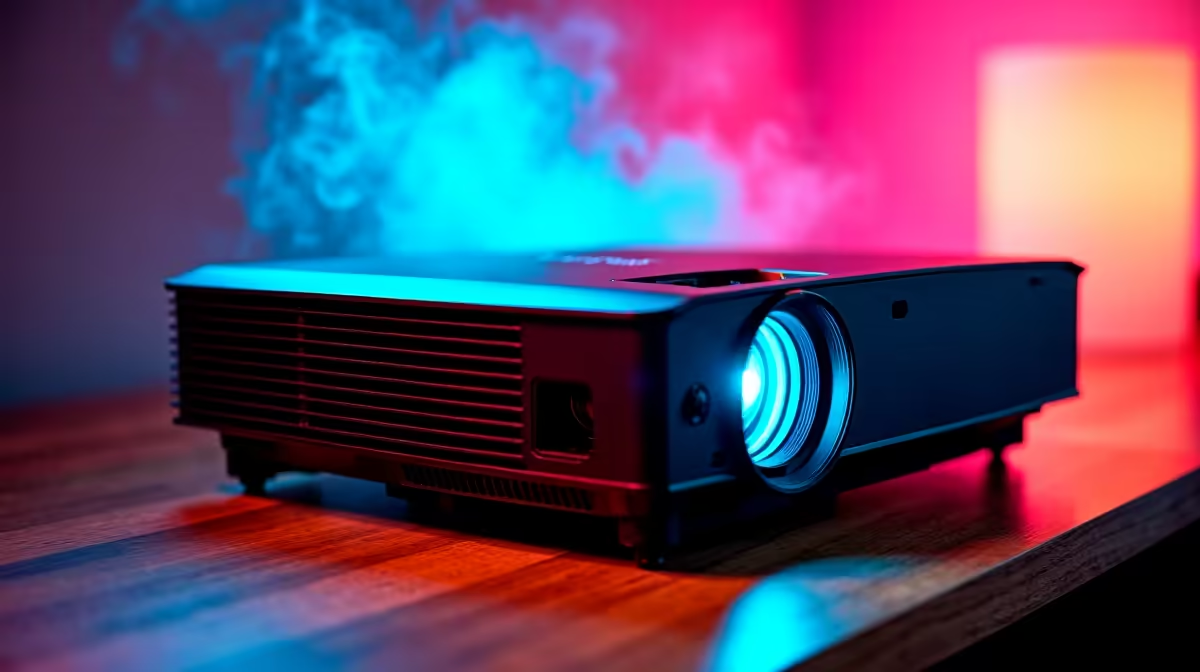
To use a projector for gaming with low input lag, choose a projector with a dedicated Game Mode that reduces processing delay to under 20ms, connect via HDMI 2.0 or 2.1, and disable image enhancement features like dynamic contrast and noise reduction that add latency.
Projectors have come a long way for gaming - getting one to feel responsive enough for competitive play or even immersive single-player is achievable with the right setup. The challenge is input lag, which projectors handle very differently from monitors. Here is how to get it right.
Understanding Input Lag on Projectors
Input lag on a projector is the delay between your controller or keyboard input and what appears on screen. Most consumer projectors, when set to default image modes, add 50ms to 120ms of processing delay. This is caused by image enhancement pipelines that sharpen, upscale, or colour-correct the signal in real time. For fast-paced games, anything above 30ms starts to feel noticeably sluggish. The key is Game Mode - almost every projector sold today includes it, but it is buried in menus and disabled by default. Enabling Game Mode bypasses most or all of the image processing pipeline. Many modern projectors drop to between 8ms and 20ms in Game Mode, which is competitive with budget gaming monitors. Check your projector's spec sheet for the "Game Mode input lag" figure specifically, not the general input lag rating.
Cable and Signal Setup for Minimum Latency
Your cable choice matters. Use HDMI 2.0 at minimum for 1080p at 60fps gaming, and HDMI 2.1 if your projector supports 4K or high refresh rates. Avoid using the projector's wireless or Bluetooth streaming features for gaming - they add 50ms to 200ms of additional latency on top of baseline projector lag. If you are connecting a gaming PC, set the output resolution in Windows display settings to exactly match the projector's native resolution - scaling mismatches force the projector's processor to work harder and can add lag even in Game Mode. For console gaming, make sure the console's output settings match the projector's capabilities, and disable HDR if the projector does not natively support it, as HDR tone mapping adds processing overhead.
Optimising the Room for Gaming
Projector gaming works best in a darkened room - ambient light washes out image contrast and can cause eyestrain during long sessions, which is a common setup mistake in well-lit SA living rooms. A screen specifically designed for projectors reflects light more efficiently than a plain wall, improving brightness without needing to push the lamp harder. Throw distance affects image size; a short-throw projector gives you a large image in a smaller room and is better suited for dedicated gaming setups. Sound is often overlooked - most projectors have weak built-in speakers, so pairing your projector with external audio makes the experience significantly more immersive.
Frequently Asked Questions
Q: What is a good input lag target for projector gaming? A: Under 20ms in Game Mode is excellent for most gaming, including competitive play. Under 30ms is acceptable for casual and single-player gaming. Anything above 50ms will feel noticeably sluggish.
Q: Can I use a projector for 144Hz gaming? A: Some projectors support 120Hz at 1080p or 4K, but 144Hz projectors are rare and expensive. Most projector gaming runs at 60Hz, which is fine for most genres but not ideal for competitive FPS titles.
Q: Is a projector or a large TV better for console gaming? A: A large TV typically has lower and more consistent input lag than a projector and is easier to set up. Projectors win on screen size per rand and portability, making them better for shared spaces or cinematic single-player experiences.
Ready to Find Your Perfect Match? Find a gaming PC to pair with your big-screen projector setup at Evetech.