Thinking about your next PC build? Forget the massive towers of yesterday. The real excitement is happening in a much smaller box. The latest compact rigs aren't just for browsing... they're becoming serious AI powerhouses. But figuring out the true Mini PC AI performance can be tricky. It’s not about clock speed anymore. It’s about new metrics that determine how well your machine can think. Let's dive into what really matters.
Beyond Clock Speeds: Understanding AI Performance Metrics
For years, we judged a PC by its gigahertz and core count. But for AI, that's only part of the story. True Mini PC AI performance hinges on specialised hardware designed for the unique workloads that machine learning demands. These tasks involve running millions of tiny calculations in parallel, something a traditional CPU isn't always optimised for.
So, what should you be looking for? The three key components are the NPU (Neural Processing Unit), the GPU (Graphics Processing Unit), and fast, high-capacity RAM. Getting the balance right is crucial for building a small-form-factor PC that punches well above its weight in AI tasks. Many of today's powerful mini PCs are already equipped with this next-gen tech.
The NPU: Your PC's Dedicated AI Brain 🧠
The newest buzzword in processing is the NPU, or Neural Processing Unit. Think of it as a dedicated co-processor built specifically to run AI models efficiently.
What is TOPS?
You'll see NPU performance measured in TOPS, which stands for Trillions of Operations Per Second. A higher TOPS number means the NPU can handle more AI calculations faster and with less power draw. This is perfect for tasks that run constantly in the background, like Windows Studio Effects for video calls or real-time language translation. Processors like AMD's Ryzen AI and Intel's Core Ultra series are leading the charge, with leading brands like Minisforum quickly adopting them. An NPU ensures your main CPU and GPU are free to focus on the task at hand… like gaming.
Why Your GPU Still Reigns Supreme for Heavy Lifting
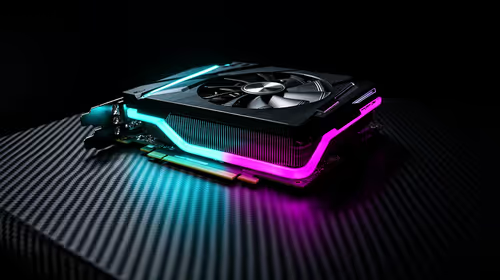
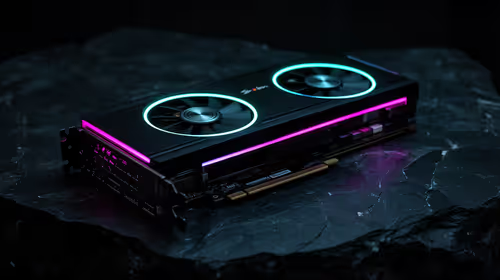
While the NPU is great for efficiency, the GPU is still the king when it comes to raw AI horsepower. For demanding tasks like generating images with Stable Diffusion, training a small machine learning model, or using AI-powered features in creative apps like Adobe Photoshop, a capable GPU is non-negotiable.
The secret ingredient here is VRAM (Video RAM). This is the GPU's dedicated, ultra-fast memory. Running large AI models requires a lot of it.
- 8GB VRAM: A decent starting point for experimenting with image generation.
- 12GB+ VRAM: Recommended for running larger, more complex models and achieving faster results without errors.
For serious AI work, the performance of a mini PC's graphics processor is a critical metric to consider.
Check Your Software Support 🔧
Before you buy, check which hardware your favourite AI tools are optimised for. Many creative and machine learning applications are built on NVIDIA's CUDA platform, which requires an NVIDIA GPU. For NPUs, software support is still growing, but it's the future for on-device AI efficiency!
Putting It All Together for Your Next Build
So, how do you choose the right machine? Excellent Mini PC AI performance comes from a balanced system. You don't need the absolute best of everything, but you do need the right components for your goals.
Consider what you'll be doing:
- For Everyday AI & Efficiency: A Mini PC with a modern CPU featuring a powerful NPU (40+ TOPS) is a fantastic, power-sipping choice.
- For AI-Powered Content Creation: Prioritise a system with a strong integrated or dedicated GPU with as much VRAM as your budget allows.
- For Future-Proofing: Aim for at least 16GB of system RAM, but 32GB is becoming the sweet spot for running local AI models smoothly alongside your other applications.
Finding the perfect fit means matching these metrics to your ambitions and budget. To see how these components come together in different packages, you can explore the latest models and find the one that ticks all your boxes. ✨
Ready to Unleash AI Power in a Small Package?
The era of local AI is here, and a compact powerhouse is the perfect way to get started. From creative projects to smarter workflows, the right machine makes all the difference. Browse our huge range of Mini PCs and find the perfect build for your desk.