So, you’ve downloaded a massive Large Language Model (LLM) like Llama 3 to run on your own rig. Awesome! But as you start generating text or code, a nagging question pops up: is your PC sweating bullets or just cruising? To get the most out of local AI, you need to know what’s happening under the hood. This guide will show you exactly how to monitor PC performance for LLMs, ensuring you spot bottlenecks before they throttle your creativity.
Why Monitoring Your PC's LLM Performance Matters
Running an LLM isn't like playing a game. It's a marathon for your hardware, stressing components in unique ways. Properly monitoring your PC's performance while running LLMs helps you:
- Identify Bottlenecks: Is it your GPU's VRAM, system RAM, or CPU holding you back? Knowing the weak link is the first step to a faster experience.
- Prevent Overheating: LLMs can push your GPU and CPU to their limits for extended periods. Monitoring temperatures is crucial to avoid thermal throttling or long-term damage.
- Optimise Your Workflow: By understanding your hardware's limits, you can choose the right model size (e.g., a 7B vs. a 70B parameter model) that runs smoothly on your machine.
Key Metrics to Monitor for LLM Performance ⚡
When you fire up an LLM, your PC's resources get put to the test. Forget frames-per-second; here are the numbers that truly count.
GPU VRAM Usage
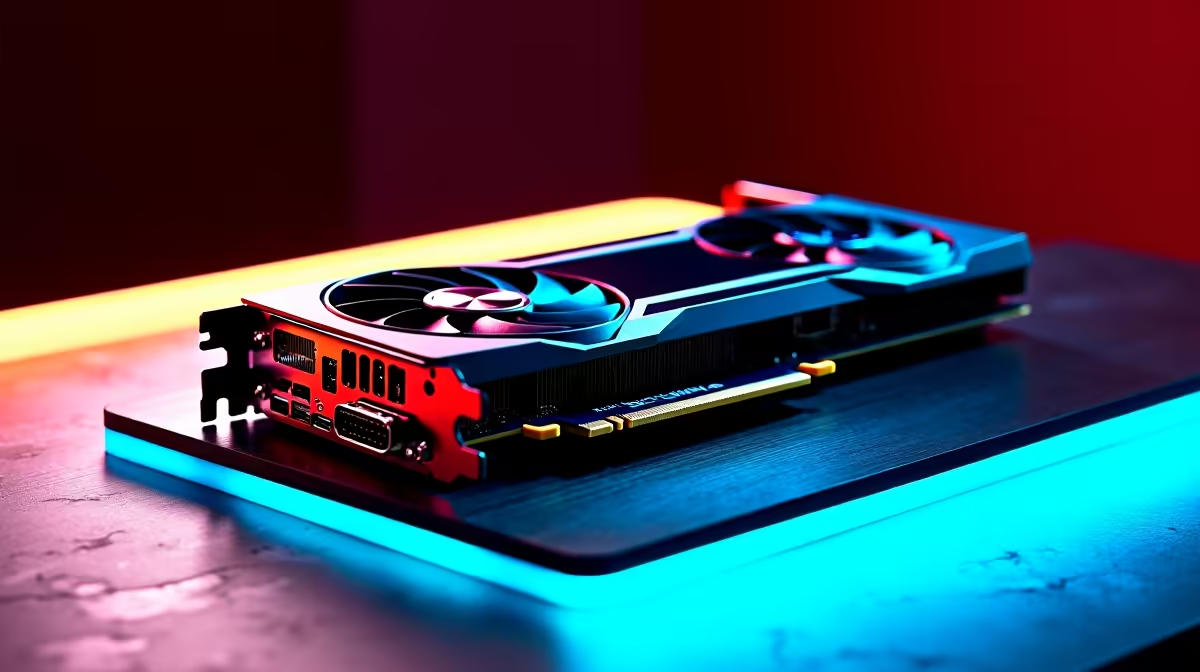
This is the big one. VRAM (Video Random Access Memory) is where the LLM's "brain"—its parameters—is loaded. If you don't have enough VRAM, your system will struggle, offloading to slower system RAM or failing entirely.
- What to look for: Aim to keep VRAM usage just under your card's maximum. If it's constantly maxed out, you're on the edge of a significant performance drop. A high-end NVIDIA GeForce Gaming PC with ample VRAM is often the top choice for serious AI enthusiasts.
GPU Utilisation
This metric shows how hard your GPU's core is working.
- What to look for: Ideally, you want to see high utilisation (90-100%) during model inference. If it's low, but your VRAM is full, the VRAM is your bottleneck. If both are low, something else, like your CPU, might be the problem.
Quick VRAM Check 🔧
For NVIDIA users, the command line is your friend. Open PowerShell or Command Prompt and type nvidia-smi. This gives you an instant, real-time snapshot of your GPU utilisation and, most importantly, how much VRAM is being used. It's the fastest way to check your primary resource for LLMs.
System RAM Usage
When your VRAM is full, your PC uses system RAM as overflow. This is much slower and can cripple your generation speed (tokens per second).
- What to look for: A sudden, massive spike in system RAM usage after your VRAM is full is a clear sign you're hitting a wall. For tasks that are heavy on both CPU and GPU, a balanced system like those found in our range of AMD Radeon Gaming PCs can offer excellent all-round performance.
CPU Usage
While the GPU does the heavy lifting, the CPU is still vital for preparing data and managing the overall process.
- What to look for: A CPU core (or several) pegged at 100% could mean it's struggling to feed the GPU data fast enough, creating a CPU bottleneck. This is less common but can happen with very fast GPUs and older processors.
Interpreting the Data: What's Next? ✨
So, you've monitored your PC performance for LLMs and found a bottleneck. What now?
If VRAM is consistently your limiting factor, the only real solution is a GPU with more memory. If you're doing professional AI development or running the largest available models, investing in purpose-built Workstation PCs can provide the stability and raw power needed for these demanding, long-running tasks. They are optimised for sustained loads far beyond typical gaming sessions.
Monitoring your hardware is the key to unlocking your PC's true AI potential. It transforms guesswork into a clear, data-driven path toward a smoother and more powerful local LLM experience.
Ready to Unleash True AI Power?
Monitoring your PC for LLMs reveals the limits of your current hardware. When you're ready to break through those barriers, Evetech has the components and pre-built systems to take your AI journey to the next level. Build your ultimate AI powerhouse with our Custom PC Builder and configure a machine that's perfect for your needs.