You know the pain. That split-second of lag that costs you the match. In South Africa, we're all too familiar with network hiccups. But what if that same lag wasn't just ruining your K/D ratio, but stalling a multi-million rand AI project? The truth is, the network speed for AI development is just as crucial as a high-end GPU. It’s the unsung hero powering the next tech revolution, right from your home office or startup hub.
Why Your AI Development Network Speed is Non-Negotiable
When we talk about building a powerful PC, our minds jump straight to processors and graphics cards. But for artificial intelligence, your network connection is the digital highway that feeds your beastly machine. Without a wide, fast, and stable highway, even the most powerful hardware sits idle, waiting for data.
Think of it this way: Bandwidth is how many lanes your highway has, while latency (ping) is the speed limit. For AI, you need both. You need massive bandwidth to move terabytes of training data and low latency for real-time collaboration and model deployment. Poor network performance for AI creates a bottleneck that no amount of processing power can fix.
The Three Bottlenecks Where Network Speed Matters Most
Your AI workflow has several critical points where a slow connection can bring everything to a grinding halt. Understanding these helps you see why optimising your network speed for AI development is mission-critical.
1. Training: The Great Data Deluge 🌊
Modern AI models are data-hungry. Datasets for image recognition or large language models (LLMs) can be enormous, often hundreds of gigabytes or even terabytes. Downloading this data, or syncing it from a cloud server, is the first step. A slow connection can mean days... or even weeks... of waiting before you can even begin training. A rig with a powerful GPU, like those found in our NVIDIA GeForce Gaming PCs, needs a constant flow of data to stretch its legs.
2. Collaboration: Syncing Across Mzansi
AI development is rarely a solo sport. Teams are often distributed, collaborating on code and models using platforms like GitHub or private servers. When you’re pushing and pulling large model checkpoints or experimental code branches, a high-speed connection is essential for a smooth workflow. A fast network ensures your team stays in sync, whether they're in Cape Town or Jozi, making versatile machines like our AMD Radeon Gaming PCs perfect for developers who also love to game.
3. Inference: The Need for Real-Time Speed 🚀
Once your model is trained, it needs to be deployed. This is the "inference" stage, where the AI makes predictions based on new data. For applications like live video analysis, financial fraud detection, or responsive chatbots, latency is the enemy. Your network must deliver data to the model and return the result in milliseconds. For these demanding, always-on tasks, a dedicated machine from our range of powerful Workstation PCs ensures maximum reliability and performance.
Quick Wins to Optimise Your AI Network 🔧
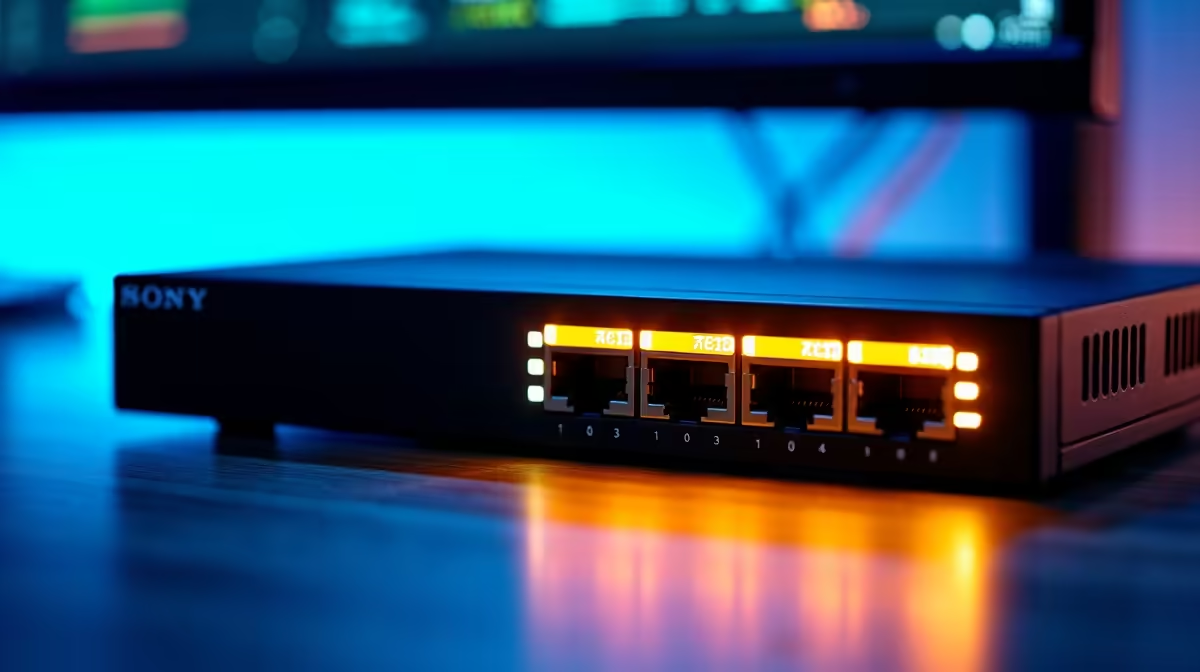
While getting fibre is the ultimate goal, there are things you can do right now to improve your setup. A stable local network is just as important as your internet provider's speed.
Pro Tip: Prioritise Your Traffic ⚡
Most modern routers have a setting called Quality of Service (QoS). You can configure it to prioritise traffic from your development machine over other devices on the network. This ensures that your large data transfers or cloud syncing don't get slowed down by someone streaming 4K video in the next room. Always choose a wired Ethernet connection over Wi-Fi for maximum stability and speed!
Ultimately, the journey into AI development requires a holistic view of your hardware. Your CPU, GPU, RAM, and storage are the engine, but your network is the fuel line. Starve it, and your performance will sputter. By ensuring your AI network requirements are met, you create an environment where innovation can happen at the speed of thought, not the speed of your connection.
Ready to Build Your AI Powerhouse? A lightning-fast network is only one part of the equation. To truly crush complex models and massive datasets, you need a machine built for the task. Explore our range of purpose-built Workstation PCs and unlock your full AI potential.