So, you’ve got a beast of a gaming rig that crushes the latest titles. But what if that same PC could do more? What if it could learn, create, and solve complex problems? Welcome to the world of AI. To optimize your PC for machine learning, you don't need a supercomputer from a sci-fi movie. Your gaming setup is already halfway there. Let's fine-tune it and unlock its hidden genius. 🚀
The Hardware Foundation: What Your PC Needs for ML
Before you write a single line of code, getting the hardware right is crucial. A balanced system ensures you're not bottlenecked when training models or processing massive datasets. Optimising your PC for ML starts with these core components.
The GPU: Your AI Workhorse
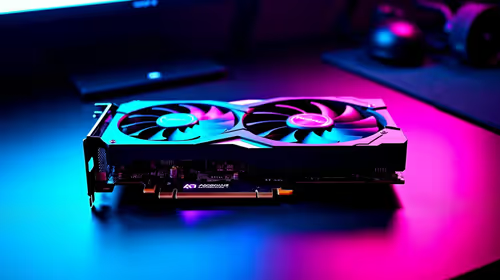
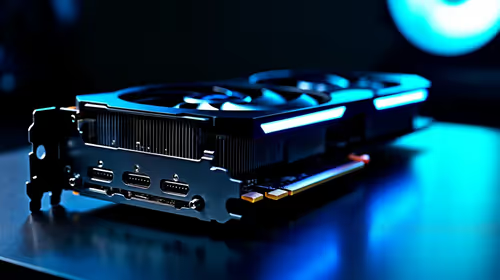
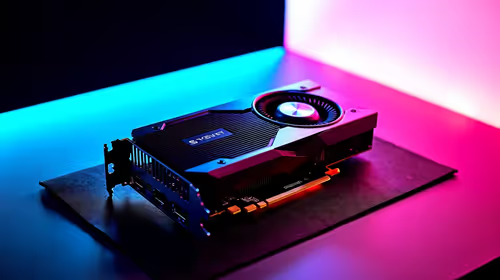
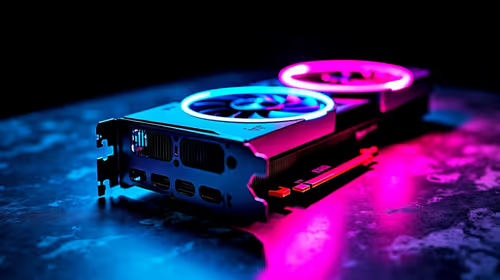
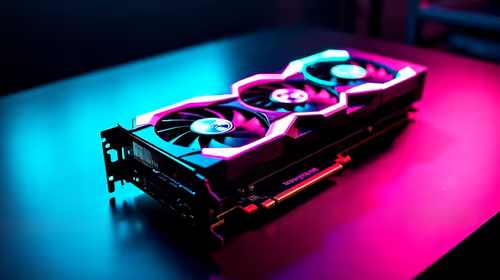
The Graphics Processing Unit (GPU) is the heart of any machine learning PC. Its parallel processing power, designed for rendering complex game graphics, is perfect for the mathematical heavy lifting of training neural networks.
- NVIDIA: Thanks to its CUDA platform, NVIDIA is the industry standard. The more CUDA cores and VRAM, the better. Exploring builds from our range of NVIDIA GeForce gaming PCs is an excellent starting point for any aspiring ML enthusiast.
- AMD & Intel: While NVIDIA dominates, don't count the others out. The latest AMD Radeon gaming PCs offer incredible performance-per-rand, and the landscape is constantly evolving with promising newcomers like these Intel Arc gaming PCs.
CPU & RAM: The Unsung Heroes
While the GPU handles the main training tasks, the Central Processing Unit (CPU) and Random Access Memory (RAM) are vital for data preparation and system responsiveness. A CPU with many cores, like those found in our AMD Ryzen PC deals, excels at preprocessing data before it even hits the GPU.
For RAM, 16GB is a bare minimum, but 32GB or more is strongly recommended. Machine learning models can be memory-hungry, and you don't want your system grinding to a halt. Pairing a high core-count processor from our Intel PC deals with ample RAM creates a balanced and powerful machine learning setup.
Software Setup: Optimising Your Digital Environment 🔧
With the right hardware in place, the next step is to configure your software environment. This is a critical part of the process to optimize your PC for machine learning and ensure everything runs smoothly.
Drivers and Libraries
Always start by installing the latest drivers for your graphics card. For NVIDIA users, the "Studio Driver" is often a more stable choice for creative and scientific workloads than the "Game Ready Driver".
Next, you’ll need to install core libraries like TensorFlow or PyTorch. This is where a clean setup becomes essential to avoid dependency conflicts down the line.
Pro Tip: Isolate Your Projects ✨
Always use virtual environments for your Python projects! It's a simple practice that saves massive headaches. Open your terminal in your project folder and type python -m venv venv to create one. Activate it with .\venv\Scripts\activate (on Windows). This keeps each project's dependencies separate and clean.
Windows Subsystem for Linux (WSL)
For those on Windows, WSL is a fantastic tool. It allows you to run a genuine Linux environment directly on Windows, without the need for a dual-boot setup. Many ML tools and guides are developed for Linux first, making WSL an invaluable asset for a smooth development experience.
Finding the Right Rig for Your ML Journey
Are you just starting out, or are you planning to train massive, complex models? Your needs will determine the best PC configuration.
For beginners, many of our budget gaming PCs offer a fantastic entry point into the world of AI. If you're looking for a bit more punch without breaking the bank, check out our best gaming PC deals for a great balance of price and performance. For those who want a system built and optimised from the ground up, our pre-built PC deals take the guesswork out of the equation. And for the pros who need uncompromising power and reliability for serious workloads, our dedicated workstation PCs are engineered to deliver maximum performance.
Ready to Build Your AI Powerhouse? The world of AI and machine learning starts with the right hardware. Whether you're training models or just exploring, a powerful PC is your launchpad. Explore our range of powerful workstation PCs and find the perfect machine to bring your ideas to life.