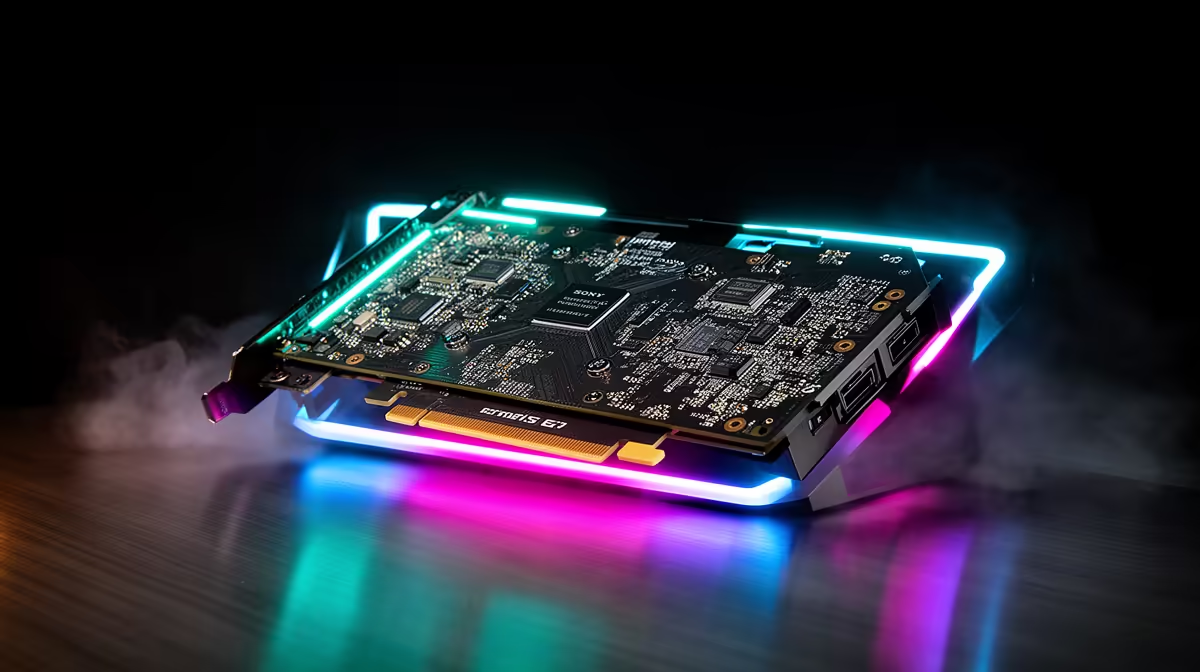
Ever wondered how AI tools like ChatGPT can spit out a detailed response in seconds? It’s not magic... it’s maths, and a whole lot of speed. For South African gamers and creators, the secret sauce is a concept you’re already familiar with: parallel processing. This is the core principle that lets your GPU render beautiful game worlds, and it's the exact same tech that's supercharging the AI revolution. Let's break it down.
Understanding Parallel Processing in LLMs
At its heart, parallel processing in an LLM (Large Language Model) is about tackling a massive job by breaking it into smaller pieces and doing them all at once. 🧠
Imagine you need to assemble 1,000 flat-pack chairs. Doing it alone (serial processing) would take ages. You’d build one chair completely, then start the next.
Now, imagine you have a team of 1,000 people. You give each person one chair to build. Everyone works at the same time (in parallel), and the entire job is finished in the time it takes to build just one chair. That’s the fundamental power of parallel computing, and it's how modern AI avoids getting bogged down. Instead of one massive calculation, an LLM performs thousands of smaller ones simultaneously.
The GPU: The Unsung Hero of AI Speed
So, what piece of hardware is perfect for doing thousands of things at once? Your graphics card. A modern CPU has a handful of powerful cores, great for complex, sequential tasks. But a GPU has thousands of smaller, simpler cores designed to work in unison.
This architecture is why your graphics card can render millions of pixels every frame in a game like Apex Legends or Warzone. Each core handles a small part of the visual puzzle simultaneously. This makes GPUs the ultimate tool for AI workloads. The same design that paints a beautiful sunset over Verdansk is also ideal for the kind of parallel processing LLMs rely on to function at high speed.
For years, PC enthusiasts have known that NVIDIA GeForce gaming PCs with their CUDA cores offer incredible performance for tasks that can be run in parallel. It's no surprise they have become a go-to for AI developers. Similarly, the powerful architecture inside modern AMD Radeon gaming PCs also delivers the raw parallel horsepower needed to drive both high-fidelity gaming and complex AI computations. 🚀
Different Flavours of AI Parallelism
Not all parallel processing is the same. In the world of AI and LLMs, developers use a few key strategies to achieve maximum speed and efficiency. Understanding them helps clarify why certain hardware choices are so important.
Data Parallelism
This is the most common type. You take a massive dataset, split it into chunks, and send each chunk to a different GPU core (or even a different GPU altogether). Each core runs the same calculation on its unique piece of data. It’s like having multiple production lines making the same product—you just get more done, faster.
Model Parallelism
What happens when the AI model itself is too enormous to fit onto a single GPU's memory? You use model parallelism. Here, the model is split into different layers or parts, with each part living on a separate GPU. Data flows through the first part of the model on GPU 1, then the output is passed to GPU 2 for the next stage, and so on. This is essential for training today's gigantic LLMs.
Hardware Pro Tip 🔧
serious AI development or 3D rendering that requires model parallelism, a single gaming GPU might not be enough. This is where dedicated [workstation PCs](https: www.evetech.co.za workstation-pcs x 1503) shine. They are often configured with multiple high-VRAM GPUs, more RAM, and robust power delivery to handle sustained, complex parallel workloads that would overwhelm a typical gaming rig.
By combining these techniques, AI developers can train and run models that would have been computationally impossible just a few years ago. The result? Faster, smarter, and more capable AI for everyone.
Ready to Harness This Power? Whether you're dominating the latest AAA title or exploring the world of AI, the secret to incredible speed is the right hardware. A powerful GPU is your gateway to next-level performance. Explore our massive range of custom-built PCs and find the perfect machine to supercharge your world.