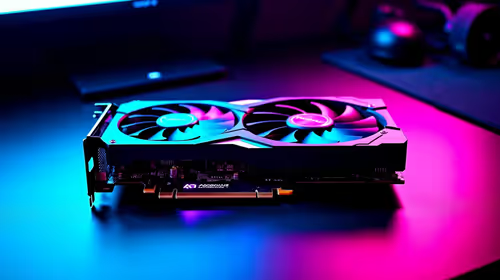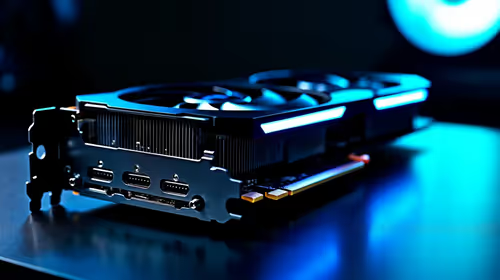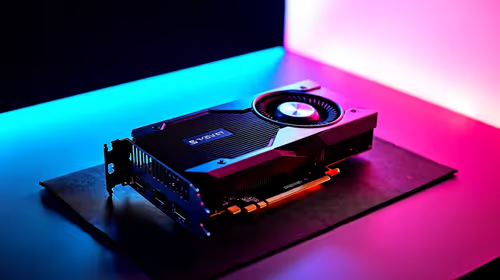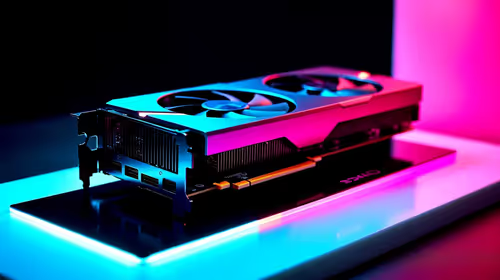
You’re generating incredible AI art with Stable Diffusion, or maybe you're training a local model for a new project. But have you noticed your PC fans screaming like a jet engine? That’s your hardware crying for help. The intense, sustained processing required by AI generates a massive amount of heat. Effective PC cooling for AI workloads isn’t just a nice-to-have… it’s essential for performance. We put it to the test to show you why.
Why AI Puts Your PC's Cooling to the Test
Gaming is intense, but it’s often a sprint. AI workloads, on the other hand, are a marathon. They push your CPU and GPU to their absolute limits for minutes or even hours at a time. This sustained load creates a constant build-up of heat that standard coolers might struggle with.
When components get too hot, they automatically slow down to protect themselves—a process called thermal throttling. Suddenly, your lightning-fast renders take forever, and your model training times double. This can happen even on some of the best gaming PC deals if the cooling isn't optimised for these specific, demanding tasks. The right thermal management for AI is what separates a powerful PC from a truly productive one.
The Evetech Lab: Our AI Cooling Test Bench 🔧
To get some real-world data, we set up a typical high-end build in our lab. We wanted to simulate a realistic scenario for a South African creator or developer.
Our test rig was a powerful machine, similar in spec to a high-end NVIDIA GeForce gaming PC, featuring a current-gen Intel Core i9 processor and an RTX 40-series GPU. This kind of setup is also the foundation for many of our powerful workstation PCs.
The Test: We ran a continuous AI image generation benchmark for 30 minutes, measuring CPU and GPU temperatures and clock speeds.
The Contenders:
- Cooler A: A premium, dual-tower air cooler.
- Cooler B: A 360mm All-in-One (AIO) liquid cooler.
The goal was simple: to see which PC cooling for AI workloads could maintain peak performance without throttling.
Monitor Your Temps 🌡️
Keeping an eye on your component temperatures is crucial. Free tools like HWMonitor or MSI Afterburner give you a real-time view of your CPU and GPU heat. If you see temperatures consistently hitting 90-100°C under load, your cooling solution might be holding back your PC's performance.
The Results Are In: Air vs. Liquid Cooling for AI
After 30 minutes of gruelling AI processing, the results were crystal clear. While both coolers kept the system from overheating, their impact on performance was dramatically different.
The Air Cooler's Performance
The high-end air cooler did an admirable job for the first 15 minutes. However, as heat saturated the heatsink, temperatures began to climb steadily. By the 25-minute mark, the CPU started to thermal throttle, dropping its clock speed by nearly 300MHz to cope. It got the job done... but not at full speed. This is a common bottleneck we see, which is why we carefully select coolers across our range of Intel PC deals.
The AIO Liquid Cooler's Dominance ✨
The 360mm AIO was in a different league. The large radiator and constant fluid circulation dissipated heat far more effectively. Throughout the entire 30-minute test, the CPU temperature remained well below the throttle point. It maintained its maximum boost clock from start to finish, completing the benchmark nearly 15% faster than the air-cooled setup. Whether you're looking at Intel or our AMD Ryzen PC deals, this performance gap highlights the importance of superior cooling for serious work.
What This Means for Your Next PC
So, what kind of cooling do you need? It depends entirely on your use case.
For casual AI tinkering or using AI-driven features in games and apps, a quality air cooler found in many of our budget gaming PCs will likely be sufficient, provided your case has good airflow.
However, if you're a professional, a researcher, or a serious hobbyist who relies on your PC for heavy AI tasks, our tests show that an AIO liquid cooler is a worthy investment. It's the key to unlocking consistent, reliable performance from high-end components, whether you're running a rig from our AMD Radeon gaming PCs lineup or the latest Intel Arc gaming PCs. Don't let inadequate cooling be the bottleneck in your workflow. For a hassle-free, expertly balanced system, exploring our pre-built PC deals is a great place to start, as they are configured by experts who understand these thermal challenges.
Ultimately, the best PC cooling for AI workloads is the one that allows your hardware to run at its full potential, ensuring you get every rand of performance you paid for. 🚀
Ready to Build Your AI Powerhouse? Don't let thermal throttling cap your creativity or research. The right cooling is crucial for any serious AI workload. Use our Custom PC Builder to design a machine with the perfect cooling solution for your specific needs.