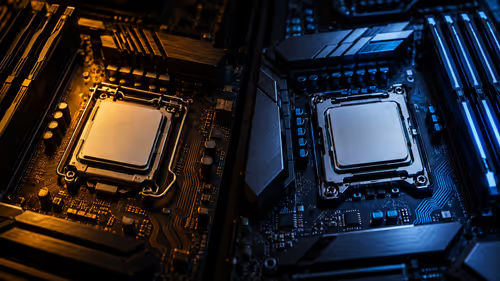
So, you’ve been playing with ChatGPT and are hooked. But what if you could run powerful AI like that locally, on your own machine, without queues or internet lag? Building a PC for Large Language Models (LLMs) is the next frontier for tech enthusiasts in South Africa. It’s about more than just bragging rights; it's about privacy, speed, and unfiltered access to the future of technology. Let's dive into what you need. 🤖
Why Build a PC for Large Language Models?
Running an LLM on your own hardware puts you in the driver's seat. Forget relying on servers in another hemisphere. A dedicated PC for Large Language Models gives you three massive advantages:
- Privacy: Your data and prompts stay on your machine. Period.
- Speed: Inference (getting a response from the model) is lightning-fast, limited only by your hardware.
- Freedom: Experiment with open-source models, fine-tune them for specific tasks, and use them offline. It's your own personal AI sandbox.
The Core Components for Your LLM Build
While a gaming PC has some overlap, the priorities for an LLM machine are different. Here’s where to focus your budget.
The GPU: VRAM is King 🧠
This is the single most important component. Large Language Models are massive, and they need to be loaded into the GPU's video memory (VRAM) to run efficiently. Raw gaming speed is secondary to VRAM capacity.
- 12GB VRAM: A good starting point for experimenting with smaller 7-billion parameter models.
- 16GB VRAM: The sweet spot for running popular medium-sized models effectively.
- 24GB+ VRAM: Essential for serious developers or those wanting to run larger, more capable models without compromises.
For this reason, NVIDIA GPUs are currently the undisputed champions in the AI space due to their CUDA software ecosystem. High-end NVIDIA GeForce gaming PCs with cards like the RTX 4080 Super or RTX 4090 are fantastic starting points. While AMD Radeon gaming PCs offer great gaming value, their software support for AI workloads is still maturing, making NVIDIA a safer bet for now.
Check the Model Size First! ⚡
Before buying a GPU, look up the VRAM requirements for the specific LLM you want to run (e.g., Llama 3, Mixtral). A quick search for "Llama 3 8B VRAM requirements" will tell you exactly what you need, preventing a costly mistake. For example, a 7B parameter model often needs at least 8-10GB of VRAM to run smoothly.
System RAM & Storage
Your system RAM acts as a backup if you run out of VRAM, but it's much slower. A good rule of thumb is to have at least double the system RAM as you have VRAM. So, for a 16GB GPU, aim for 32GB of fast DDR5 RAM.
For storage, a fast NVMe SSD is non-negotiable. Models can be huge (5GB to over 100GB), and loading them from a slow hard drive will create a serious bottleneck.
Gaming Rig or Dedicated AI Workstation?
So, can your gaming PC double as a PC for LLMs? Absolutely! A high-end gaming rig with a modern NVIDIA card is a perfect entry point into the world of local AI. You get a machine that can smash the latest AAA titles and run complex language models. 🚀
However, if your primary goal is AI development, machine learning, or running multiple models, stepping up to one of our powerful workstation PCs makes a lot of sense. These machines are optimised for sustained, heavy workloads with superior cooling, more robust power delivery, and support for multiple GPUs, giving you a professional-grade platform to build upon.
Ready to Build Your AI Powerhouse? Running local AI is no longer science fiction. For the ultimate performance and customisation in South Africa, a purpose-built PC is the only way to go. Explore our powerful workstation PCs and start your journey into the future of AI today.