Ever wrestled with a slow, clunky AI model on your PC? You're not alone in Mzansi. Large Language Models (LLMs) are powerful but demand serious hardware. Getting your PC optimization for LLM right is the key to faster, more accurate results, whether you're experimenting with local AI or building the next big thing. Let's dive into how you can fine-tune your rig and unlock true AI potential right here in South Africa. 🚀
Why PC Optimization for LLM is Crucial
Before tweaking settings, it helps to understand why LLMs are so hungry for resources. These complex neural networks, like the ones powering ChatGPT or Stable Diffusion, consist of billions of parameters. Think of these as the model's 'neurons'. To run a model, your PC must load these parameters into its memory and perform trillions of calculations.
Poor PC optimization for LLM leads to frustratingly slow inference (generation) times and can even cause errors or crashes. A well-optimised machine, however, allows you to iterate faster, test different models, and ultimately achieve more accurate and useful outputs. It’s the difference between a sluggish assistant and a lightning-fast creative partner.
The Core Components for Peak LLM Performance
Your PC is a team of components, but for AI, a few players are the undeniable stars of the show. Focusing your optimisation efforts here will yield the biggest gains.
The GPU: Your AI Powerhouse ⚡
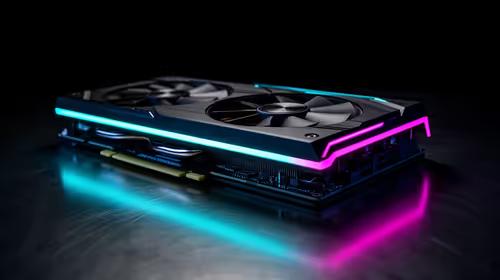
The Graphics Processing Unit (GPU) is the single most important piece of hardware for running LLMs locally. Its thousands of parallel processing cores are perfectly suited for the mathematical operations AI relies on.
The main factor to consider is VRAM (Video RAM). This is the dedicated memory on your graphics card where the model's parameters are stored. If a model is too large for your VRAM, it simply won't run efficiently, if at all. For anyone serious about local AI, a GPU with at least 12GB of VRAM is a strong starting point. NVIDIA's CUDA technology has long been the industry standard, making their cards a popular choice. High-performance NVIDIA GeForce gaming PCs often come equipped with the VRAM and core counts needed to get started.
Of course, NVIDIA isn't the only option. AMD has made significant strides, and their hardware often presents a compelling value proposition. For developers and enthusiasts willing to work with alternative software platforms like ROCm, a system built around one of Evetech's AMD Radeon gaming PCs can deliver incredible performance for the price.
System RAM: Don't Let It Be a Bottleneck
While VRAM holds the model, your system RAM holds the operating system, your applications, and the data you're actively working with. If you're running an LLM while multitasking, insufficient RAM will force your system to use slower storage (a swap file), grinding performance to a halt. For smooth PC optimization for LLM, 32GB of fast DDR4 or DDR5 RAM should be your baseline.
Check Your VRAM Usage 🔧
On a Windows PC with an NVIDIA GPU, you can easily monitor your VRAM usage. Just open the Command Prompt and type nvidia-smi. This command-line utility shows you exactly how much VRAM is being used, helping you understand if your GPU is the bottleneck when running a specific LLM.
Storage Speed: From Loading to Launching
LLM files can be massive, often spanning tens of gigabytes. Loading these models from a traditional hard drive can take ages. An NVMe SSD (Non-Volatile Memory Express Solid-State Drive) drastically cuts down these loading times. The faster your storage, the quicker you can switch between models or restart a project, which is a massive quality-of-life improvement.
When an Upgrade is the Smartest Move ✨
Software tweaks and driver updates can only take you so far. If your hardware is fundamentally underpowered—for instance, a GPU with less than 8GB of VRAM or a system with only 16GB of RAM—you will constantly hit a performance ceiling. The most effective PC optimization for LLM is sometimes a strategic upgrade.
For professionals, data scientists, or serious developers in South Africa whose time is money, investing in a purpose-built machine is the logical next step. These systems are designed for sustained, heavy workloads, with superior cooling and component synergy. Exploring dedicated workstation PCs can reveal options specifically configured for the intense demands of AI and machine learning, saving you the guesswork and ensuring stability.
Ready to Build Your AI Powerhouse? Optimising your current rig can take you far, but for serious AI development, the right foundation is everything. Stop wrestling with hardware limitations. Explore our range of powerful Workstation PCs and configure a machine built to crush complex models and accelerate your projects in Mzansi.