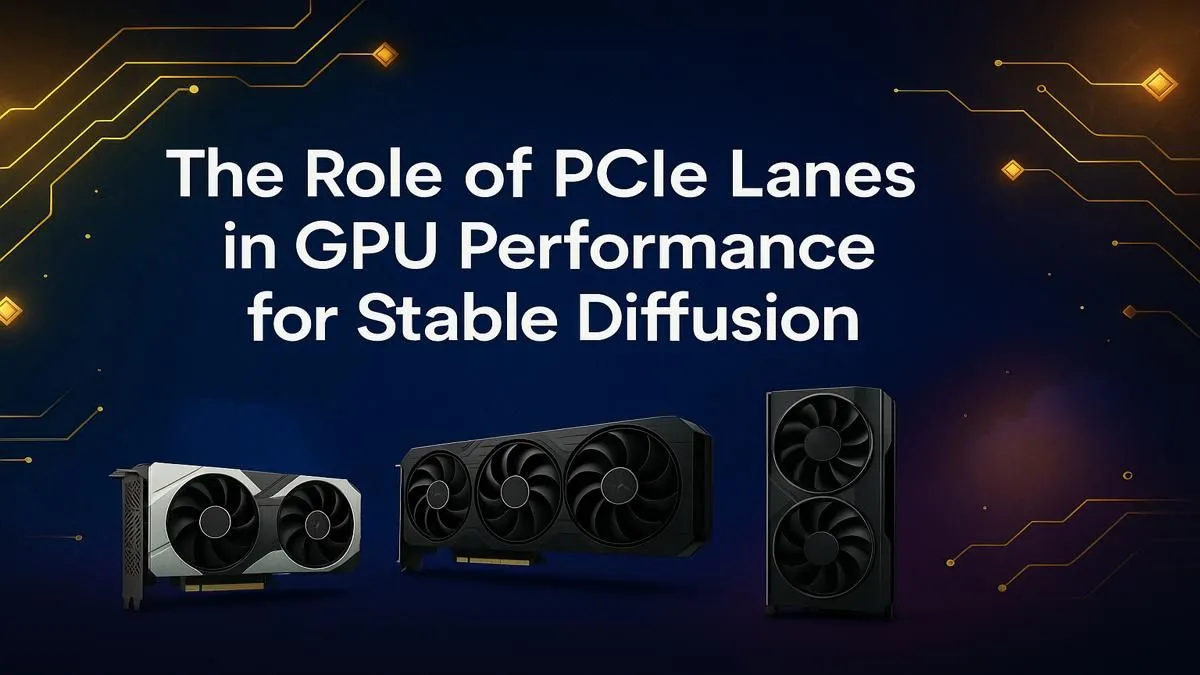
You’ve got a powerful gaming rig, and now you’re diving into the incredible world of AI art with Stable Diffusion. It’s a wild ride. But as you tweak prompts and chase that perfect image, a technical question pops up: do PCIe lanes for Stable Diffusion really matter? You've optimised your PC for framerates, but is the data highway between your CPU and GPU a bottleneck for your creativity? Let's break it down, South African style. ⚡
Understanding PCIe Lanes and Your GPU
First, what even are PCIe lanes? Think of them as the highways on your motherboard that carry data between your components. Your graphics card slots into a PCIe slot, and the number of lanes (like x16, x8, or x4) determines the width of that highway. A PCIe 4.0 x16 slot is a massive, super-fast motorway, while a PCIe 3.0 x4 slot is more like a quiet suburban road.
For gaming, more lanes at a higher generation (like PCIe 4.0 or 5.0) can mean a slight performance uplift by ensuring the GPU gets all the data it needs without delay. But does this same logic apply to AI image generation?
The Real Impact of PCIe Lanes on Stable Diffusion
Here’s the short answer: for most users, not really. The most demanding part of running Stable Diffusion is the image generation itself (the inference step). During this process, the AI model is loaded directly into your GPU's VRAM. Once it's there, your GPU is doing all the heavy lifting internally. The communication back and forth over the PCIe bus is minimal.
The main moment the PCIe lanes for Stable Diffusion come into play is during the initial loading of the model into VRAM. A faster connection (like x16) will load that 2-8 GB model a few seconds quicker than a slower one (like x8). But once it’s loaded, the performance difference for generating images is often negligible... we're talking milliseconds. Your GPU's core count and, most importantly, its VRAM capacity and speed are the true kings here. Whether you're looking at mainstream NVIDIA GeForce cards or powerful AMD Radeon options, VRAM is your primary focus.
Check Your Link Speed! 🔧
Not sure if your GPU is running at its full potential? Download a free tool like GPU-Z. In the "Graphics Card" tab, look for the "Bus Interface" field. It will tell you your slot type and what it's currently running at (e.g., PCIe x16 4.0 @ x16 4.0). Sometimes, a GPU in the wrong slot or a BIOS setting can limit your bandwidth without you even knowing!
When PCIe Bandwidth Actually Becomes a Bottleneck
So, is the discussion around PCIe lanes for Stable Diffusion completely irrelevant? Not entirely. There are a few specific scenarios where having maximum bandwidth is crucial:
- Training Models: If you are training or fine-tuning your own AI models, there is a constant, massive flow of data between your system RAM, CPU, and GPU. Here, every bit of bandwidth helps.
- Out-of-Memory Scenarios: If you're working with enormous models that don't fit entirely in your GPU's VRAM, the system will use shared memory (piping data over the PCIe bus). This is slow and not ideal, but a faster bus will make it less painful.
- Multi-GPU Setups: Running two or more GPUs for a single task requires a high-speed interconnect, and the underlying PCIe infrastructure is vital. This is where high-end workstation graphics cards on motherboards with plenty of lanes truly shine.
For the average South African hobbyist or artist generating images, your money is far better spent on a GPU with more VRAM than on a motherboard upgrade just for more PCIe 5.0 lanes. A solid card with 12GB+ of VRAM on a standard PCIe 4.0 x16 or even x8 connection will deliver fantastic results. 🚀
Ready to Unleash Your AI Creativity? Worrying about PCIe lanes is for the 1%, but having enough VRAM and raw power is for everyone. For the best performance in Stable Diffusion, the right graphics card is non-negotiable. Explore our massive range of graphics cards and find the perfect engine for your digital canvas.