You've seen the incredible AI-generated art and clever chatbots taking over the internet. Now you want to run these Large Language Models (LLMs) on your own machine. But the big question hits: how much RAM for LLM performance is actually enough? Is your trusty gaming rig up to the task, or are you looking at a major upgrade? Let's break down exactly what you need to dive into the world of local AI, right here in South Africa. 🇿🇦
The Golden Rule: Model Size vs. Memory
Before we talk gigabytes, let's get one thing straight: the amount of RAM you need is directly tied to the size of the LLM you want to run. Think of an LLM as a massive library of books (these are its "parameters"). To read any book, you first need to take it off the shelf and put it on your desk. Your RAM (and VRAM) is that desk. A bigger model means more books, demanding a bigger desk.
These models are measured in billions ofparameters. For example:
- Small Models (e.g., Llama 3 8B): These are relatively light and can run on more modest hardware.
- Medium Models (e.g., Mixtral 8x7B): These are more capable and require a significant memory jump.
- Large Models (e.g., Llama 3 70B): These are powerful beasts that demand serious hardware.
System RAM vs. VRAM: The Critical Difference for LLMs
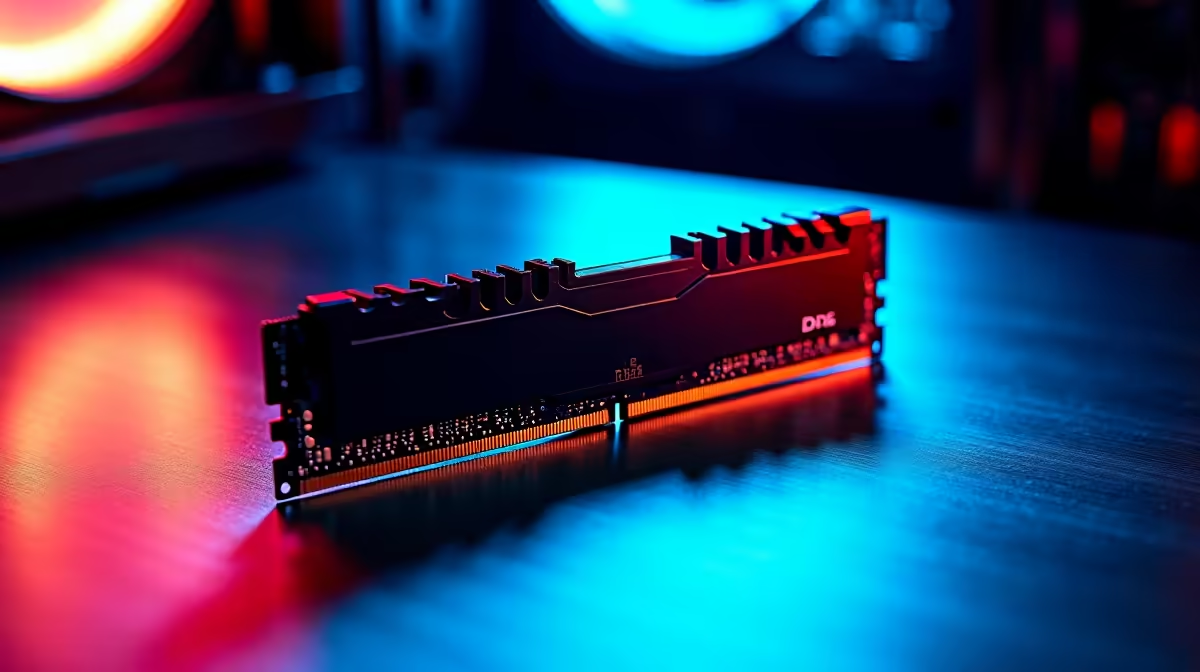
When discussing memory for AI, we have to distinguish between two types: your system's main RAM (the sticks on your motherboard) and your graphics card's VRAM.
For LLMs, VRAM is king. 👑 It's significantly faster, and loading the model onto the GPU's VRAM provides the best performance by a long shot. If the model is too big for your VRAM, the system will use your slower system RAM, which can drastically reduce the speed at which the AI generates responses (its "tokens per second").
This is why a powerful graphics card is so crucial. High-end NVIDIA GeForce Gaming PCs with cards like the RTX 4080 SUPER (16GB) or RTX 4090 (24GB) are popular choices because their generous VRAM can handle very large models entirely on the GPU.
Pro Tip: Check the Quantization ⚡
When downloading an LLM, look for different versions called 'quantizations' (like Q4_K_M or GGUF). These are compressed versions of the model that use significantly less RAM and VRAM with only a minor drop in quality. This trick can make a massive model runnable on a machine that otherwise wouldn't stand a chance.
How Much RAM for LLM Performance Do You Really Need?
Let's get practical. Here are some real-world recommendations based on what you want to achieve.
### Entry-Level Tinkering (7B-13B Models)
For experimenting with smaller models like Llama 3 8B or Phi-3 Mini, you'll want:
- System RAM: 32GB is the new sweet spot. 16GB can work, but you'll be pushing it.
- VRAM: A GPU with 8GB - 12GB of VRAM is a great starting point.
### Enthusiast AI (13B-40B Models)
This is where you can run more powerful and creative models for tasks like coding assistance or advanced text generation.
- System RAM: 32GB is the minimum, but 64GB is strongly recommended to avoid bottlenecks.
- VRAM: 16GB+ is ideal. This is where cards like the RTX 4080 Super shine. Don't count out Team Red, either; modern AMD Radeon Gaming PCs offer excellent performance-per-rand and are becoming increasingly competitive in the AI space.
### Pro-Level & Future-Proofing (70B+ Models)
If you're serious about running the biggest open-source models available or even fine-tuning your own, you need to bring out the big guns.
- System RAM: 64GB is the absolute minimum, with 128GB or more being the standard.
- VRAM: 24GB is the goal. For these demanding workloads, you're moving beyond standard gaming rigs and into the realm of high-performance Workstation PCs, which are built to handle massive datasets and sustained computational loads with ease. 🚀
The Verdict: More is Always Better
When it comes to RAM for LLM performance, the answer isn't a single number. It depends entirely on your ambition. While your current gaming PC might be a great starting point for smaller models, diving deeper into the AI world requires a serious look at both your system RAM and, most importantly, your GPU's VRAM. Investing in a machine with ample memory today is the best way to prepare for the even more powerful models of tomorrow.