Quick Answer
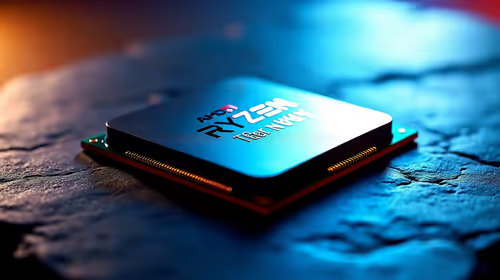
The Ryzen 5 9600X is a capable processor for entry-level and hobbyist machine learning workloads in 2026 but is not a specialist ML chip. It handles CPU-bound ML tasks like data preprocessing, scikit-learn model training and smaller neural network inference efficiently. For GPU-accelerated deep learning, the 9600X is a strong host CPU but the actual ML computation happens on the GPU. In South Africa, the 9600X offers solid value for ML hobbyists and data science students.
The AMD Ryzen 5 9600X occupies an interesting position for South African users interested in machine learning. It is not an ML-specific processor - there is no dedicated AI accelerator die or NPU of meaningful scale here. But as a host CPU for a GPU-accelerated ML rig or as the compute resource for CPU-only ML workloads, the 9600X has genuine strengths worth examining for the South African market in 2026.
CPU-Bound ML Tasks: Where the 9600X Performs Well
Many common machine learning workflows are CPU-intensive rather than GPU-intensive. Data preprocessing, feature engineering, pandas operations on large datasets, scikit-learn model training (gradient boosted trees, random forests, SVMs) and inference for deployed lightweight models all run on CPU. In these tasks, the Ryzen 5 9600X delivers strong performance.
The 9600X's Zen 5 architecture brings improved floating-point throughput compared to the previous generation, and its 6 cores with 12 threads handle parallel ML preprocessing pipelines efficiently. In benchmarks using Python-based workloads (pandas operations, scikit-learn training on large tabular datasets), the 9600X is competitive with higher core count chips because these workloads often do not scale linearly with core count beyond 6 to 8 cores.
For South African data science students and entry-level ML practitioners using tools like Jupyter notebooks, scikit-learn and XGBoost, the 9600X is a genuinely capable processor that handles these workflows without bottlenecking.
GPU-Accelerated Deep Learning: The 9600X as Host CPU
For deep learning with PyTorch or TensorFlow, the real compute happens on a CUDA-capable GPU. The CPU's role is to feed data to the GPU efficiently - handling data loading, augmentation pipelines and preprocessing fast enough that the GPU is never waiting for the CPU. In this host CPU role, the 9600X performs well.
Its high single-core performance and fast memory controller mean data pipelines do not bottleneck the GPU in most training workloads. The 9600X paired with an RTX 4070 or RTX 4080 GPU is a practical configuration for image classification training, NLP fine-tuning on consumer datasets and similar hobbyist or small-scale professional ML tasks.
For large-scale distributed training or workloads where CPU preprocessing is genuinely intensive (very large datasets with complex augmentation), a higher core count chip might offer marginal improvements. But for the workloads most South African ML practitioners handle in 2026, the 9600X is not the limiting factor.
SA Value Rating: Is the 9600X a Smart ML Buy in 2026?
In the South African market, the Ryzen 5 9600X typically sits between R4,500 and R6,000, representing a mid-range price point with flagship-adjacent single-core performance due to the Zen 5 architecture improvements. For an ML-focused build, the budget question is always about allocation - does it make more sense to spend more on the CPU or redirect that budget toward a more capable GPU?
For most ML use cases, the answer is to prioritise GPU budget over CPU. A system with a 9600X and an RTX 4070 will outperform a system with a more expensive CPU paired with an RTX 3060 in virtually every deep learning benchmark. The 9600X's value proposition is that it delivers strong enough host CPU performance to not constrain your GPU investment without spending CPU budget you could direct elsewhere.
For CPU-only ML workloads - data science without GPU, scikit-learn heavy work, traditional ML algorithms - the 9600X is an efficient and well-priced option in SA. The value rating here is strong, particularly for students and hobbyists where budget allocation efficiency matters.
Frequently Asked Questions
Q: Can the Ryzen 5 9600X handle PyTorch deep learning training? A: The 9600X can run PyTorch on CPU but GPU-based training is dramatically faster for neural networks. The 9600X excels as the host CPU in a GPU-accelerated setup, handling data loading and preprocessing efficiently without bottlenecking an RTX-series GPU.
Q: How much RAM is recommended for machine learning on a 9600X system? A: 32GB DDR5 is the practical recommendation for ML workloads on a 9600X system. Large datasets, model checkpoints and data augmentation pipelines can consume significant RAM. 64GB is worthwhile for practitioners working with very large tabular datasets or running memory-intensive scikit-learn operations.
Q: Is the Ryzen 5 9600X worth choosing over the Ryzen 7 9700X for ML in South Africa? A: For most ML workloads, the 9600X is sufficient and the price difference versus the 9700X is better spent on GPU budget. The 9700X's 2 additional cores help in heavily parallelised CPU preprocessing but the performance gap is modest in typical ML pipelines. Prioritise GPU over CPU for most ML budget allocation decisions.
Ready to Find Your Perfect Match? Find PC deals with the CPU and GPU performance combination that powers machine learning and data science workloads.