You’ve spent ages crafting the perfect prompt: "a photorealistic hadeda causing chaos at a Sunday braai, cinematic lighting". You hit 'Generate,' your PC whirs to life… and then, nothing. A dreaded CUDA error: out of memory message, or worse, a total system freeze. If your Stable Diffusion is crashing, you're not alone. Here in South Africa, many budding AI artists hit this wall. More often than not, your graphics card is the culprit.
Why Your GPU is the Usual Suspect When Stable Diffusion Crashes
Think of your Graphics Processing Unit (GPU) as the engine for AI art. While your CPU manages the computer, the GPU does the heavy lifting for image generation. It uses thousands of specialised cores to perform the complex calculations needed to turn your text prompt into a picture.
The two most important factors are:
- VRAM (Video RAM): This is super-fast memory on the graphics card itself. Stable Diffusion loads the AI model, your prompt, and the image being generated into VRAM. Run out of it, and the process will crash. Simple as that.
- Compute Power: Measured in things like CUDA Cores (NVIDIA) or Compute Units (AMD), this determines how fast your images are generated.
When Stable Diffusion crashes, it's usually because it demanded more VRAM than your card could offer.
Common GPU-Related Crash Culprits and Fixes 🔧
Before you start looking for a new GPU, let's troubleshoot. Often, a few software tweaks can solve the problem of Stable Diffusion crashing and get you back to creating.
Insufficient VRAM: The Number One Crash Cause
This is the big one. Generating high-resolution images (like 1024x1024 and above) or creating multiple images in a single batch consumes a massive amount of VRAM. If your card only has 6GB or 8GB, you'll hit the limit quickly.
- The Fix: The easiest solution is to lower your image resolution or generate one image at a time. You can also look for command-line arguments or settings in your Stable Diffusion UI like
--medvramor--lowvram. These trade a bit of speed for lower VRAM usage. If you consistently run into VRAM limits, it might be time to start exploring the latest graphics cards with more memory.
Outdated Graphics Drivers
AI models and the software that runs them are constantly being updated. Graphics card manufacturers like NVIDIA and AMD release new drivers to optimise performance and fix bugs for these new workloads. Running on old drivers can lead to instability and unexpected crashes.
- The Fix: This is a simple one! Head to the NVIDIA GeForce Experience or AMD Software: Adrenalin Edition application and download the latest "Game Ready" or "Studio" driver. A fresh driver installation is often the quickest fix for constant crashing.
Pro Tip for a Clean Slate ✨
If updating drivers doesn't work, try a completely clean installation. Use a free tool called Display Driver Uninstaller (DDU) to completely remove all traces of your old drivers in Safe Mode. Then, install the latest version from scratch. This can solve stubborn, hidden conflicts that cause Stable Diffusion to crash.
Overheating and Power Issues
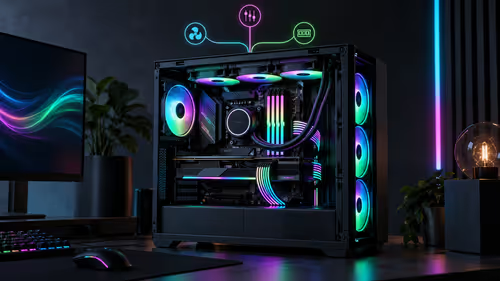
Stable Diffusion is a marathon, not a sprint. It can push your GPU to 100% load for minutes at a time, generating a serious amount of heat. If your PC's cooling can't keep up, your GPU will automatically slow down (thermal throttle) or even cause the system to crash to protect itself.
- The Fix: Check your GPU temperatures while generating an image. If they're creeping above 85°C, it's time for some maintenance. Clean the dust out of your PC case, fans, and heatsinks. Ensure you have good airflow. Even powerful older NVIDIA GeForce cards need a clean environment to run at their best.
Is It Time for a GPU Upgrade? 🚀
If you've tried all the software fixes and your Stable Diffusion is still crashing, your hardware may simply not be up to the task. Software tweaks can only go so far.
For a smooth Stable Diffusion experience, 8GB of VRAM is the absolute minimum, but 12GB or 16GB is the new sweet spot for enthusiasts. This allows you to generate higher-resolution images, use more complex models, and experiment without constantly worrying about VRAM limits.
While NVIDIA's CUDA platform has historically dominated the AI space, modern AMD Radeon graphics cards are becoming increasingly viable alternatives thanks to improved software support. For those doing this professionally or running complex training models, investing in professional workstation graphics cards with 24GB of VRAM or more is the ultimate way to eliminate hardware bottlenecks.
Ready to Stop Crashing and Start Creating? While software tweaks can help, the ultimate fix for Stable Diffusion crashing is a GPU with enough power and VRAM. Explore our massive range of graphics cards and find the perfect engine for your AI art journey.