You’ve typed the perfect prompt, hit "Generate," and watched a stunning piece of art appear from nothing. It feels like magic. But as your PC fans spin up, a thought might cross your mind, especially here in South Africa: what is the real-world cost of this magic? We're not just talking about rands and cents on your electricity bill. We're talking about the Stable Diffusion environmental impact and your powerful GPU's carbon footprint. Let's break it down. 🌍
Understanding Your GPU's Carbon Footprint
When we discuss the environmental impact of Stable Diffusion, we're primarily talking about electricity consumption. Every component in your PC draws power, but the graphics card is the hungriest of them all, especially during intensive tasks like AI image generation. The power draw of your graphics card is measured in Watts (W), and running it for hours racks up kilowatt-hours (kWh) on your utility bill.
In South Africa, where the grid is under pressure, every watt counts. A high-end GPU running at full tilt for an afternoon of AI art experiments can consume more electricity than your fridge. Understanding this consumption is the first step toward minimising your GPU's carbon footprint.
How AI Image Generation Pushes Your Hardware
Unlike gaming, which has peaks and troughs of intensity, running Stable Diffusion is like a full-throttle sprint for your GPU that doesn't stop until the image is complete. The process heavily relies on parallel processing capabilities, hammering the CUDA or Tensor cores found in modern NVIDIA GeForce cards to perform millions of calculations per second.
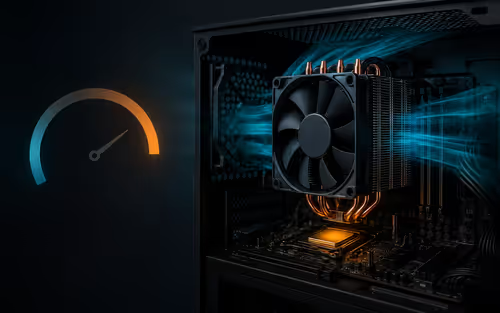
This sustained, high-intensity workload is why your GPU gets hot and draws so much power. Both VRAM capacity and memory bandwidth are pushed to their limits. While consumer cards are incredibly capable, this also highlights the efficiency gains seen in the latest architectures from both NVIDIA and AMD's Radeon™ series, which are designed to deliver more performance per watt.
Practical Steps to Reduce Your AI Carbon Footprint ⚡
The good news? You don't have to stop creating. By being a bit smarter with your workflow and hardware, you can significantly reduce the environmental cost of your GPU.
Optimise Your Workflow
Instead of generating single images, plan your sessions. Use batch processing to generate multiple images at once. This keeps the GPU in its high-performance state for one continuous block, which can be more efficient than starting and stopping it for individual renders. Reducing the number of inference steps in your settings can also speed up generation and save power, often with a negligible drop in quality.
Quick Tip for Power Efficiency 💡
Many Stable Diffusion interfaces like AUTOMATIC1111 allow you to add command-line arguments. Using --lowvram or --medvram can help reduce VRAM usage, which can lead to lower power consumption, especially on cards with less memory. It's a great way to make the process a little lighter on your hardware.
Choose Efficient Hardware
Newer isn't always just about more power; it's about smarter power. The latest GPU architectures often bring huge leaps in performance-per-watt. This means a new mid-range card could generate images faster and more efficiently than a top-tier card from a few generations ago. For those running AI models for hours on end for commercial or research purposes, investing in power-efficient professional-grade workstation graphics cards can lead to significant long-term energy savings. ✨
Making a conscious choice about your hardware is the single biggest factor you can control to lessen the Stable Diffusion environmental impact. It’s about finding the sweet spot between performance, price, and power consumption.
Ready to Generate More Efficiently? Your creativity shouldn't be limited by power concerns. A modern, efficient GPU can reduce your carbon footprint and your electricity bill. Explore our massive range of graphics cards and find the perfect, power-conscious engine for your AI art journey.