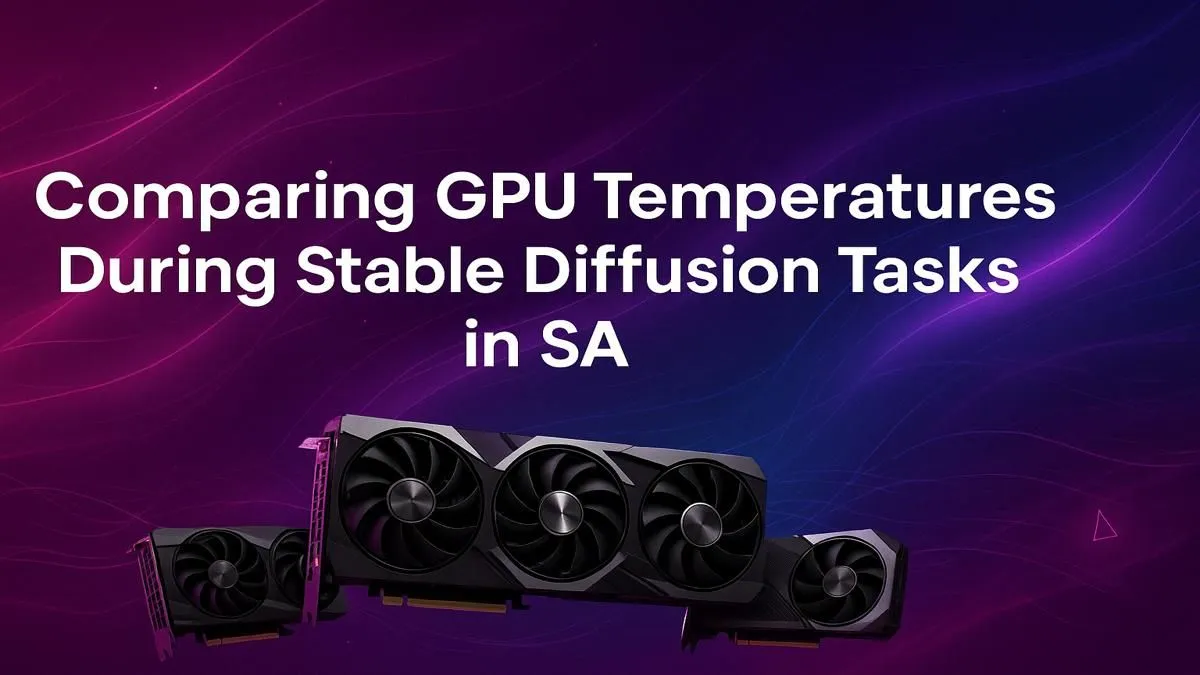
Jumping into Stable Diffusion is thrilling... until you feel the heat pouring from your PC case. Is your graphics card about to melt? Here in South Africa, where ambient temperatures can be a challenge, managing your Stable Diffusion GPU temperature is crucial. Don't stress. We've tested NVIDIA and AMD cards under heavy AI loads to find out what's normal, what's not, and how to keep your creative engine running cool and fast. Let's dive in. 🚀
Understanding Stable Diffusion GPU Temperature
Ever wondered why generating a single AI image makes your PC's fans spin up like a jet engine? It's because Stable Diffusion is an intense, sustained workout for your graphics card. Unlike gaming, which has peaks and troughs in demand, AI image generation maxes out your GPU's processing cores and VRAM for the entire duration of the task.
This constant, heavy load generates significant heat. Your GPU's cooling system—the heatsink and fans—works overtime to dissipate this energy. If it can't keep up, temperatures rise, potentially leading to performance loss. So, having one of the latest powerful graphics cards with a robust cooling solution is your first line of defence.
NVIDIA vs. AMD: The SA Temperature Test
When it comes to AI, NVIDIA has historically had the edge thanks to its mature CUDA platform. But how do the two giants stack up in a Stable Diffusion GPU temperature SA showdown? The answer isn't as simple as one being "cooler" than the other.
NVIDIA's GeForce Lineup
NVIDIA cards, especially the RTX 30 and 40 series, are incredibly efficient at AI tasks due to their dedicated Tensor Cores. This specialisation means they can often complete image generation tasks faster, resulting in less time under sustained load. While high-end cards like the RTX 4090 can draw a lot of power, their advanced coolers are typically well-equipped to handle the heat. For many users in South Africa, the efficiency of NVIDIA's GeForce lineup makes them a top choice for AI work.
AMD's Radeon Contenders
Team Red has made massive strides. Newer AMD Radeon GPUs offer incredible raw performance and generous VRAM for their price point. While their AI software support (ROCm) is still maturing compared to CUDA, they are more than capable of running Stable Diffusion. AMD cards can sometimes run a bit warmer under these specific workloads, but partner models with beefy triple-fan coolers often keep temperatures well within safe limits, delivering amazing value.
What's a Safe GPU Temperature for Stable Diffusion?
So, what numbers should you be looking for? For any prolonged AI workload, a safe Stable Diffusion GPU temperature is generally anything below 85°C.
- Ideal Range: 65°C - 80°C. Your card is performing optimally without stress.
- Acceptable Range: 80°C - 85°C. A bit toasty, but safe for most modern GPUs. Consider improving your case airflow.
- Warning Zone: 86°C and above. At this point, your GPU will likely start "thermal throttling"—automatically reducing its own speed to prevent overheating. This will slow down your image generation significantly. ✨
Cooling Pro Tip ❄️
Monitoring your GPU temperature is easy with tools like HWMonitor or MSI Afterburner. If you're consistently hitting 85°C, try setting a more aggressive custom fan curve. This tells your GPU fans to spin up earlier and faster, which can often shave off 5-10°C during heavy AI workloads and prevent thermal throttling.
Are Workstation GPUs a Cooler Option?
If you're running Stable Diffusion for hours on end for professional or commercial projects, it might be worth looking beyond consumer gaming cards. Cards designed for professional use are built for a different purpose: marathon-like stability, not just sprint-like speed.
These professional workstation graphics cards, like NVIDIA's RTX Ada Generation series, often use blower-style coolers. While sometimes louder, these are designed to exhaust all hot air directly out of the PC case, which is excellent for thermal management in systems running 24/7. They are optimised for sustained performance, ensuring your AI renders are stable and predictable.
Ready to Build Your AI Powerhouse? Choosing the right GPU is the first step. For a fully optimised system built for intense AI workloads like Stable Diffusion, a pre-configured machine is often the smartest choice. Explore our range of AI & Deep Learning PCs and get a rig that's ready to create, right out of the box.