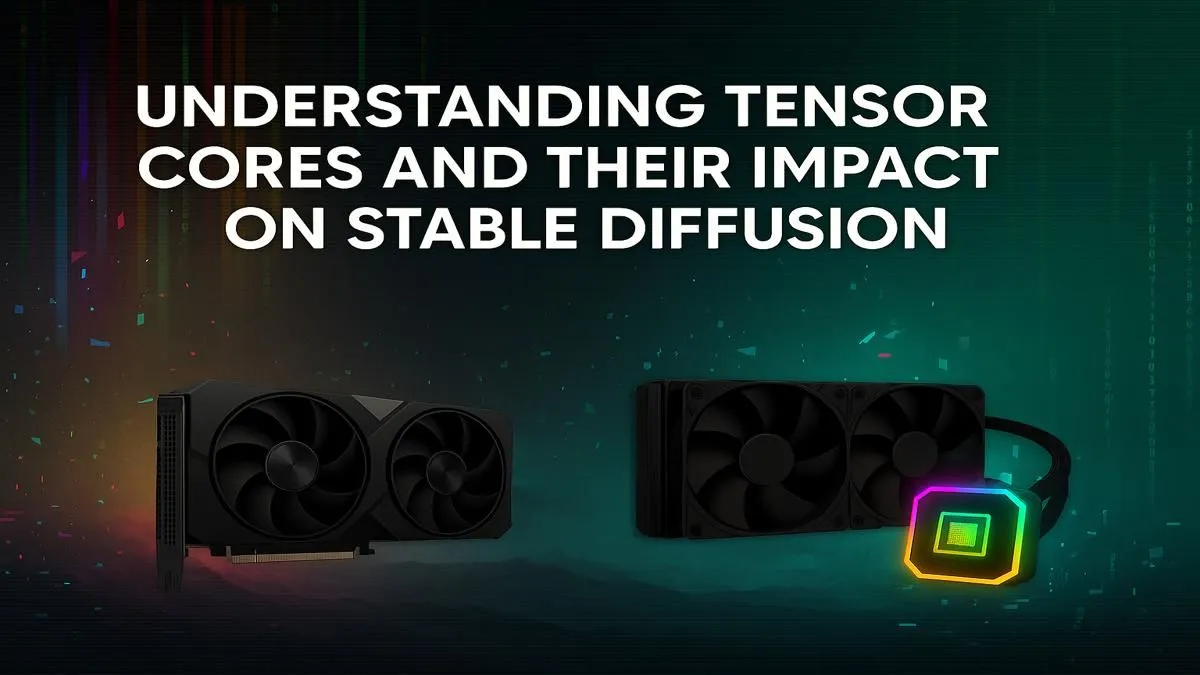
Staring at a progress bar while your AI art generator slowly grinds out an image? We've all been there. That frustrating wait can kill your creative flow. But what if you could slash that time, turning minutes into mere seconds? For South African creators using Stable Diffusion, the secret weapon is hiding inside your NVIDIA RTX graphics card: Tensor Cores. Understanding how Tensor Cores Stable Diffusion performance is linked is the key to unlocking blistering speeds. 🚀
What Are Tensor Cores, Anyway?
Think of a standard GPU core (a CUDA core) as a versatile bakkie – it can handle almost any job you throw at it. A Tensor Core, however, is a specialised piece of hardware, like a purpose-built racing machine. Introduced with NVIDIA's RTX series, these cores are designed to accelerate the specific mathematical calculations (matrix operations) that are the lifeblood of AI and machine learning.
Stable Diffusion relies heavily on these exact calculations to build images from your text prompts. When the software runs on an RTX card, it offloads these intensive tasks to the Tensor Cores. The result? A massive speed-up that leaves older hardware in the dust. This is why an RTX 4070 will generate images significantly faster than even high-end older NVIDIA GeForce GTX cards that lack this specialised architecture.
Unlocking Maximum AI Art Speed
Having an RTX card is the first step, but you need to ensure your software is configured to use it properly. The performance gains from using Tensor Cores with Stable Diffusion aren't always automatic. You need to give your setup a little nudge. ✨
Firstly, always keep your NVIDIA drivers updated. Newer drivers often include performance optimisations for AI workloads. Secondly, the specific version of Stable Diffusion you use matters. Popular interfaces like AUTOMATIC1111's web UI have built-in optimisations that you can enable. While the specific hardware gives NVIDIA a clear edge for this task over competing AMD Radeon graphics cards, you still need to flick the right switches to get the best results.
Pro Tip for AUTOMATIC1111 Users ⚡
To ensure you're leveraging your GPU's full potential, enable memory-efficient attention mechanisms. Edit your webui-user.bat file and add the command line argument --xformers. This popular library is specifically designed to accelerate diffusion models on NVIDIA GPUs, often doubling your image generation speed and lowering VRAM usage. It's a must-do tweak!
Choosing the Right GPU for Your AI Ambitions
When it comes to AI art, not all GPUs are created equal. The two most important factors are the presence of Tensor Cores and the amount of VRAM (video memory).
- Tensor Cores: This is non-negotiable for speed. You need an NVIDIA RTX 20-series card or newer. The more powerful the card and the later the generation (e.g., 40-series vs 30-series), the faster your image generation will be.
- VRAM: Stable Diffusion is hungry for VRAM. 8GB is a decent starting point for generating standard 512x512 images. However, if you want to work with higher resolutions, train your own models, or use advanced features like LoRAs, you'll want 12GB, 16GB, or even more. For heavy-duty professional work, cards like the ones found in our professional-grade workstation graphics cards section become essential.
Ultimately, the best Tensor Cores Stable Diffusion setup depends on your budget and goals. An RTX 4060 offers an incredible entry point for hobbyists in South Africa, while an RTX 4090 is the undisputed champion for those who demand the absolute best. Making the right choice when choosing between the latest graphics cards will define your entire creative experience.
Ready to Supercharge Your AI Art?
Don't let slow hardware limit your creativity. The performance boost from Tensor Cores with Stable Diffusion is undeniable. Whether you're a hobbyist or a pro, we've got the GPU to bring your visions to life... faster. Explore our massive range of NVIDIA RTX graphics cards and find the perfect engine for your imagination.